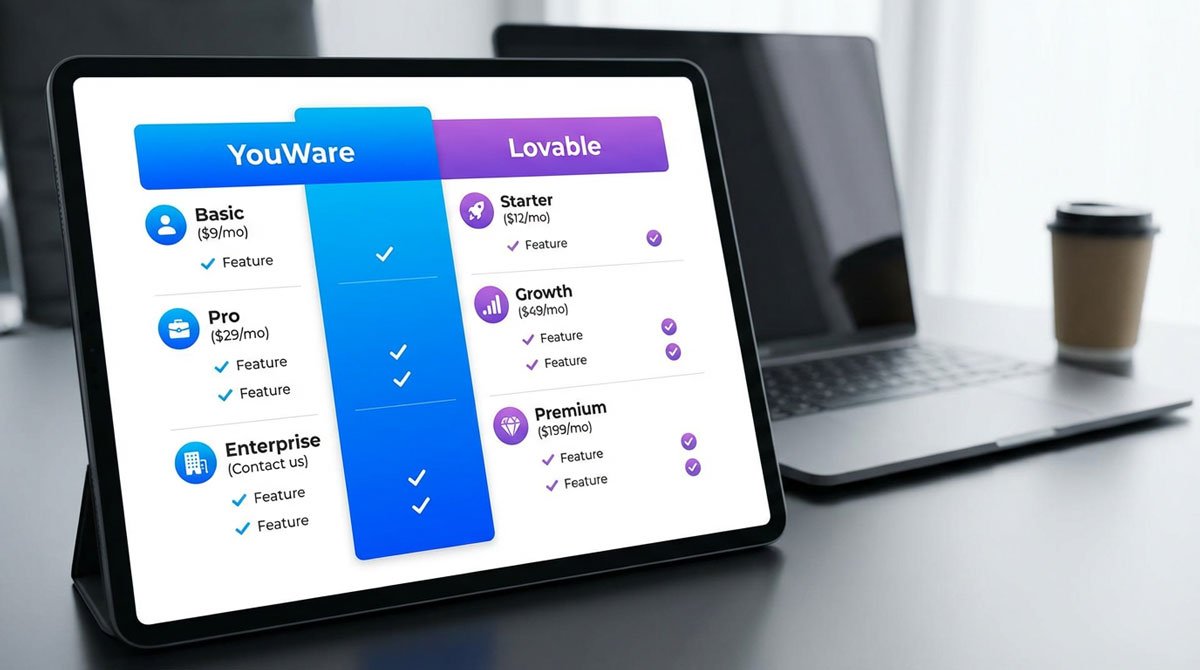

AI-driven site creation is moving from “page building” to “product building.” For IT and digital teams in supply chain/logistics (e.g., supplier onboarding portals, shipment tracking dashboards, carrier microsites, internal workflows), the relevant question is no longer whether an ai website builder can generate a landing page, but whether an ai website generator can reliably support integrations, data persistence, identity, governance, and operational controls.
This report establishes a multi-dimensional evaluation model and applies it to YouWare and Lovable. It focuses on procurement-grade decision criteria, and avoids qualitative superlatives. Where vendors do not publicly disclose metrics (e.g., latency, uptime), this report flags the gap explicitly rather than inferring.
Multi-Dimensional Evaluation Model
The model below uses eight dimensions commonly used in enterprise tooling selection. Suggested weights reflect a typical logistics/IT scenario (external-facing site + internal workflows + moderate compliance expectations). Teams should adjust weights to match risk tolerance and architectural standards.
| Dimension | What To Measure | Typical Evidence | Suggested Weight |
| Total Cost Of Ownership | Subscription, usage credits, engineering time, hosting | Public pricing + internal effort estimates | 15% |
| Speed To Value | Time to first usable prototype; iteration speed | Tutorials, product UX, plan limits | 15% |
| Full-Stack Capability | Database, auth, storage, server logic | Product docs and plan gating | 15% |
| Integration & Extensibility | APIs, “connections,” export, deploy options | Docs, integrations list | 15% |
| Governance & Security | SSO, access control, data training opt-out, abuse prevention | Pricing pages, security pages, third-party reports | 15% |
| Collaboration & Workflow | Roles, permissions, multi-user sharing | Plan feature lists | 10% |
| Deployment & Operations | Custom domains, hosting model, environments | Plan feature lists, documentation | 10% |
| Vendor Signals & Adoption | Public adoption signals; roadmap posture | Vendor site claims, changelogs | 5% |
YouWare (Positioning And Stack Implications)
YouWare positions YouBase as a built-in backend layer providing “authentication, database, storage,” and other backend capabilities, and states it can generate frontend + backend code and run it in the cloud.

YouWare documentation states YouBase requires a paid plan (Pro/Ultra) and describes upgrade triggers when backend functionality is needed.
YouWare Docs also list Pro Plan ($20) and Ultra Plan ($200) as examples of plan pricing and intended use cases.
Lovable (Positioning And Stack Implications)
Lovable documentation describes the product as enabling users of any skill level to create full-stack websites via natural language prompts.
Lovable’s pricing page lists Pro at $25/month and Business at $50/month, with both described as “shared across unlimited users,” and includes features such as custom domains, roles/permissions, and (Business) SSO.
Lovable also claims “500,000+ founders” are building with Lovable (an adoption signal, not a verified customer count).
Comparative Analysis By Dimension
Total Cost Of Ownership
YouWare — Strengths
- Lower entry paid tier cited in docs (Pro $20) relative to many collaborative tools, with a higher-end Ultra tier ($200) for heavier usage patterns.
- If YouBase reduces the need for separate backend hosting and scaffolding, it can lower engineering overhead for teams that would otherwise stand up auth + database + storage separately (not quantified publicly).
YouWare — Potential Limitations
- Public pricing details can be fragmented across marketing pages vs. docs; teams may need a short procurement sprint to map credits/limits to expected workloads.
- When backend functionality is plan-gated, scaling beyond prototypes can trigger plan changes; this should be modeled as usage grows.
Lovable — Strengths
- Clear list pricing for Pro ($25) and Business ($50) and plan-level governance features (e.g., roles/permissions; SSO in Business) helps budgeting.
- “Shared across unlimited users” can simplify cost allocation for cross-functional teams (design, ops, IT).
Lovable — Potential Limitations
- Credit-based usage and “Usage-based Cloud + AI” implies variable cost components beyond subscription, which requires workload forecasting (vendor-specific credit economics).
Speed To Value
YouWare — Strengths
- YouBase is described as “zero configuration” and designed to convert natural language requirements into deployed frontend + backend quickly.
- For logistics prototypes (e.g., “carrier check-in form + database + basic auth”), a built-in backend can reduce dependency on separate infrastructure setup steps.
YouWare — Potential Limitations
- YouWare documentation notes compatibility considerations between legacy backend approaches and YouBase; migrations may require re-implementation choices in some cases.
Lovable — Strengths
- Lovable positions the workflow as “create apps and websites by chatting with AI,” which typically shortens iteration cycles for UI and page structure.
Lovable — Potential Limitations
- Speed-to-value depends on credit availability and rate limits; teams should validate whether plan credits support expected iteration frequency during peak sprints.
Full-Stack Capability (Backend, Data, Identity)
YouWare — Strengths
- YouBase is explicitly described as providing backend capabilities including data storage, authentication, server-side logic, and file management.
- For supply chain use cases requiring persistence (shipment records, POD uploads, supplier master updates), this is a differentiator versus “static-site-first” builders.
YouWare — Potential Limitations
- The platform’s “enterprise-grade” descriptors are vendor assertions; teams should request independent evidence (e.g., audit reports, SLAs) during procurement.
Lovable — Strengths
- Lovable documentation frames the product as “full-stack,” which indicates it targets more than page generation and can support application-like workflows.
- Business plan includes SSO and access control features that matter when internal tools touch operational data.
Lovable — Potential Limitations
- Public documentation in the provided sources does not enumerate backend primitives as directly as YouBase’s “database/auth/storage” phrasing; teams may need deeper validation on data models, tenancy, and governance boundaries.

Conclusion
For logistics/IT teams, the selection hinges on whether you want the platform to behave more like an AI web builder with explicit backend primitives (YouWare + YouBase) or a collaboration- and governance-forward builder with clear tiered controls (Lovable). Pricing differences are visible (YouWare Pro $20 vs Lovable Pro $25; Lovable Business $50; YouWare Ultra $200), but cost should be evaluated against expected credit burn and the engineering effort avoided by built-in backend capabilities.

Most Viewed