Every school year, millions of students across North America take the MAP (Measures of Academic Progress) 2.0 assessment. Yet when parents receive their child’s results, they often find themselves staring at a confusing array of numbers, percentiles, and acronyms. What does a RIT score of 215 really mean? Is the 62nd percentile good or concerning? Should you be worried if your child’s growth metrics show a 5-point increase instead of 8?
These questions matter because MAP 2.0 post assessment answers aren’t just test scores—they’re a window into your child’s learning journey. Unlike traditional standardized tests taken once or twice a year, MAP 2.0 provides detailed, actionable data that teachers and parents can use to support academic growth throughout the school year. The challenge isn’t finding the answers; it’s understanding what they actually tell you about your child’s progress.

This comprehensive guide cuts through the confusion. We’ll decode every component of your MAP 2.0 results, expose the common misconceptions that mislead parents and educators, and provide you with a practical framework for turning data into real educational improvements. Whether you’re a parent trying to support your child’s learning or an educator designing personalized instruction, you’ll discover exactly how to interpret and act on MAP 2.0 post assessment answers.
What Exactly Is MAP 2.0? Beyond the Basics
MAP 2.0, or Measures of Academic Progress 2.0, represents a significant evolution in how schools measure student learning. It’s not just an updated version of the original MAP—it’s a fundamentally different approach to assessment that adapts in real-time to each student’s abilities.
Here’s what makes it different: Traditional standardized tests give every student the same questions in the same order. A struggling student faces questions that are too hard, leading to frustration and low scores. An advanced student breezes through easy questions, never reaching their actual ceiling. MAP 2.0 eliminates this problem through computer-adaptive testing (CAT).
As your child answers questions, the test adjusts. Answer correctly, and the next question becomes harder. Answer incorrectly, and the next question becomes easier. This dynamic adjustment means the test pinpoints your child’s precise academic level—whether they’re working above grade level, at grade level, or below grade level. The result? More accurate, more nuanced data about what your child actually knows and can do.
Schools typically administer MAP 2.0 three times per year: fall, winter, and spring. This frequency allows educators to track growth across the entire school year and identify students who need additional support before they fall too far behind. The assessment covers reading, mathematics, language, and science—the core academic areas that matter most for student success.
Decoding MAP 2.0 Post Assessment Answers: What Each Number Means
When you receive your child’s MAP 2.0 post assessment report, you’ll see several key data points. Each one tells a different part of your child’s academic story. Understanding them separately is important, but understanding how they work together is what really matters.
Understanding RIT Scores: Your Child’s Academic Level
The RIT (Rasch Unit) score is the foundation of the entire MAP 2.0 system. It measures your child’s academic ability on a scale that’s consistent across grade levels and years. Think of it like a height measurement—it’s an absolute measure that allows meaningful comparisons over time.
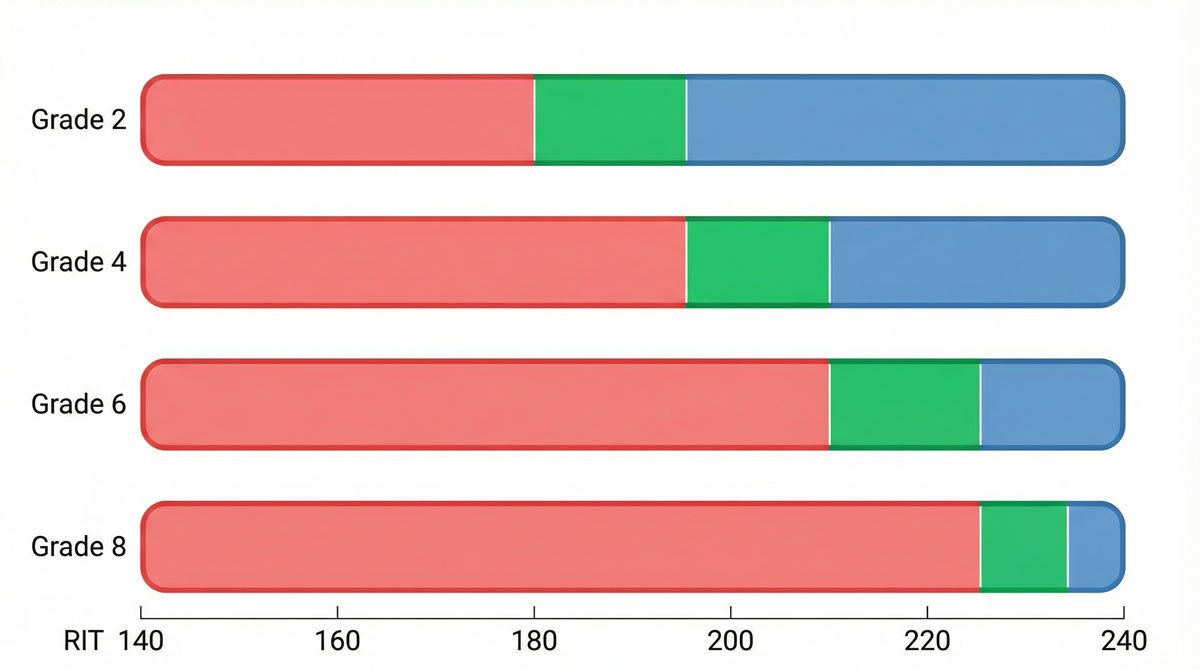
RIT scores typically range from about 140 (kindergarten level) to 300+ (advanced high school level). But here’s what makes RIT scores powerful: a student with a RIT score of 215 in fall and 220 in spring has made measurable progress. That same 5-point increase means something consistent whether your child is in 3rd grade or 7th grade.
Most importantly, RIT scores are not percentages. A RIT score of 200 doesn’t mean your child got 200 out of something. It’s a measure of academic ability, and the scale is designed so that a 10-point increase at any level represents roughly the same amount of learning growth.
| Grade Level | Typical RIT Range | Below Grade Level | At Grade Level | Above Grade Level |
|---|---|---|---|---|
| 2nd Grade | 170-195 | <170 | 170-195 | >195 |
| 4th Grade | 185-210 | <185 | 185-210 | >210 |
| 6th Grade | 200-225 | <200 | 200-225 | >225 |
| 8th Grade | 210-235 | <210 | 210-235 | >235 |
Percentiles Explained: How Your Child Compares
If RIT scores measure absolute ability, percentiles measure relative performance. A percentile tells you what percentage of students scored at or below your child’s level. If your child scores in the 75th percentile, that means they performed as well as or better than 75% of students who took the same test.
Here’s where many parents get confused: percentiles are useful for context, but they can be misleading. A student in the 40th percentile isn’t “failing”—they’re simply performing below the average for their grade. Meanwhile, a student in the 90th percentile is performing exceptionally well, but that doesn’t mean they’re “perfect” or that there’s no room for growth.
The critical insight: percentiles should never be your only measure of success. A student could be in the 50th percentile but still be working significantly above grade level in certain skills. Conversely, a student in the 75th percentile might have specific learning gaps that need targeted support.
Growth Metrics: The Real Indicator of Progress
Here’s where MAP 2.0 becomes truly powerful. Growth metrics measure how much your child has improved from one assessment to the next. This is where you see whether your child is making adequate progress toward meeting grade-level standards.
Let’s say your child’s RIT score was 205 in fall and 212 in spring. That’s a 7-point growth. Is that good? That depends on several factors: the grade level, the subject area, the amount of time between assessments, and what research shows is typical growth for that grade level.
Schools typically set growth targets based on research about what constitutes adequate progress. A 3rd grader might be expected to grow 8-10 RIT points per school year, while a 7th grader might be expected to grow 5-7 points. When students meet or exceed their growth targets, it signals that instruction is working. When growth stagnates or declines, it’s a signal that intervention is needed.
Common Misconceptions About MAP 2.0 Answers
This is where we separate fact from fiction. Parents and educators often misunderstand MAP 2.0 data in ways that can lead to poor decisions. Let’s clear these up.
Misconception #1: “A High RIT Score Means My Child Is Smart”
The Reality: RIT scores measure academic performance in specific subjects at a specific point in time. They don’t measure intelligence, potential, or overall ability. A student with a high RIT score in reading might have a much lower RIT score in mathematics. Both are accurate measures of their current performance in those subjects.
More importantly, a student’s RIT score reflects their performance on the specific content covered by MAP 2.0. A child might be brilliant at creative problem-solving, artistic thinking, or social-emotional skills—none of which MAP 2.0 measures. RIT scores are useful data points, not comprehensive measures of a child’s abilities.
Misconception #2: “Percentiles Are the Most Important Number”
The Reality: Percentiles provide context, but they’re often the least useful number on the report. Here’s why: percentiles change based on who takes the test. If your child’s school has particularly high-performing students, the same RIT score might result in a lower percentile than in a school with different demographics.
Additionally, percentiles can mask important information. A student in the 45th percentile might be performing at grade level in a school where the average is below grade level. Conversely, a student in the 55th percentile might be significantly below grade level in a school where most students perform above grade level.
Focus on RIT scores and growth metrics instead. These provide more stable, actionable information about your child’s actual learning.
Misconception #3: “One Low Score Means There’s a Problem”
The Reality: Single assessments provide a snapshot, not a diagnosis. A student might score lower on one assessment due to illness, a bad day, lack of sleep, or simply natural variation. What matters is the trend over time.
This is why schools give MAP 2.0 three times per year. If a student scores lower in winter than fall but then improves in spring, that’s a different story than consistent decline. If a student scores lower in one subject but maintains strong performance in others, that suggests a specific area for support rather than a general learning problem.
Always look at the pattern, not the single data point.
Misconception #4: “MAP 2.0 Scores Directly Predict State Test Performance”
The Reality: While MAP 2.0 and state standardized tests both measure academic achievement, they’re not perfectly correlated. MAP 2.0 is adaptive and diagnostic, providing detailed information about specific skills. State tests are typically fixed-form tests that measure broader standards.
A student might score well on MAP 2.0 but struggle on state tests due to test anxiety, unfamiliarity with the test format, or gaps in specific content areas that MAP 2.0 didn’t assess. Conversely, a student might score lower on MAP 2.0 but perform well on state tests due to test-taking skills or familiarity with that specific test format.
Use MAP 2.0 data to inform instruction and identify learning gaps. Use state test data as one additional data point, but don’t treat them as interchangeable measures.
Misconception #5: “All Students Should Have the Same Growth”
The Reality: Growth trajectories vary significantly based on where students start. A student who enters 3rd grade significantly below grade level might show 12-15 points of growth as they catch up. A student who enters at grade level might show 8 points of growth. A student who enters above grade level might show only 5 points of growth because they’re already performing at a high level.
This is why schools set individualized growth targets. The goal isn’t for all students to grow the same amount—it’s for each student to make meaningful progress toward grade-level standards and beyond.
How to Use MAP 2.0 Post Assessment Answers: A Decision-Making Framework
Understanding MAP 2.0 data is only half the battle. The real value comes from using that data to make decisions that improve learning. Here’s how different stakeholders can turn MAP 2.0 answers into action.

For Teachers: From Data to Personalized Instruction
Teachers have the most direct opportunity to use MAP 2.0 data. The diagnostic reports that accompany the scores break down exactly which skills each student has mastered and which skills need work.
Step 1: Identify Skill Gaps
Review the diagnostic report for each student. It will show which specific standards and skills the student demonstrated and which ones they didn’t. For example, a 4th grader might demonstrate proficiency in “identifying main ideas” but struggle with “inferring author’s purpose.”
Step 2: Group Students Strategically
Students with similar skill gaps can be grouped together for targeted instruction. This doesn’t mean tracking or permanent grouping—it means flexible, skill-based grouping that changes as students master skills and new gaps emerge.
Step 3: Design Targeted Interventions
Use the skill gap information to design specific interventions. If multiple students struggle with fraction concepts, provide additional practice, manipulatives, and alternative explanations focused specifically on fractions. If students struggle with reading comprehension strategies, teach those strategies explicitly.
Step 4: Monitor Progress
Use the growth metrics to monitor whether your interventions are working. If a student shows growth in the next assessment, your intervention was effective. If growth stagnates, adjust your approach.
| Data Point | What It Tells You | Action to Consider |
|---|---|---|
| RIT Score Below Grade Level | Student needs support | Provide targeted small-group instruction |
| Specific Skill Gaps | Which skills to focus on | Design skill-specific interventions |
| Declining Growth | Current approach isn’t working | Adjust instruction, increase intensity of support |
| Significant Growth | Student is responding well | Maintain current approach, consider advancement |
| Percentile in 25th or Below | Student significantly behind peers | Consider comprehensive support plan, parent communication |
For Parents: Supporting Learning at Home
Parents often feel helpless when they receive MAP 2.0 results. You can’t teach your child in the same way a teacher does, but you can provide powerful support.
Step 1: Understand Your Child’s Specific Needs
Ask your child’s teacher: “What specific skills is my child working on? Where does my child need the most support?” Don’t just ask about overall performance—ask about specific, actionable skills.
Step 2: Create a Home Learning Environment
Support the skills your child is working on. If your child is working on reading comprehension, read together and ask questions about what you’ve read. If your child is working on math problem-solving, play games that involve strategy and calculation. If your child is working on writing, encourage journaling or letter-writing.
Step 3: Communicate with Teachers
Share observations from home. If you notice your child struggling with a particular skill, let the teacher know. If you notice your child making progress, celebrate that with the teacher. This two-way communication helps teachers understand your child’s learning in different contexts.
Step 4: Maintain Perspective
Remember that one assessment doesn’t define your child. Focus on growth over time, not on single scores. Celebrate effort and improvement, not just achievement.
Parent Support Action Checklist
- Request a meeting with your child’s teacher to discuss MAP 2.0 results
- Ask specifically about skill gaps and areas of strength
- Identify 1-2 skills to focus on supporting at home
- Create a plan for how you’ll support those skills (reading together, playing games, etc.)
- Check in with the teacher monthly about progress
- Celebrate growth and effort with your child
- Avoid comparing your child’s scores to other children’s scores
For School Administrators: Data-Driven Improvement
School leaders can use aggregate MAP 2.0 data to identify patterns and make strategic decisions about curriculum, instruction, and resource allocation.
Identify Schoolwide Patterns: If 60% of 3rd graders score below grade level in reading, that’s a signal that your reading instruction needs attention. If 4th grade math scores are consistently lower than 3rd grade scores, that suggests a transition issue or curriculum gap.
Allocate Resources Strategically: Use MAP 2.0 data to identify which grade levels and subjects need additional support. Invest in professional development, interventions, or resources where data shows the greatest need.
Monitor Intervention Effectiveness: When you implement a new reading program or math curriculum, use MAP 2.0 data to measure whether it’s working. Compare growth rates before and after implementation.
Real-World Case Study: How One School Used MAP 2.0 Data to Improve Student Outcomes
Let’s look at a concrete example of how MAP 2.0 data can drive real improvement.
The School
Riverside Elementary, a mid-sized school in a suburban district with approximately 450 students in grades K-5.
The Challenge
In fall 2023, Riverside’s 3rd grade reading scores were concerning. Approximately 55% of 3rd graders scored below grade level in reading. Teachers felt they were working hard, but something wasn’t clicking. The school had a strong reading curriculum on paper, but implementation was inconsistent across classrooms.
The Data Analysis
The instructional leadership team reviewed MAP 2.0 diagnostic reports for all 3rd graders. They found a pattern: students struggled most with “inferring meaning from context” and “identifying author’s purpose.” These weren’t basic decoding skills—students could read the words. They struggled with comprehension and critical thinking.
The Intervention
Rather than overhauling the entire reading program, the team focused specifically on comprehension strategy instruction. They:
- Provided professional development on explicit comprehension strategy instruction
- Created a common language and set of strategies used across all 3rd grade classrooms
- Implemented daily comprehension strategy practice using shared texts
- Created small intervention groups for students who needed additional support
The Results
- Winter 2024: 48% of 3rd graders scored below grade level (7% improvement)
- Spring 2024: 38% of 3rd graders scored below grade level (17% improvement from fall)
- Average RIT growth: 9 points (exceeding the school’s 8-point target)
- Teacher feedback: “We finally have a common approach. We can see which strategies are working.”
Key Lesson
Riverside didn’t need a complete curriculum overhaul. They needed targeted, data-informed intervention focused on the specific skills where students were struggling. MAP 2.0 data helped them identify exactly where to focus their efforts.
MAP 2.0 vs. Other Assessment Tools: A Comprehensive Comparison
How does MAP 2.0 compare to other ways schools measure student learning? Understanding these differences helps you appreciate what MAP 2.0 offers and its limitations.
| Feature | MAP 2.0 | State Standardized Tests | Other Adaptive Tests | Classroom Assessments |
|---|---|---|---|---|
| Frequency | 3x/year | 1-2x/year | Varies | Ongoing |
| Adaptive | Yes | No | Yes | Varies |
| Diagnostic Detail | Very High | Medium | Medium-High | High |
| Cost | Moderate | Low | Moderate-High | Low |
| Time to Results | 1-2 weeks | 2-3 months | Varies | Immediate |
| Measures Growth | Excellent | Good | Good | Excellent |
| Actionability | Very High | Medium | Medium-High | Very High |
| Scope | Reading, Math, Language, Science | State Standards | Varies | Subject-specific |
What MAP 2.0 Does Best: Provides frequent, detailed, actionable data about specific skills. The adaptive nature means it accurately measures students at all performance levels. The diagnostic reports tell you exactly which skills need work.
What MAP 2.0 Doesn’t Do: It doesn’t measure everything that matters. It can’t assess creativity, collaboration, character, or many other important skills. It also doesn’t replace the need for classroom assessments and teacher observation.
The Bottom Line: MAP 2.0 is best used as one tool in a comprehensive assessment system. Use it alongside classroom assessments, state tests, and teacher observation to get a complete picture of student learning.
Frequently Asked Questions About MAP 2.0 Post Assessment Answers
“Good” is relative. A RIT score is good if it’s at or above grade level for your child’s grade and subject. However, growth is more important than the absolute score. A student who grows 8 points is making good progress even if their absolute RIT score is below grade level. Ask your child’s teacher: “Is my child at grade level? Is my child making adequate growth?” Those are the right questions.
Most schools administer MAP 2.0 three times per year: fall, winter, and spring. This frequency allows schools to track growth throughout the year and identify students who need support before they fall too far behind. Some schools may assess more or less frequently depending on their needs.
Most schools provide online portals where parents can view their child’s MAP 2.0 results. Ask your child’s school or teacher for access information. You should be able to see your child’s RIT scores, percentiles, growth metrics, and sometimes diagnostic reports.
First, don’t panic. One lower score doesn’t indicate a problem. Look at the trend over time. If scores are consistently declining, schedule a meeting with your child’s teacher. Ask: “What specific skills is my child struggling with? What support is being provided? What can I do at home?” Work together to develop a plan.
MAP 2.0 and state tests both measure academic achievement, but they’re different tools. MAP 2.0 is adaptive and diagnostic; state tests are typically fixed-form. A student might score differently on these two types of tests. Use MAP 2.0 data to inform daily instruction. Use state test data as one additional data point about your child’s learning.
Percentiles are relative to the group that took the test. If your child’s school has particularly high-performing students, the same RIT score might result in a lower percentile than in a school with different demographics. Focus on whether your child’s RIT score is at or above grade level, not on the percentile ranking.
Conclusion: From Data to Action
MAP 2.0 post assessment answers aren’t mysterious numbers to be confused about. They’re a clear, detailed picture of your child’s academic learning. When you understand what each number means and how to use that information, you gain real power to support your child’s success.
The key insight: Data only matters if you act on it. A teacher who reviews MAP 2.0 results but doesn’t adjust instruction hasn’t really used the data. A parent who receives results but doesn’t understand them can’t provide meaningful support. A school leader who collects data but doesn’t use it to make strategic decisions is missing the entire point.
Start today. If you’re a parent, request a meeting with your child’s teacher. Ask specifically about skill gaps and areas of strength. If you’re a teacher, review your students’ diagnostic reports. Identify one specific skill gap to address. If you’re a school leader, look at your aggregate data. Identify one pattern that suggests where your school needs to focus.
MAP 2.0 post assessment answers are a tool for improvement. Use them wisely, and you’ll see real growth in your students’ academic achievement.

Most Viewed