In the last 18 months, a staggering 83% of companies have suffered at least one cloud security breach [1]. This isn’t just a number. It’s a reality check for modern business. As organizations race to the cloud for its incredible power and flexibility, many are leaving a digital door wide open for attackers.
The old castle-and-moat security model is dead. Your company’s critical data is no longer safe behind a simple on-premise wall. It’s distributed across multiple cloud providers, accessed by a global workforce. So, how do you protect your most valuable assets in this new, borderless world?
This guide cuts through the noise. We will show you exactly how a modern firewall in cloud computing operates. It is your most critical line of defense. You will learn how to choose the right one for your needs, transforming your security from a barrier into an intelligent, agile enabler.
What Exactly Is a Firewall in Cloud Computing? (And Why It’s Not Your Old-School Firewall)
A firewall in cloud computing is a virtual, software-based shield designed specifically for the dynamic nature of cloud environments. Forget the bulky, physical boxes bolted into a server rack. Think of it as an intelligent, invisible security force that protects your data and applications, no matter where they are.
It’s like upgrading from a single bouncer at a nightclub’s front door to having a dedicated, hyper-aware security detail for every single guest inside. This detail moves with them, understands their context, and protects them from threats in real-time, creating a truly secure environment.
This powerful approach is often delivered as a Firewall-as-a-Service (FWaaS). It provides robust network security without the hardware headaches. This service model allows businesses to scale their security on-demand, paying only for what they use while ensuring they always have the latest protection.
The Core Engine: How Do Cloud Firewalls Actually Work?
At its heart, a cloud firewall operates on a simple yet powerful principle: inspect everything. It sits between your cloud resources and the outside world, scrutinizing every piece of data that attempts to cross its path. The process is a seamless, high-speed workflow.
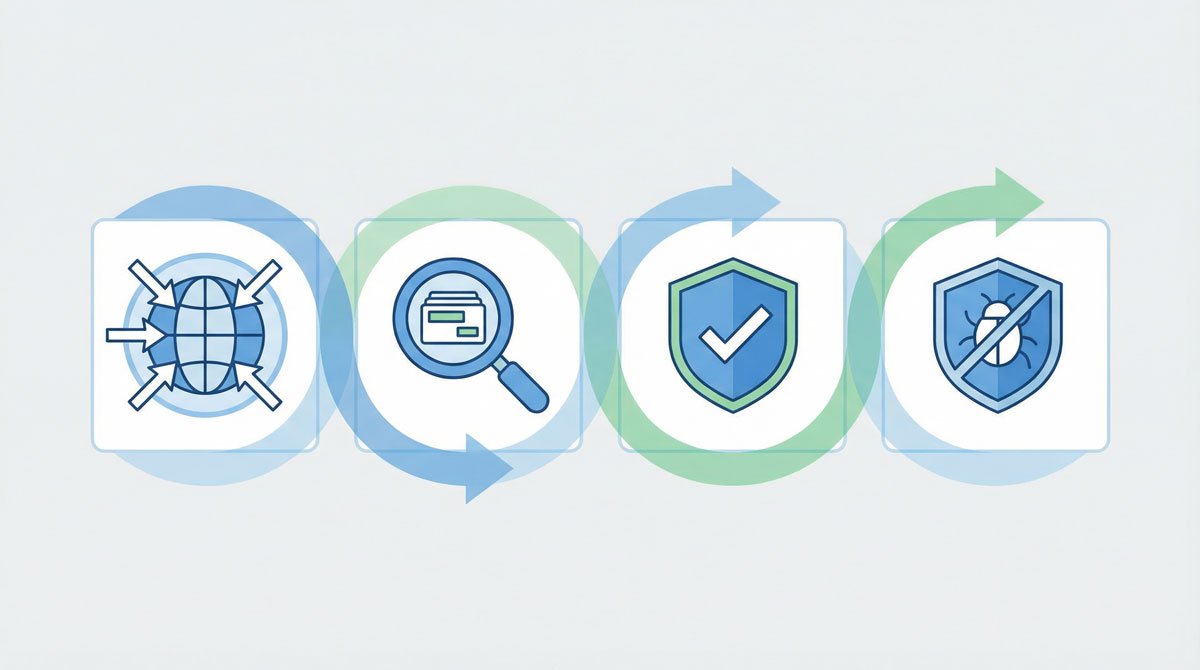
Here’s a breakdown of the journey a data packet takes:
- Traffic Interception: The firewall is strategically placed to intercept all traffic. This includes data moving between the internet and your cloud (North-South traffic) and data moving between different parts of your cloud (East-West traffic).
- Deep Packet Inspection (DPI): This is where the real intelligence lies. The firewall doesn’t just look at the address on the envelope; it opens it up and reads the letter. It analyzes the actual content of the data packets, looking for malicious code, known attack patterns, or policy violations.
- Policy Enforcement: Based on the rules you’ve set, the firewall makes a split-second decision. Is this data from a trusted source? Is it trying to access a permitted application? If it meets the criteria, it passes through. If not, it’s blocked instantly.
- Threat Detection & Prevention: Modern cloud firewalls use integrated Intrusion Prevention Systems (IPS) and constantly updated threat intelligence feeds. They can proactively identify and block emerging threats, such as malware and DDoS attacks, before they can cause damage.
The Modern Arsenal: Types of Cloud Firewalls Explained
Not all cloud firewalls are created equal. The right choice depends entirely on what you need to protect. Understanding the different types is the first step toward building a robust defense. Each type offers a specialized form of protection for different parts of your digital estate.
Next-Generation Firewall (NGFW)
NGFWs are the evolution of traditional firewalls, enhanced with application awareness and threat intelligence. They can be deployed both on-premises and in the cloud, making them a solid choice for hybrid environments. They provide granular control over which applications users can access.
Web Application Firewall (WAF)
A WAF is a specialist. Its sole purpose is to protect your web applications and APIs (the front door to your business) from attacks at the application layer. It’s specifically designed to block common threats like SQL injection and cross-site scripting (XSS) that other firewalls might miss.
Firewall-as-a-Service (FWaaS)
FWaaS is the most cloud-native approach. It delivers comprehensive network security directly from the cloud, managed by a vendor. This model provides the ultimate scalability and simplifies management, making it ideal for distributed organizations with a remote workforce and multiple cloud deployments.
To help you decide, here’s a clear comparison:
| Feature | Next-Generation Firewall (NGFW) | Web Application Firewall (WAF) | Firewall-as-a-Service (FWaaS) |
|---|---|---|---|
| Primary Focus | Network & Application Layer Security | Web Application & API Protection (Layer 7) | Comprehensive, Cloud-Delivered Network Security |
| Best For | Hybrid environments needing application control | Protecting public-facing websites and APIs | Distributed, cloud-first organizations |
| Key Capability | Application Awareness, Integrated IPS | SQLi/XSS Prevention, Bot Mitigation | Centralized Policy, Global Scalability, Low TCO |
Cloud Firewall vs. Traditional Firewall: A Head-to-Head Battle
The shift from on-premise data centers to the cloud has sparked a necessary evolution in firewall technology. While both traditional and cloud firewalls aim to secure your network, their approach, capabilities, and business impact are worlds apart. Understanding these differences is crucial for making an informed security decision.
A traditional firewall is a gatekeeper for a single, well-defined fortress. A cloud firewall, however, is a dynamic security force for a borderless, ever-changing digital landscape. It’s not just a different location; it’s a fundamentally different philosophy.
Here’s a direct comparison of how they stack up:
| Aspect | Traditional Firewall | Cloud Firewall |
|---|---|---|
| Deployment | Physical Hardware Appliance | Virtual Service in the Cloud |
| Scalability | Manual, requires purchasing new hardware | Elastic, scales automatically with traffic |
| Cost Model | High Upfront Capital Expense (CapEx) | Predictable Subscription (OpEx) |
| Management | Requires dedicated in-house IT team | Fully managed by the service provider |
| Protection | Secures a fixed, on-premise perimeter | Protects distributed resources and remote users |
| Updates | Manual patching and firmware updates | Automatic, seamless, and continuous |
The Real-World Impact: 7 Key Benefits of a Cloud-First Firewall Strategy
Adopting a cloud firewall isn’t just a technical upgrade; it’s a strategic business decision that delivers tangible benefits. It moves security from a cost center to a business enabler, providing the agility needed to compete in the modern digital economy. Here are the most significant advantages.
- Unmatched Scalability
Your security can now grow at the speed of your business. A cloud firewall scales elastically to handle traffic spikes without manual intervention or performance bottlenecks, ensuring protection is always adequate. - Significant Cost Savings
By eliminating the need for expensive hardware and the associated maintenance, power, and cooling costs, cloud firewalls drastically reduce the Total Cost of Ownership (TCO). The subscription model provides predictable, operational expenses. - Centralized Management & Visibility
Manage security for your entire organization—across multiple clouds and physical locations—from a single pane of glass. This unified view simplifies policy enforcement and provides complete visibility into all network traffic. - Superior Threat Protection
Cloud firewalls leverage global threat intelligence networks, updated in real-time. This means they can protect against the latest malware, ransomware, and zero-day threats far more effectively than an isolated, on-premise appliance. - Enhanced Availability and Reliability
FWaaS providers build their infrastructure on highly resilient, redundant architectures. This guarantees uptime and continuous security, a level of reliability that is often prohibitively expensive to achieve in-house. - Secure the Modern Workforce
In an era of remote work, a cloud firewall ensures that all users have the same level of protection, no matter where they are connecting from. It extends the corporate security perimeter to every employee’s home office. - Simplified Compliance
Centralized logging, reporting, and consistent policy enforcement across all environments make it significantly easier to demonstrate compliance with regulations like GDPR, HIPAA, and PCI DSS.
From Theory to Practice: A Real-World Enterprise Migration Case Study
To understand the transformative power of a cloud firewall, let’s look at a practical example. “InnovateCorp,” a fictional mid-sized retail company, was struggling with its legacy security infrastructure as it expanded its e-commerce platform onto a multi-cloud environment (AWS and Azure).
The Challenge:
InnovateCorp’s on-premise firewalls were creating a significant bottleneck. Every bit of traffic from their cloud applications had to be routed back to their physical data center for inspection. This process, known as “traffic tromboning,” was slow, expensive, and complex to manage. Their security team couldn’t keep up with the inconsistent policies across AWS and Azure, leading to security gaps.
The Solution:
After evaluating their options, InnovateCorp decided to adopt a unified Firewall-as-a-Service (FWaaS) solution. This allowed them to deploy a consistent security policy across their entire network—on-premise, AWS, and Azure—all managed from a single, cloud-based console. They eliminated the need for physical appliances entirely.
The Implementation:
The migration was phased over three months. First, they integrated the FWaaS with their identity provider to enforce user-based access rules. Next, they deployed virtual firewalls in their AWS and Azure VPCs. Finally, they routed all branch office and remote user traffic directly to the FWaaS provider, securing their entire distributed network.
The Results:
The impact was immediate and profound.
- 35% Reduction in TCO: By eliminating hardware and maintenance costs.
- 50% Faster Threat Response: Centralized logging and automated threat intelligence allowed for quicker detection.
- Improved Application Performance: Removing the traffic bottleneck significantly reduced latency for their e-commerce platform.
Making the Right Choice: A Decision Framework for Your Business
Choosing the right cloud firewall isn’t a one-size-fits-all decision. It requires a careful evaluation of your unique environment, goals, and resources. Before you talk to a single vendor, ask yourself these critical questions to build a clear picture of your needs.
- What is your primary environment?
- Public Cloud Only (e.g., AWS, Azure, GCP): A cloud-native firewall or FWaaS is likely the best fit, offering deep integration.
- Hybrid Cloud (On-Premise + Cloud): An NGFW with strong hybrid capabilities or a comprehensive FWaaS solution is essential to maintain consistent policies.
- Multi-Cloud (Multiple Public Clouds): A vendor-agnostic FWaaS platform is critical to avoid vendor lock-in and manage security from a single console.
- What level of technical expertise do you have in-house?
- Large, experienced security team: You might manage a more complex, self-hosted virtual NGFW deployment.
- Small or overburdened IT team: A fully managed FWaaS solution is ideal, as it offloads maintenance, updates, and infrastructure management to the provider.
- What are your primary compliance requirements?
- Strict Regulations (e.g., HIPAA, PCI DSS): Look for a firewall that offers specific compliance reporting, certified environments, and features like advanced data loss prevention (DLP) and logging.
- What is your budget model?
- Prefer Capital Expenditures (CapEx): A traditional or virtual NGFW with a perpetual license might align with your budget.
- Prefer Operational Expenditures (OpEx): A subscription-based FWaaS model offers predictable monthly or annual costs without a large upfront investment.
7 Common (and Costly) Mistakes to Avoid When Deploying Cloud Firewalls
Deploying a cloud firewall is a powerful step, but it’s not a magic bullet. Missteps during implementation can undermine your security posture and leave you exposed. Here are the most common pitfalls to watch out for.
- Ignoring East-West Traffic: Many teams focus only on North-South traffic (internet to cloud), but most modern attacks spread laterally within the cloud. Ensure your firewall can inspect and segment traffic between applications.
- Relying on Default Configurations: Default rules are often too permissive. You must tailor policies to your specific applications and data flows, following the principle of least privilege.
- Neglecting IAM and Access Policies: A firewall is only as strong as the access controls around it. Weak Identity and Access Management (IAM) can allow an attacker to simply turn the firewall off.
- Forgetting about Multi-Cloud Complexity: Applying a security policy designed for AWS directly to Azure won’t work. You need a solution that can translate policies across different cloud provider constructs.
- Failing to Integrate with Other Security Tools: Your firewall should be part of a larger ecosystem. Integrate it with your SIEM, SOAR, and endpoint protection platforms for a unified defense.
- Underestimating Performance Impact: Deep packet inspection and other advanced features consume resources. Monitor performance closely to ensure your firewall isn’t creating a bottleneck.
- Lack of Continuous Monitoring: The cloud is dynamic. New applications and services are spun up constantly. Continuous monitoring is essential to detect new, unprotected assets and ensure policies remain effective.
The Future is Now: AI, SASE, and the Next Generation of Cloud Firewalls

The world of cybersecurity is never static. The cloud firewall of today is already evolving, driven by the convergence of powerful new technologies. The next generation of network security is not about building higher walls; it’s about creating an intelligent, adaptive security fabric that is woven directly into the network itself.
“The future of network security isn’t about building higher walls; it’s about creating an intelligent, adaptive security fabric. AI and SASE are the threads weaving that fabric together.” – Dr. Alistair Finch, Cybersecurity Futurist
Here are the key trends shaping the future:
- Artificial Intelligence (AI) and Machine Learning (ML): AI is transforming firewalls from reactive gatekeepers into predictive defenders. By analyzing vast amounts of traffic data, ML algorithms can identify subtle, zero-day threats and automatically generate and adapt security policies in real-time.
- SASE (Secure Access Service Edge): SASE represents a fundamental architectural shift. It converges network capabilities (like SD-WAN) and a full stack of security services (including FWaaS, ZTNA, and CASB) into a single, cloud-native platform. This provides a unified, policy-driven security model for the entire enterprise.
- Zero Trust Architecture (ZTA): The principle of “never trust, always verify” is becoming the gold standard. Future firewalls will be a critical enforcement point for ZTA, ensuring that every user and device is authenticated and authorized before accessing any resource, regardless of their location.
Frequently Asked Questions (FAQ)
- 1. What is a firewall in cloud computing?
- A firewall in cloud computing is a software-based security solution that monitors and controls network traffic to and from cloud resources. Unlike traditional hardware, it’s a virtual barrier designed for the dynamic, distributed nature of the cloud, often delivered as a Firewall-as-a-Service (FWaaS).
- 2. What are the 4 main types of cloud firewalls?
- The four primary types are Next-Generation Firewalls (NGFW) for hybrid environments, Web Application Firewalls (WAF) for protecting websites, Firewall-as-a-Service (FWaaS) for a fully cloud-native approach, and SaaS Firewalls designed to secure an organization’s network from the cloud.
- 3. What is an example of a cloud firewall?
- Leading examples include AWS Network Firewall, Azure Firewall, Google Cloud Firewall, and comprehensive platforms from vendors like Palo Alto Networks, Fortinet, and Cloudflare. These services provide scalable, integrated security for their respective cloud or multi-cloud environments.
- 4. How does a cloud firewall improve security for remote workers?
- A cloud firewall extends the corporate security perimeter to wherever the user is. It inspects all traffic from a remote worker’s device before it reaches corporate or cloud resources, ensuring consistent policy enforcement and protection against threats, regardless of the user’s location or network.
- 5. Can a cloud firewall replace a traditional firewall entirely?
- For many cloud-first organizations, yes. A comprehensive FWaaS solution can replace traditional on-premise firewalls entirely, simplifying infrastructure and reducing costs. For businesses with significant on-premise investments, a hybrid approach using both is common during a transitional period.
Conclusion: Your Next Step Towards a Secure Cloud Perimeter
The move to the cloud demands a new way of thinking about security. A firewall in cloud computing is no longer just an option; it is an essential, strategic component of any modern business. It offers the scalability to grow with you, the intelligence to outsmart attackers, and the flexibility to secure your assets in a world without borders.
Your journey to a more secure cloud begins now. Start by auditing your current cloud environment. Identify your critical assets, map your traffic flows, and use our decision framework to assess which type of cloud firewall best fits your security posture. The secure, agile, and resilient business of tomorrow is built on the smart security decisions you make today.
References
[1] SentinelOne, “50+ Cloud Security Statistics in 2026,” January 2026. https://www.sentinelone.com/cybersecurity-101/cloud-security/cloud-security-statistics/

Most Viewed