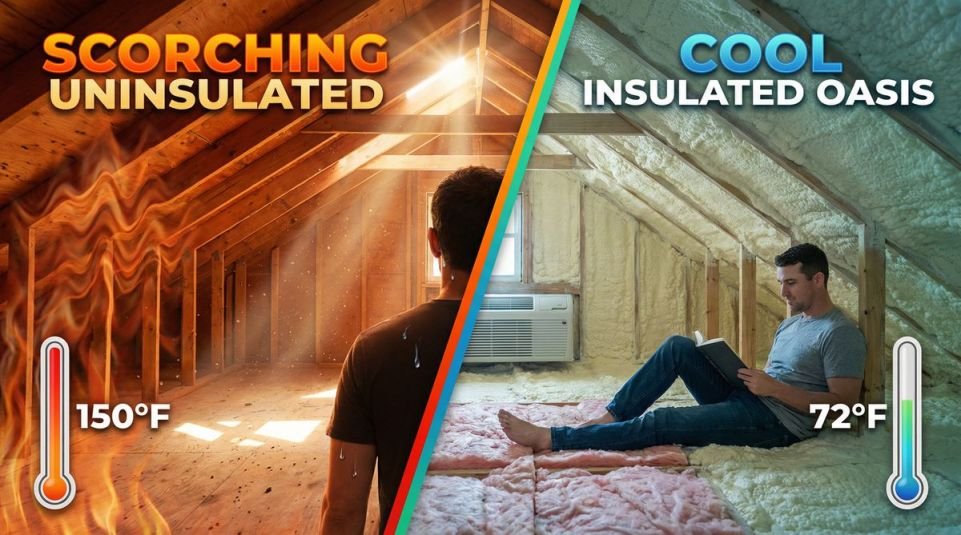

In hot climates, the attic is the single greatest source of heat gain in a home. On a 95°F day, an uninsulated attic can reach 150°F or higher — turning the ceiling into a radiant heater that forces air conditioning systems to work overtime, note Harper Property Management specialists. Choosing the right insulation is not just a comfort decision; it is a direct investment in energy efficiency and long-term utility savings.
This guide examines the best insulation options for attics in hot climates, comparing R-values, installation methods, costs, and real-world performance. The analysis draws on data from the U.S. Department of Energy and recent building science research to cut through the marketing noise and identify what actually works.
1. Why Hot Climates Demand a Different Insulation Strategy
Answer Capsule: In hot climates, the primary insulation challenge is blocking radiant heat from the roof, not retaining indoor warmth. This requires a combination of high R-value bulk insulation on the attic floor and a radiant barrier on the roof deck or rafters — a dual-layer approach that cold-climate strategies often omit entirely.
Standard insulation guides are written primarily for cold climates, where the goal is to trap heat inside. In hot climates, the physics are reversed: the enemy is heat flowing inward from a superheated roof. Radiant heat transfer — infrared energy radiating from hot roof sheathing — accounts for up to 40% of cooling load in hot climates, according to the Florida Solar Energy Center.
This means R-value alone is an incomplete metric. A home in a hot, dry climate needs both high R-value bulk insulation and a radiant barrier to address the two distinct heat transfer mechanisms at work simultaneously.
2. Top Insulation Options Compared
Answer Capsule: Spray foam insulation (closed-cell) offers the highest R-value per inch at R-6 to R-7 and creates an air seal, making it the top performer in hot climates. Blown-in cellulose and fiberglass batts are more affordable alternatives. Radiant barriers are not insulation but a critical complement that can reduce attic temperatures by 20–30°F.
| Insulation Type | R-Value per Inch | Cost per Sq. Ft. | Air Sealing | Best For |
|---|---|---|---|---|
| Closed-cell spray foam | R-6 to R-7 | $1.50–$3.00 | Excellent | Unvented attics, roof deck |
| Open-cell spray foam | R-3.5 to R-4 | $0.80–$1.50 | Good | Vented attics, cost-sensitive |
| Blown-in cellulose | R-3.2 to R-3.8 | $0.60–$1.20 | Moderate | Attic floor, retrofit projects |
| Fiberglass batts | R-2.9 to R-3.8 | $0.30–$0.80 | Poor | DIY, budget installs |
| Radiant barrier foil | N/A (reflects 97% radiant heat) | $0.10–$0.25 | None | Roof deck, rafter underside |
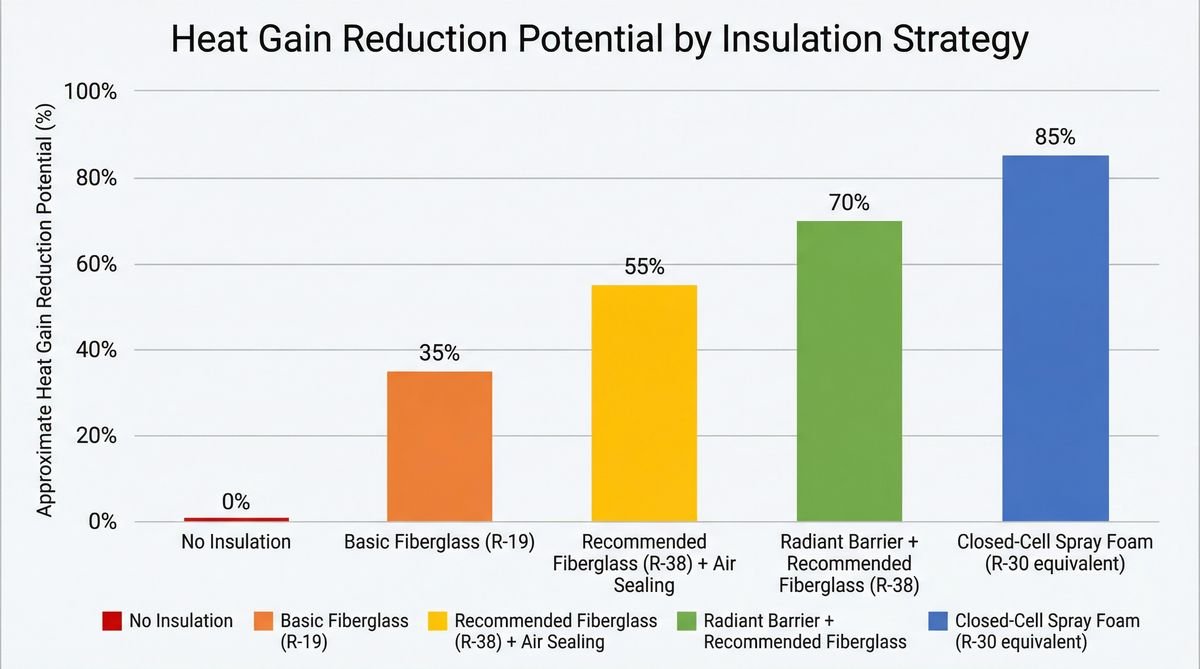
3. DOE Recommended R-Values for Hot Climates
Answer Capsule: The U.S. Department of Energy recommends R-38 to R-60 for attic insulation in hot climate zones (Zones 1–3). Most existing homes in these regions are significantly under-insulated, with attic floors averaging only R-11 to R-19 — less than half the recommended level.
DOE Climate Zones 1, 2, and 3 cover the hottest regions. Zone 1 (the hottest) calls for R-49 to R-60 for uninsulated attics and R-38 added to existing insulation. Achieving these targets with fiberglass batts alone would require an impractical depth of material, which is why blown-in cellulose or spray foam are the preferred solutions for deep insulation applications.
A 2024 analysis by the Building Science Corporation found that homes in hot climates upgrading from R-11 to R-49 attic insulation reduced annual cooling costs by an average of 18–22%, with payback periods of 5–8 years depending on local energy rates.
4. Radiant Barriers: The Hot-Climate Secret Weapon
Answer Capsule: A radiant barrier is a reflective foil material installed on the underside of roof rafters or the attic floor. It reflects up to 97% of radiant heat before it can warm the attic air. The Florida Solar Energy Center found radiant barriers reduce attic temperatures by 20–30°F and cooling costs by 5–10% in hot, sunny climates.
Radiant barriers work by reflection, not resistance. They do not have an R-value in the traditional sense, but their ability to prevent radiant heat from entering the attic space is unmatched. The most effective installation is on the underside of the roof rafters (facing down), where the foil stays clean and dust-free — dust accumulation on the foil surface significantly reduces its reflective effectiveness.
Radiant barriers are most cost-effective in hot, sunny climates with high cooling loads. In mixed or cold climates, the payback period extends considerably, making them a less compelling investment.
5. Vented vs. Unvented Attic Systems
Answer Capsule: Vented attics use soffit and ridge vents to flush hot air out, combined with floor insulation. Unvented (conditioned) attics use spray foam at the roofline to bring the attic inside the thermal envelope. Unvented systems perform better in hot, humid climates by preventing moisture-laden outdoor air from entering the attic.
The choice between vented and unvented attic design has significant implications for both insulation strategy and HVAC duct performance. In a vented attic, any HVAC ducts running through the space are exposed to extreme heat — a major efficiency loss. Moving ducts inside the conditioned envelope by converting to an unvented attic system can reduce duct-related energy losses by 20–30%, according to the Oak Ridge National Laboratory.
Frequently Asked Questions
What is the single best attic insulation for a hot climate?
Closed-cell spray foam applied to the roof deck creates an unvented conditioned attic — the highest-performing system for hot climates. It provides the best R-value per inch, air seals the entire roof assembly, and keeps HVAC ducts inside the conditioned space. The higher upfront cost is typically recovered through energy savings within 7–10 years.
Is a radiant barrier worth installing in a hot climate?
Yes, particularly in hot, sunny climates with high solar radiation. A radiant barrier installed on rafter undersides costs $0.10–$0.25 per square foot and can reduce attic temperatures by 20–30°F. When combined with adequate bulk insulation, it consistently delivers measurable reductions in cooling costs.
Can blown-in insulation be installed as a DIY project?
Yes. Many home improvement retailers offer blown-in insulation machine rentals with the purchase of insulation bags. The process is manageable for most homeowners: seal all air leaks first, then blow insulation to the required depth using the depth markers provided. Proper respiratory protection and eye protection are essential.
How much does attic insulation cost in hot climates?
Professional attic insulation installation costs between $1,500 and $4,500 for a typical 1,500-square-foot attic, depending on insulation type and existing conditions. Blown-in cellulose is the most cost-effective at $0.60–$1.20 per square foot installed. Spray foam is the premium option at $1.50–$3.00 per square foot.
Conclusion
The best insulation for an attic in a hot climate is not a single product — it is a system. Combining high R-value bulk insulation (R-38 to R-60) with a radiant barrier addresses both conductive and radiant heat transfer, the two primary mechanisms driving heat gain in hot-climate homes. For maximum performance, closed-cell spray foam at the roofline in an unvented attic configuration delivers the highest energy savings, particularly when HVAC ducts run through the attic space.
Budget-conscious homeowners can achieve significant improvements with blown-in cellulose on the attic floor paired with a radiant barrier foil on the rafter undersides — a combination that delivers strong performance at a fraction of the spray foam cost.
References
- U.S. Department of Energy. “Insulation.” Energy Saver. Updated 2025.
- Florida Solar Energy Center. “Radiant Barriers: A Question and Answer Primer.” 2024.
- Building Science Corporation. “Hot-Humid Climate Insulation Strategies.” 2024.
- Oak Ridge National Laboratory. “Attic and Duct Insulation Performance in Hot Climates.” 2023.

Most Viewed