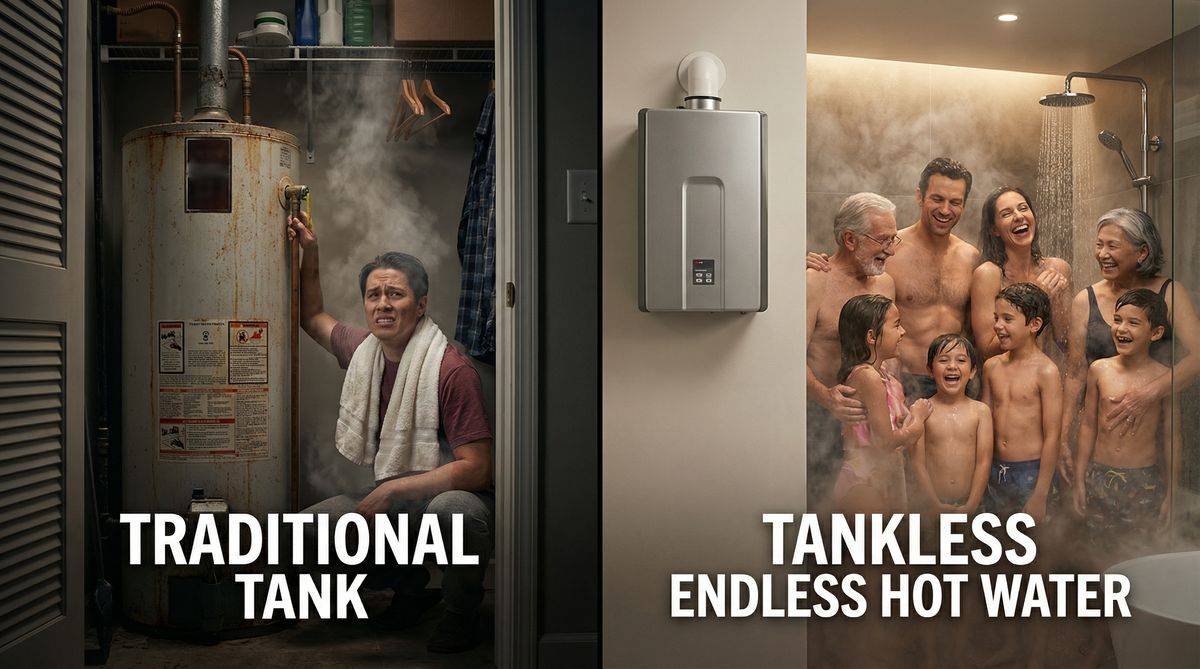

A family of five running two showers, a dishwasher, and a washing machine simultaneously is the ultimate stress test for any water heating system. Traditional tank water heaters often fail this test — the hot water runs out, notes a leading property management Norfolk company. Tankless water heaters promise an endless supply, but the reality for large families is more nuanced than the marketing suggests.
This guide examines the genuine pros and cons of tankless water heaters for large families, with specific attention to flow rate limitations, installation costs, and the critical sizing decisions that determine whether a tankless system thrives or frustrates in a high-demand household.
1. The Real Advantages for Large Families
Answer Capsule: Tankless water heaters provide endless hot water on demand, reduce energy consumption by 24–34% compared to tank heaters in homes using 41+ gallons daily, and last 20+ years versus 10–15 years for tank units. For large families with staggered hot water use, these advantages are substantial and financially meaningful over time.
The most compelling advantage is the elimination of hot water recovery time. A traditional 50-gallon tank heater takes 30–60 minutes to reheat after depletion. A properly sized tankless unit heats water instantaneously as it flows through the heat exchanger, meaning the sixth shower of the morning is just as hot as the first.
Energy efficiency is the second major advantage. The U.S. Department of Energy reports that tankless water heaters are 24–34% more energy efficient than conventional storage tank heaters for homes using 41 gallons or more of hot water daily — the typical consumption level for a family of four or more. This translates to annual savings of $100–$200 on energy bills, depending on fuel type and local rates.
Longevity is a third underappreciated benefit. Tankless units typically last 20 years or more with proper maintenance, compared to 10–15 years for tank heaters. The longer lifespan partially offsets the higher upfront cost when evaluated over a full ownership period.
2. The Real Disadvantages Large Families Must Know
Answer Capsule: The primary drawback for large families is flow rate limitation. A single whole-house tankless unit typically delivers 5–8 gallons per minute (GPM) — enough for two simultaneous showers but potentially insufficient for three showers plus a dishwasher running at the same time. Undersizing is the most common and costly mistake.
Flow rate is measured in gallons per minute (GPM). A standard shower uses approximately 2.0–2.5 GPM. A dishwasher uses 1.0–1.5 GPM. A washing machine uses 1.5–3.0 GPM. A family running two showers and a dishwasher simultaneously needs a unit capable of delivering at least 5.5–7.5 GPM at the incoming water temperature.
In cold climates, incoming groundwater temperatures can drop to 40°F in winter. Heating water from 40°F to 120°F requires significantly more energy and reduces the effective GPM output of the unit. A unit rated at 8 GPM in warm climates may deliver only 4–5 GPM in cold climates during peak winter demand.
| Factor | Advantage | Disadvantage |
|---|---|---|
| Hot water supply | Endless — no recovery time | Flow rate limits simultaneous use |
| Energy efficiency | 24–34% more efficient than tank | High-demand moments spike gas/electric use |
| Upfront cost | — | $800–$2,000 unit + $500–$1,500 install |
| Lifespan | 20+ years vs. 10–15 for tank | Maintenance (descaling) required annually |
| Space | Wall-mounted, very compact | Requires dedicated gas line or 240V circuit |
| Cold climate performance | — | GPM output drops significantly in winter |
3. How to Size a Tankless Heater for a Large Family
Answer Capsule: To size a tankless water heater correctly, calculate the maximum simultaneous hot water demand in GPM, then add 20% as a buffer. A family of 5–6 typically needs a unit rated at 9–11 GPM. In cold climates, choose a unit with a higher BTU input to compensate for low incoming water temperatures.
The sizing formula is straightforward. List every hot water fixture that might run simultaneously during peak morning hours. Add their GPM requirements. That sum is the minimum flow rate the unit must deliver. Then calculate the temperature rise needed: subtract the average incoming groundwater temperature from the desired output temperature (typically 120°F).

4. Gas vs. Electric Tankless: Which Is Better for Large Families?
Answer Capsule: Gas tankless water heaters are strongly preferred for large families because they deliver higher flow rates (8–11+ GPM) and heat water faster. Electric tankless units are limited to 3–8 GPM and require significant electrical upgrades (200–amp service minimum), making them better suited for point-of-use applications than whole-house use.
A whole-house electric tankless heater for a large family requires 150–200 amps of dedicated electrical capacity — often necessitating a panel upgrade that adds $1,500–$3,000 to the installation cost. Natural gas units, by contrast, typically require only a new gas line connection and proper venting. For most large families, gas is the more practical and cost-effective choice.
Frequently Asked Questions
Should a large family install two tankless units instead of one?
Yes, in many cases. Installing two smaller units — one for the master bathroom and one for the rest of the house — or a parallel configuration of two identical units is a common solution for large families with high simultaneous demand. This approach also provides redundancy: if one unit needs maintenance, the other continues operating.
How often does a tankless water heater need maintenance?
Annual descaling (flushing with white vinegar or a descaling solution) is recommended in areas with hard water. Hard water mineral deposits accumulate on the heat exchanger and reduce efficiency over time. In soft water areas, descaling every 2–3 years is typically sufficient. Filter screens should be cleaned every 6 months.
What is the total installed cost of a tankless water heater for a large family?
A whole-house gas tankless unit suitable for a large family costs $800–$2,000 for the unit itself. Professional installation adds $500–$1,500, including gas line work and venting. Total installed cost typically ranges from $1,300 to $3,500 — compared to $600–$1,200 for a traditional 50-gallon tank heater installed.
Is a tankless water heater worth it for a large family?
For families planning to stay in their home for 7 or more years, yes. The energy savings of $100–$200 annually, combined with the 20+ year lifespan, typically produce a positive return on investment over the ownership period. The endless hot water supply is a quality-of-life improvement that is difficult to quantify but consistently valued by large families who make the switch.
Conclusion
Tankless water heaters offer genuine advantages for large families — endless hot water, lower energy consumption, and a longer lifespan than traditional tank units. But the technology demands careful sizing. An undersized unit is worse than a tank heater: it delivers lukewarm water under simultaneous demand, which is exactly the problem it was supposed to solve.
The path to success is straightforward: calculate peak simultaneous GPM demand, add a 20% buffer, choose gas over electric for whole-house applications, and budget for proper installation. Done right, a tankless system is one of the most impactful home upgrades a large family can make.
References
- U.S. Department of Energy. “Tankless or Demand-Type Water Heaters.” Energy Saver. Updated 2025.
- American Council for an Energy-Efficient Economy (ACEEE). “Water Heating.” 2024.
- Rinnai Corporation. “Sizing Guide for Whole-House Tankless Water Heaters.” 2025.
- HomeAdvisor. “Tankless Water Heater Installation Cost Guide.” 2025.

Most Viewed