

The home inspection report arrives and it is longer than expected. Every home has issues — even new construction — and a thorough inspector will document dozens of items ranging from minor maintenance notes to significant structural concerns, says Stringer Management Charlotte County. The challenge is knowing which findings to negotiate, how to frame the request, and what outcome to pursue.
This guide covers the strategy behind repair negotiations after a home inspection: which items are worth negotiating, how to prioritize requests, the difference between asking for repairs versus credits, and how to handle a seller who refuses to negotiate.
1. What to Negotiate (and What to Let Go)
Answer Capsule: Focus repair negotiations on three categories: safety hazards (electrical issues, carbon monoxide risks, structural concerns), major system failures (HVAC, roof, plumbing, foundation), and items that were not visible or disclosed before the offer. Cosmetic issues, routine maintenance items, and minor defects that were apparent during the showing are generally not worth negotiating and can damage goodwill with the seller.
A useful mental framework: ask whether the issue would have changed the offer price if it had been known before the offer was submitted. A cracked heat exchanger in the furnace — a safety hazard and a $1,500–$3,000 repair — almost certainly would have. A worn caulk line around the bathtub would not. This distinction separates legitimate negotiation items from requests that sellers (and their agents) will view as overreaching.
Items that are almost always worth negotiating: roof damage or end-of-life roof, HVAC systems that are non-functional or near end of life, electrical panel issues (Federal Pacific or Zinsco panels, double-tapped breakers, aluminum wiring), evidence of active water intrusion, foundation cracks with movement, and any safety code violations.
2. Repairs vs Closing Credits: Which to Request
Answer Capsule: Requesting a closing credit (a reduction in the purchase price or seller-paid closing costs) is generally preferable to requesting repairs for most issues. Credits give the buyer control over the quality of the repair and the contractor used. Seller-completed repairs are often done at the lowest possible cost, and the buyer has limited recourse if the work is substandard.
The exception is safety-critical repairs that require permits and licensed contractors — electrical panel replacements, structural repairs, and HVAC replacements. For these items, requesting that the seller complete the repair with licensed contractors and provide documentation (permits, receipts) before closing ensures the work meets code and provides a paper trail for future disclosure.
| Situation | Recommended Approach | Reason |
|---|---|---|
| Minor repairs (under $500) | Closing credit | Seller repair quality is unpredictable |
| Cosmetic issues | Closing credit or drop the request | Not worth the negotiation friction |
| HVAC replacement | Closing credit (buyer selects contractor) | Buyer can choose quality and warranty |
| Electrical panel replacement | Seller repair with permit documentation | Requires licensed electrician and permit |
| Roof replacement | Either, depending on market conditions | Large cost; buyer may prefer credit |
| Active water intrusion | Seller repair with documentation | Source must be identified and fixed |
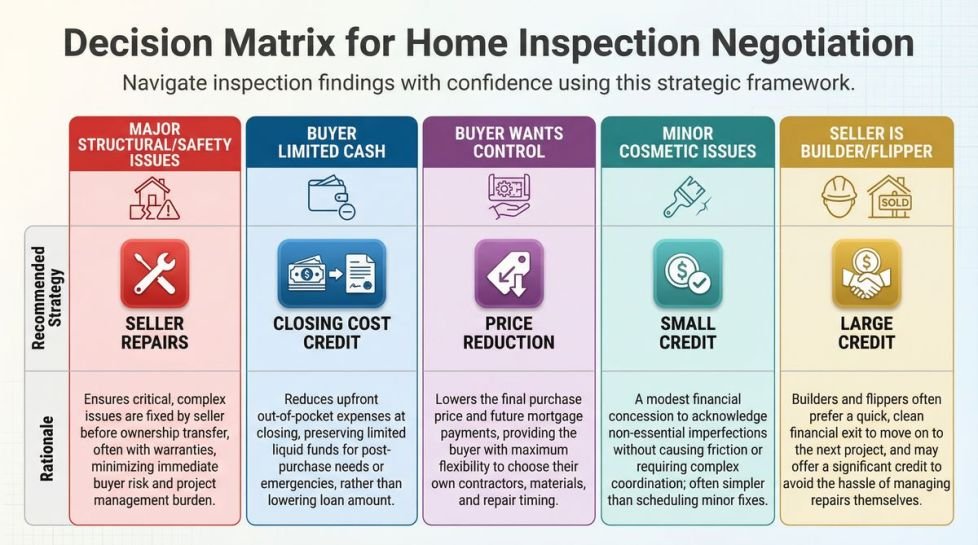
3. How to Frame the Repair Request
Answer Capsule: Submit repair requests in writing through the buyer’s agent, referencing specific inspection report items by page number and description. Request repair estimates from licensed contractors before submitting the request when possible — a request supported by a $3,200 roofing estimate is far more persuasive than a vague request to “fix the roof.” Limit the request to the highest-priority items rather than submitting every finding in the inspection report.
The number of items in a repair request matters as much as the dollar amount. A request for three significant repairs is received very differently than a request for twenty-three items that includes every maintenance note in the inspection report. Sellers and their agents interpret a long list as a sign of buyer anxiety or bad faith, which hardens their negotiating position. A focused, well-documented request for legitimate issues is far more likely to result in a productive negotiation.
4. When the Seller Refuses to Negotiate
Answer Capsule: If the seller refuses to negotiate repairs or credits, the buyer must decide whether to proceed as-is, renegotiate the purchase price, or exercise the inspection contingency to cancel the contract. In a seller’s market, sellers have more leverage to decline repair requests. The inspection contingency is the buyer’s primary protection — it should not be waived unless the buyer is fully prepared to accept the property in its current condition.
A seller’s refusal to negotiate on safety issues — particularly electrical hazards, structural concerns, or evidence of active water intrusion — is a significant red flag. Sellers who are unwilling to address genuine safety issues may be concealing other problems or may be in a financial position that limits their ability to make repairs. This response warrants careful consideration before proceeding.
Frequently Asked Questions
How much should a buyer ask for in repair credits?
Request credits based on actual contractor estimates whenever possible. For items where estimates are not available, use the mid-range cost from reliable cost databases (HomeAdvisor, Angi, RSMeans). Requesting the high end of the cost range invites counter-offers; requesting a documented actual estimate is harder to dispute. A reasonable request is typically 50–100% of the estimated repair cost for major items.
Do inspection negotiations apply to new construction?
Yes. New construction homes should be inspected before closing, and deficiencies should be documented and addressed through the builder’s warranty process. Builders typically provide a one-year workmanship warranty and longer warranties for structural components. Issues identified before closing are addressed through a punch list — a formal list of items the builder agrees to complete before or shortly after closing.
What does “as-is” mean in a home sale?
An “as-is” designation means the seller will not make repairs or provide credits for inspection findings. The buyer retains the right to inspect the property and cancel the contract if the findings are unacceptable — the inspection contingency still applies. “As-is” does not mean the buyer waives the right to inspect; it means the seller has communicated that the price reflects the property’s current condition.
Conclusion
Effective post-inspection negotiation is focused, documented, and strategic. The goal is not to extract maximum concessions but to ensure the buyer is not taking on undisclosed financial risks. Prioritizing safety issues and major system concerns, requesting credits rather than repairs where possible, and supporting requests with contractor estimates are the practices that lead to productive negotiations and successful closings.
The inspection contingency is the buyer’s most important protection in this process. Using it thoughtfully — to address genuine concerns rather than as a general renegotiation tool — maintains credibility with the seller and increases the likelihood of a fair resolution.
References
- National Association of Realtors (NAR). “Home Inspection Negotiation Guide.” 2025.
- American Society of Home Inspectors (ASHI). “Understanding Your Inspection Report.” 2024.
- Consumer Financial Protection Bureau (CFPB). “Home Inspection and Repair Negotiations.” 2025.

Most Viewed