
If you have spent any time in the world of personal electric vehicles over the past few years, you have probably noticed something interesting happening. Riders who once swore by their e-bikes are quietly swapping notes about electric scooters, and scooter riders are equally curious about what a proper electric bike can do. The two categories are no longer living in separate lanes. They are colliding, overlapping, and forcing riders to think more carefully about what they actually need from a ride.
This is not a simple “which one is better” debate. Both categories have matured significantly, and the answer genuinely depends on how you ride, where you ride, and what you want out of an electric vehicle. What makes this conversation more interesting now is how much the technology on both sides has evolved, and how the lines between casual commuter and serious off-road enthusiast have blurred.
Before diving into the scooter side of things, it is worth acknowledging just how broad the electric bike world has become. Commuter models, cargo bikes, fat bikes, mountain bikes, and even buy electric dirt bikes options have carved out distinct audiences. The diversity within the e-bike category is part of what makes any head-to-head comparison with scooters tricky; you are rarely comparing apples to apples.
Table of Contents
ToggleWhat the Numbers Are Telling Us
The growth of the electric scooter market is hard to ignore. According to Polaris Market Research, the global electric scooter market reached USD 28.36 billion in 2024 and is projected to expand to USD 81.48 billion by 2034, representing an 11.2% compound annual growth rate. That is not the trajectory of a niche product. It is the kind of momentum that signals a genuine shift in how people think about short to medium distance transportation.
Part of this is being driven by urban infrastructure catching up. More cities are building dedicated lanes, relaxing bylaws around personal electric vehicles, and actively encouraging residents to ditch four wheels for two. Electric scooters happen to be an excellent fit for that kind of urban grid: compact, fast to charge, easy to park, and requiring almost no learning curve.
The Portability Advantage (and Its Real Limits)
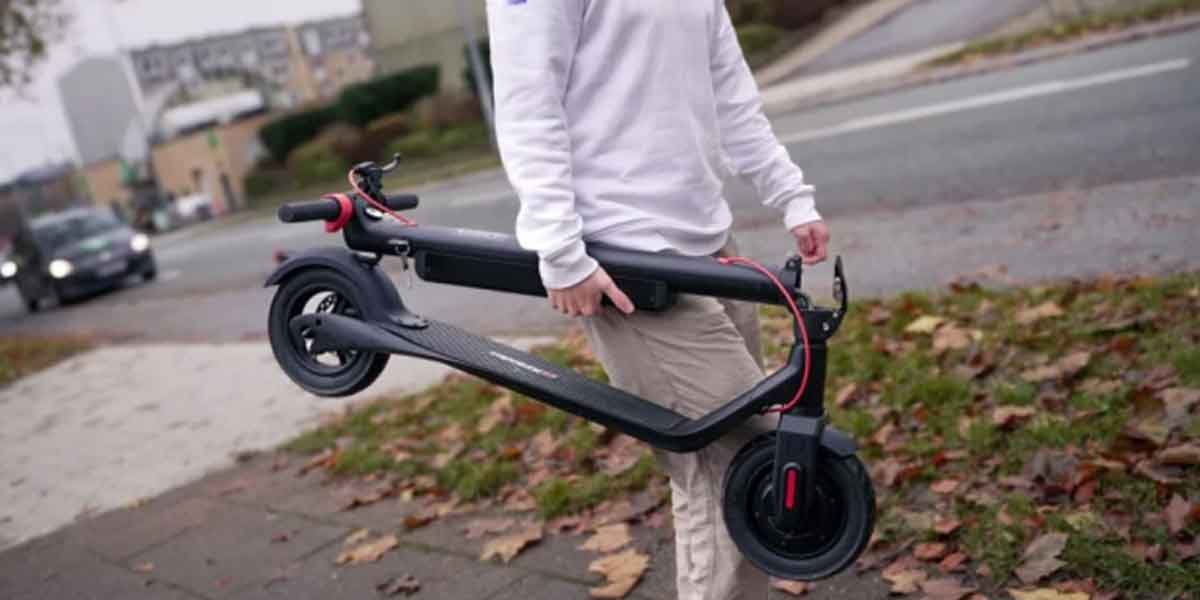
Ask most scooter converts why they made the switch and portability comes up within the first thirty seconds. A quality folding electric scooter collapses down in a matter of seconds, slides under a desk, fits in a trunk without folding the rear seats, and can be carried into a building without turning heads. For apartment dwellers in dense cities, that is a huge practical advantage over an e-bike that needs a dedicated storage space and a secure lock-up.
But portability has its limits. A scooter is not magic once the pavement ends. Smaller wheels, which typically run between 8 and 11 inches on most commuter models, are inherently less forgiving over potholes, gravel paths, and rough road surfaces. If your daily route involves a mix of bike paths, cracked sidewalks, and the occasional grassy shortcut, that comfort gap becomes noticeable quickly. High-performance scooters with larger pneumatic tires close some of that gap, but they also tend to sacrifice the foldability that made the category appealing in the first place.
Speed, Range, and the Battery Dependency Problem
This is where the e-bike holds a structural advantage that no amount of scooter development has been able to fully close. On an electric bike, a dead battery is an inconvenience. On an electric scooter, a dead battery effectively ends your ride. Pedaling your way home on a heavy e-bike with a flat battery is not fun, but it is possible. Trying to kick-scoot a 20 kg high-performance scooter back to your apartment is a different story entirely.
Range anxiety affects both categories, but it hits scooter riders harder in practical terms. Most commuter-grade scooters deliver somewhere between 25 and 40 kilometers on a single charge under real-world conditions, accounting for rider weight, wind, and terrain. Premium models push that figure considerably higher, but they also come with a price tag and weight penalty that changes the value equation.
Electric bikes, particularly Class 3 models with larger battery packs, routinely deliver 60 to over 100 kilometers of range. For anyone using their electric vehicle as a genuine car replacement for commuting, that headroom matters. You stop thinking about charging as a daily ritual and start treating it more like a weekly task.
Where Scooters Have Actually Gotten Better
It would be unfair to only look at where scooters fall short. The technology has moved remarkably fast. Hydraulic disc brakes, air suspension forks, dual-motor drivetrains, integrated lighting systems, and app connectivity have all made their way into scooters that would have looked like science fiction ten years ago. High-performance models from brands like Kaabo and Nami are genuinely quick, handle significantly better than entry-level scooters, and are built to take punishment.
Battery technology is also improving across both categories. Lithium-ion cells with better energy density, combined with smarter battery management systems, are extending range and improving charging times. The shift away from sealed lead-acid batteries, which once dominated the lower end of the scooter market, has made a real difference in weight, reliability, and longevity.
Rider posture on scooters has also been quietly addressed by some manufacturers. While the standing riding position is a fundamental part of what a kick-style scooter is, seat attachments and hybrid designs have started to appear, giving riders options that did not exist even a few years ago.
The Riding Experience Is Just Different
One thing that gets lost in spec-sheet comparisons is how differently the two vehicles actually feel to ride. An electric bike encourages you to lean into a journey. The ergonomics, the seating position, and the pedal assist all work together to make longer rides comfortable and engaging. You arrive at your destination feeling like you did something, even if you let the motor do most of the work on hills.
A scooter, by contrast, is efficient in a very different way. The standing position keeps you alert, gives you excellent visibility in traffic, and makes short hops feel effortless. There is an immediacy to scooter riding that commuters genuinely love. You step on, you go, you step off. It fits into the rhythm of a busy urban day without requiring you to shift mental gears.
Neither experience is objectively better. They appeal to different types of riders with different relationships to their commute.
Making the Right Call for Your Situation
The honest answer is that neither category wins outright, and the right choice comes down to a handful of questions that only you can answer. How far do you ride in a typical day? Do you have secure storage at home and at your destination? How important is the option to exercise while you ride? What kind of terrain does your route involve? And perhaps most practically, do you need a vehicle that can double as something genuinely fun on a weekend, or are you purely solving a commuting problem?
Riders who live in dense urban areas with good infrastructure, short commutes under 15 kilometers, limited storage, and a need to combine their ride with transit will often find that an electric scooter fits their life better than an e-bike. The convenience is real and it adds up over time.
Riders who cover longer distances, deal with mixed terrain, want the option to keep moving when the battery dies, or simply enjoy the act of cycling will almost always be better served by an e-bike. The riding experience is richer, the range is more generous, and the versatility across different use cases is genuinely hard to match.
For riders who are unsure, the best move is always the same: try both. The gap between what looks good on a spec sheet and what actually works for your daily life only becomes clear once you are out there riding. If you can test ride options across both categories before committing, that experience will tell you more than any comparison article ever could.
What is clear from where the market is heading is that both electric bikes and electric scooters are here to stay, and both are getting better at a rapid pace. The real winner in all of this is the rider, who now has more thoughtful, capable, and varied options than at any point in the history of personal electric transport.

Chase Durkish
Most Viewed