
A 20 percent down payment on a house significantly impacts mortgage terms, monthly payments, and overall financial flexibility, influencing whether private mortgage insurance is required and potentially securing a lower interest rate for the borrower. This substantial upfront investment can lead to considerable long-term savings and increased financial stability for homeowners across various regions, while guidance from BanCal Properties team can help homeowners consider the broader property-management context behind the purchase.
A 20 percent down payment on a house is often advantageous because it reduces the loan amount, lowers monthly payments, and can secure better interest rates, ultimately saving homebuyers money over the mortgage term.
A 20 percent down payment offers several financial benefits for homebuyers, primarily by eliminating private mortgage insurance (PMI) and often securing more favorable loan terms. This substantial initial investment reduces the loan-to-value (LTV) ratio, signaling lower risk to lenders and potentially leading to a lower interest rate over the life of the mortgage. Furthermore, a larger down payment results in a smaller loan amount, which directly translates to lower monthly mortgage payments, freeing up cash flow for other financial goals or home-related expenses. In competitive real estate markets, a 20 percent down payment can also make an offer more attractive to sellers, as it indicates a financially strong and serious buyer, potentially providing an edge in bidding wars.
Homebuyers can avoid Private Mortgage Insurance (PMI) by making a 20 percent or greater down payment, which eliminates an additional monthly cost and reduces the overall expense of homeownership.
Private Mortgage Insurance (PMI) is typically required by lenders when a homebuyer makes a down payment of less than 20 percent of the home’s purchase price, serving as protection for the lender against potential default. By putting down 20 percent or more, homebuyers can completely avoid this additional monthly expense, leading to significant savings over the life of the loan. PMI costs generally range from 0.3% to 1.5% of the original loan amount annually, adding a notable sum to monthly mortgage payments. Eliminating PMI not only reduces the overall housing cost but also simplifies the monthly budget, providing greater financial predictability and allowing more funds to be allocated towards principal repayment or other investments.
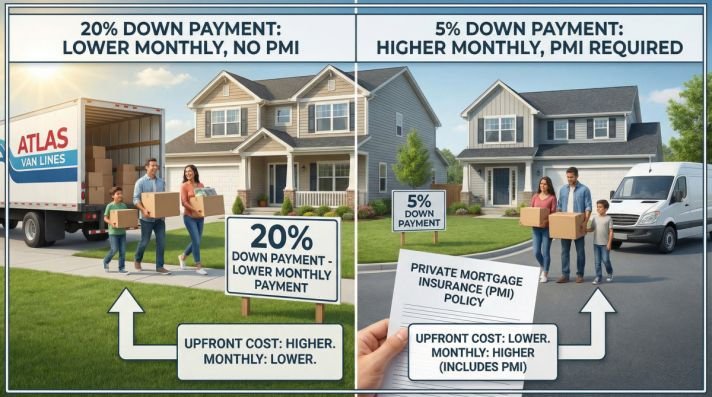
Despite its benefits, a 20 percent down payment can have drawbacks, such as reduced financial liquidity and delayed homeownership, especially if saving the large sum depletes emergency funds or prevents timely market entry.
While a 20 percent down payment offers numerous benefits, it also presents potential drawbacks, particularly concerning liquidity and opportunity cost. Saving a substantial sum for a down payment can delay homeownership, especially in rapidly appreciating markets, as property values may increase faster than savings accumulate. Tying up a significant portion of liquid assets in a down payment can also limit financial flexibility, potentially depleting emergency funds or hindering other investment opportunities that could yield higher returns. For some buyers, a smaller down payment might allow them to enter the market sooner, begin building equity, and take advantage of current interest rates, even with the added cost of PMI. The decision ultimately depends on individual financial circumstances, market conditions, and personal priorities regarding immediate homeownership versus long-term financial planning.
For those unable to make a 20 percent down payment, alternative strategies like FHA, VA, and USDA loans offer lower or no down payment options, enabling homeownership with varying terms and requirements.
For homebuyers unable or unwilling to make a 20 percent down payment, various alternative strategies and loan programs exist to facilitate homeownership. Government-backed loans, such as FHA (Federal Housing Administration) loans, VA (Veterans Affairs) loans, and USDA (United States Department of Agriculture) loans, offer lower down payment requirements, with some even allowing zero down. FHA loans typically require a minimum of 3.5% down, while VA and USDA loans often require no down payment for eligible borrowers. Conventional loans also offer options with down payments as low as 3%, though these usually come with PMI. Additionally, some lenders provide specific programs for first-time homebuyers or those in certain professions, which may include down payment assistance or reduced mortgage insurance premiums. Exploring these alternatives can help individuals achieve homeownership without the necessity of a large upfront investment, though it is crucial to understand the associated costs and benefits of each option.
Making an informed decision about a 20 percent down payment involves evaluating personal finances, market conditions, and long-term goals, often with the guidance of a financial advisor, to align with individual homeownership aspirations.
The decision of whether to make a 20 percent down payment on a house is a complex one, requiring careful consideration of personal financial health, market conditions, and long-term goals. While a larger down payment can lead to lower monthly payments, avoidance of PMI, and potentially better interest rates, it may also deplete savings and delay entry into the housing market. Conversely, a smaller down payment allows for quicker homeownership and the preservation of liquid assets, but often involves PMI and higher monthly costs. Consulting with a qualified financial advisor or mortgage professional is highly recommended to assess individual circumstances, explore all available loan options, and understand the full financial implications of each choice. This personalized guidance ensures that homebuyers make a strategic decision that aligns with their financial capacity and aspirations for homeownership.
FAQ: Frequently Asked Questions
What is PMI, and how can I avoid it?
PMI, or Private Mortgage Insurance, protects lenders if a borrower defaults on a loan with less than a 20% down payment. You can avoid PMI by making a down payment of 20% or more of the home’s purchase price.
Will a 20 percent down payment lower my interest rate?
While not guaranteed, a 20 percent down payment often leads to a lower interest rate because it reduces the lender’s risk. Lenders typically offer more favorable terms to borrowers with higher equity from the start.
Is it always better to put 20 percent down?
Not always. While it offers benefits like avoiding PMI and lower interest rates, it might deplete your savings or delay homeownership. The best approach depends on your financial situation and market conditions.
What if I cannot afford a 20 percent down payment?
Many loan programs, such as FHA, VA, and USDA loans, allow for lower or even no down payments. It’s important to explore these options and understand their specific requirements and associated costs.
How does a 20 percent down payment affect my monthly mortgage?
A 20 percent down payment reduces the principal loan amount, resulting in lower monthly mortgage payments. Additionally, by avoiding PMI, your overall monthly housing expenses will be further decreased.
Conclusion
Deciding on the optimal down payment for a home is a pivotal financial choice for prospective buyers. A 20 percent down payment offers clear advantages, including the elimination of private mortgage insurance, potentially lower interest rates, and reduced monthly mortgage payments. These benefits can lead to substantial long-term savings and increased financial stability. However, the decision must be weighed against individual financial liquidity, the opportunity cost of tying up significant capital, and the desire to enter the housing market sooner. Various loan programs and strategies exist for those unable to meet the 20 percent threshold, each with its own set of considerations. Ultimately, a thorough evaluation of personal finances, coupled with expert advice from mortgage professionals, will guide homebuyers toward the most suitable down payment strategy, ensuring a sound investment in their homeownership journey.

Most Viewed