
When a garbage disposal hums but does not grind, the motor is trying to spin against a mechanical lock. The impeller plate — the spinning disk with metal lugs that slings food outward against the grinding ring — is jammed. An object wedged between the impeller and the ring prevents rotation, adds CHL Rentals team.
The motor stalls and produces a low-frequency hum, which is the sound of electrical current flowing through windings that cannot turn the rotor. Continuing to run the disposal in this state for more than a few seconds will overheat the motor and trip the thermal overload protector. At that point, the disposal will fall silent until it cools, which takes 15 to 30 minutes.
This is the most common garbage disposal failure mode, accounting for roughly 70% of service calls according to plumber survey data. The remaining 30% are split between seized motor bearings, failed capacitors, and tripped circuit breakers. The jam clearance procedure solves the vast majority of cases and requires no parts.
Safety First: Disconnect Power
Before reaching toward or into a garbage disposal, disconnect it from power. If the disposal plugs into an outlet under the sink, unplug it. If it is hardwired, turn off the circuit breaker that controls the disposal circuit. Verify by flipping the wall switch.
The disposal should do nothing. This is not a precaution. A disposal that frees itself and spins with your hand inside the grinding chamber will amputate fingers. The motor produces between one-half and one full horsepower at the impeller. Human fingers lose that contest instantly and irreversibly.
Free the Jammed Impeller
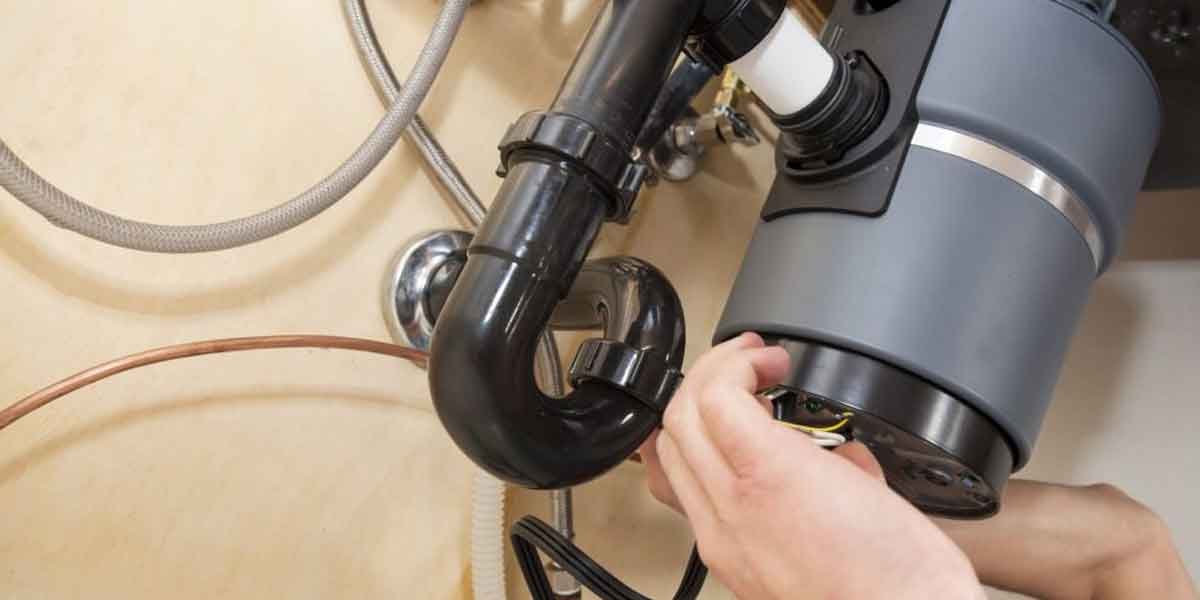
Almost all garbage disposals have a hex-shaped socket centered on the bottom of the unit, accessible from under the sink. Insert the hex wrench provided with the disposal — or a standard 1/4-inch Allen wrench , into the socket. Rotate the wrench back and forth in a short arc.
You will feel resistance as the obstruction presses against the grinding ring. Continue working the wrench until the resistance gives way and the shaft rotates freely through a full circle. The freed object will drop into the grinding chamber.
If your disposal does not have a bottom hex socket , some older or budget models lack this feature , insert a wooden broom handle or a long wooden spoon through the sink drain into the grinding chamber. Position the handle against one of the metal impeller lugs on the impeller plate and push firmly to rotate the plate. Use wood, not metal.
A metal tool will damage the impeller lugs or the grinding ring. Never insert your hand into the grinding chamber even with the power disconnected. The impeller lugs are sharp and can pinch fingers when the plate snaps free.
Remove the Obstruction
Once the impeller rotates freely, use long-nose pliers, tongs, or a mechanical retrieval tool to extract the object that caused the jam. Shine a flashlight into the drain opening and inspect the entire grinding chamber, including the space between the impeller plate and the housing wall. Remove every visible fragment.
Common jam-causing objects include bones, fruit pits, corn cobs, metal bottle caps, broken glass, small utensils, and fibrous vegetable matter like celery or artichoke leaves that wrapped around the impeller shaft. Remove all of it. Even small fragments that escape notice will migrate back into the gap between the impeller and the grinding ring the next time the disposal runs.
Run cold water into the disposal and spin the impeller manually with the hex wrench while the water runs. This flushes remaining particles through the drain. Cold water is important: it keeps the motor housing cool during operation and solidifies any residual grease so it can be ground into small enough particles to pass through the plumbing.
| Step | Action | Tool Needed | Time |
|---|---|---|---|
| 1. Disconnect Power | Unplug or turn off breaker | None | 1 min |
| 2. Free Impeller | Rotate hex socket back and forth | 1/4-inch Allen wrench | 2 min |
| 3. Remove Debris | Extract obstruction with pliers | Long-nose pliers, flashlight | 3 min |
| 4. Flush Chamber | Run cold water, spin impeller manually | Allen wrench | 2 min |
| 5. Reset Overload | Press red button on bottom of unit | None | 1 min |
Reset the Thermal Overload Protector
If the disposal hummed for more than three to five seconds before you shut it off, the internal thermal overload protector almost certainly tripped. This is a small red button located on the bottom or lower side of the disposal housing. Press it firmly until it clicks and stays depressed. If the button will not stay in, the motor is still too hot.
Wait 15 minutes and press again. Once the button stays in, plug the disposal back in or restore power at the breaker. Turn on cold water at the sink. Flip the wall switch. The disposal should spin immediately and quietly.
When the Disposal Needs Replacement
A disposal that still only hums after the impeller has been freed, the chamber has been cleared, and the overload protector has been reset has a failed motor. The rotor windings are burned out or the motor bearings have seized. No repair is possible. The motor is a sealed unit and is not designed to be serviced. Replace the disposal.
A disposal that trips the circuit breaker immediately when turned on has a dead short in the motor windings. Replace it immediately. Do not reset the breaker and try again. A shorted motor can arc internally and create a fire risk.
A disposal that spins but produces a loud grinding or rattling noise has damaged impeller lugs or a cracked grinding ring. The noise indicates metal-on-metal contact inside the chamber. Replacement is the correct course of action.
Replacement units cost $80 to $250 for a standard 1/2 to 3/4 horsepower residential disposal. Installation takes approximately one hour. Units above 10 years old should be replaced rather than repaired even if the jam was successfully cleared, because the grinding ring has dulled and the motor bearings are nearing the end of their service life.
Frequently Asked Questions
What causes a garbage disposal to hum but not spin?
An object is wedged between the impeller plate and the grinding ring, mechanically locking the motor shaft. The motor is receiving power and attempting to spin, producing the hum. The jam must be cleared using the hex socket on the bottom of the unit or a wooden handle through the drain opening. Continuing to run the disposal while jammed can burn out the motor.
How do I know if my garbage disposal motor is burned out?
A burned-out motor produces no sound at all when the switch is flipped, even after the thermal overload protector has been reset and pressed in. A motor that hums is not burned out , it is jammed. A motor that does nothing after the overload has been reset and the circuit breaker has been verified as on has failed and requires replacement of the entire disposal.
How much does it cost to fix or replace a garbage disposal?
Clearing a jam costs nothing. A replacement disposal costs $80 to $250 depending on brand and horsepower. Professional installation adds $150 to $300. If the disposal is more than 10 years old, replacement is more cost-effective than attempting to diagnose and repair a failed motor, because sealed motor units are not repairable and the grinding components are worn.
Can I prevent my garbage disposal from jamming?
Run cold water before, during, and for 15 seconds after grinding. Cold water keeps grease solidified so it is ground and flushed.
Avoid grinding bones, fruit pits, corn cobs, fibrous vegetables, coffee grounds in large quantities, eggshells, and pasta or rice that expands in water. Cut large items into smaller pieces before feeding them into the disposal. Never pour grease or oil down the disposal , it coats the impeller and grinding ring and traps food particles that eventually harden into a paste that prevents the impeller from spinning.

Most Viewed