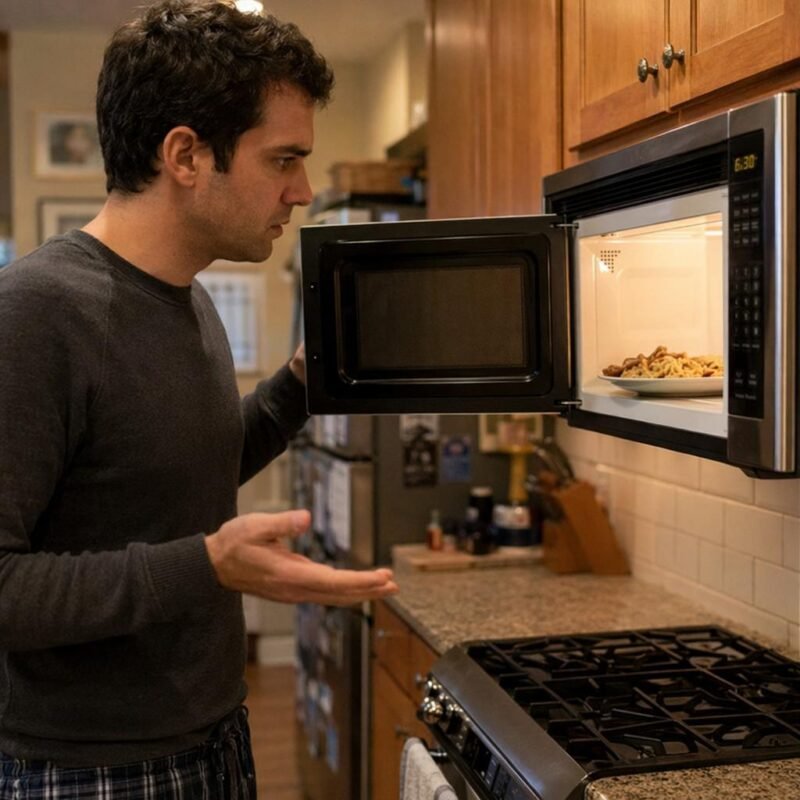

When a microwave not heating food turns on, spins the plate, and counts down normally — but leaves everything stone cold — the problem is almost always one of six components. The good news: one of them costs $10 to fix yourself. The bad news: others involve voltages that remain lethal for up to 30 minutes after the unit is unplugged.
Critical Safety Warning Before Any Diagnosis
Before any internal inspection, understand what you’re dealing with. A microwave’s high-voltage capacitor stores charge at roughly 2,000 volts — enough to cause a fatal shock — even after the unit has been unplugged and sitting idle. This isn’t a precaution that can be skipped. Every internal repair on a microwave requires discharging this capacitor first, using an insulated discharge tool or a properly constructed resistor discharge lead. This is why the appliance repair industry consistently treats microwave internal work as professional-only territory, and the U.S. Consumer Product Safety Commission consistently recommends professional service for appliance electrical repairs. The safe checks described below are limited to external observation and door switch testing.
Why a Microwave Runs But Doesn’t Heat
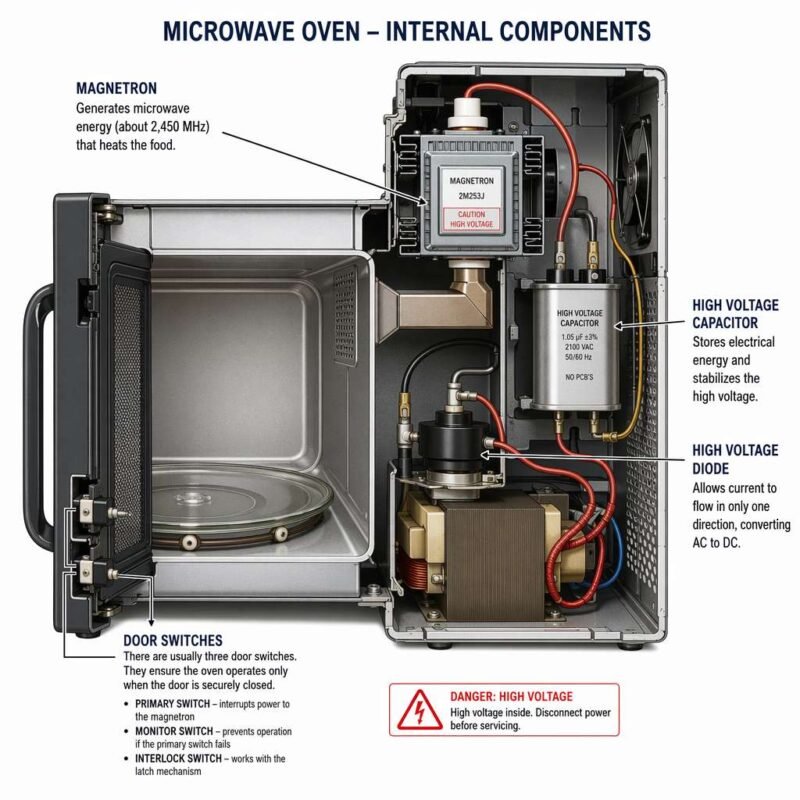
A microwave that runs without heating food has separated its control functions from its heating function. The timer, light, turntable motor, and display draw from standard household current. The magnetron — the component that actually generates microwave energy, operates on a completely separate high-voltage circuit. When anything in that high-voltage circuit fails, the microwave behaves normally in every visible way while producing zero heat.
| Component | How Common | Typical Repair Cost | DIY Safe? |
|---|---|---|---|
| Door interlock switch | Very common | $10–$30 | Yes (with care) |
| High voltage diode | Common | $10–$20 | Professional only |
| Thermal fuse / cutout | Common | $15–$50 | Professional only |
| High voltage capacitor | Moderate | $20–$60 | Professional only |
| Magnetron | Less common | $100–$200 parts + labor | No |
| Control board | Least common | $100–$300 | No |
The 6 Causes, Diagnosed
The six components below account for nearly all cases of a microwave not heating food. They are listed from most to least common, with repair costs and safety notes for each. Start with door switches before assuming a more expensive failure.
1. Faulty Door Interlock Switches
Door interlock switches are the most frequently overlooked cause of a microwave not heating food. Most microwaves have two or three of these switches, and they must all close in the correct sequence for the high-voltage circuit to activate. A single failed switch prevents heating entirely while allowing every other function to work normally. Testing them requires a multimeter set to continuity mode, with the microwave unplugged. If any switch fails to show continuity when the door is pressed closed (simulating a closed door), that switch is the culprit. Replacement switches are inexpensive ($5–$15 each) and this is the one internal repair that some experienced DIYers handle safely, since the switches are located near the door frame rather than near the high-voltage section.
2. Blown High Voltage Diode
The high voltage diode converts the alternating current from the transformer into the direct current that powers the magnetron. When it fails, the magnetron receives no usable power. A failed diode often produces a loud humming sound during operation, distinctly different from the normal operating hum. It may also cause the microwave to blow its internal fuse. The diode itself costs around $10, making it one of the least expensive microwave repairs possible. The problem: it’s located directly adjacent to the high-voltage capacitor, which is why this repair belongs in professional hands despite the low parts cost.
3. Blown Thermal Fuse or Cutout
Microwaves have one or more thermal cutouts that act as safety devices, interrupting the circuit if the unit overheats. These are one-time-use components: once they blow, they must be replaced. A blown thermal fuse will typically cause the microwave to stop heating entirely, though the unit may still appear to function. Overheating causes include blocked ventilation, running the microwave empty, or a failing fan motor. Identifying a blown fuse requires continuity testing with a multimeter. Replacement costs are low ($15–$50), but the location inside the unit requires working near the high-voltage section.
4. Failed High Voltage Capacitor
The capacitor works with the diode and transformer to double the household voltage to approximately 2,000 volts for the magnetron. A failed capacitor typically produces a loud buzzing or humming sound, and the microwave may trip its internal fuse. This component is the primary reason microwave internal repair requires professional service: it retains its dangerous charge even after unplugging. A properly trained technician will discharge it using a resistor before any other work. Capacitor replacement parts run $20–$60, but labor brings the total to $100–$200 at a service center.
5. Dead Magnetron
The magnetron is the component that actually generates microwave radiation to heat food. When it fails, it often does so with an audible pop or bang, a sound many owners remember distinctly. Magnetron failure is confirmed by testing resistance between the terminals and the housing; a reading of anything other than infinity indicates a short. Replacement magnetrons cost $100–$150 in parts, and labor typically doubles that figure. There is an additional safety consideration: magnetrons contain a ceramic insulator made of beryllium oxide, which is toxic if powdered or inhaled. A cracked magnetron is a hazardous materials situation, not a DIY parts swap.
6. Faulty Control Board
Control board failure is the least common cause of a microwave not heating food, but it does occur. The board manages the relay that connects household current to the high-voltage transformer. A failed relay on the board can prevent the entire heating circuit from activating while leaving display and timer functions intact. Diagnosis requires professional equipment. Board replacement runs $100–$300 for parts, making this the most expensive repair scenario and often the one that tips the repair-versus-replace calculation toward replacement.
What You Can Safely Check First
Before contacting a repair service, several checks can narrow down the problem without opening the unit at all. Work through this list in order, since each takes under two minutes.
- Confirm the power outlet is working. Plug something else into the same outlet. If nothing works, the problem is the circuit, not the microwave.
- Check the circuit breaker and microwave’s internal reset button. Many over-the-range models have a reset button behind the grill or on the back panel. A tripped breaker or reset button explains the issue without any component failure at all.
- Examine the door seal and hinges. A visibly warped door frame can prevent the interlock switches from seating properly. If the door doesn’t close with a firm click, the switch circuit may not be completing.
- Listen for abnormal sounds during operation. Loud buzzing or humming points toward the diode or capacitor circuit. A one-time pop followed by silent operation suggests magnetron failure. Normal-sounding operation with zero heat is often a door switch.
- Try the microwave on a different setting and duration. Run it for 30 seconds on 100% power with a cup of water inside. If the water is completely cold afterward, the heating circuit has failed entirely. Partial heating (slightly warm water) can indicate a magnetron degrading rather than completely failed.
The cup-of-water test is more diagnostic than people realize. A magnetron on its way out often heats inconsistently before failing completely. That gradual decline, warming food one day, barely warming it the next, is the magnetron telling you its end is near.
When to Repair vs. Replace
The appliance repair industry uses a standard threshold: if the repair cost exceeds 50% of the cost of a comparable new unit, replacement is usually the better financial decision. For microwaves, that math changes based on the type of unit.
| Microwave Type | Typical Replacement Cost | Maximum Sensible Repair |
|---|---|---|
| Countertop (basic) | $80–$150 | $40–$75 |
| Countertop (mid-range) | $150–$300 | $75–$150 |
| Over-the-range | $400–$700 | $200–$350 |
| Built-in / convection | $500–$1,200+ | $250–$600 |
A $10 diode fix on any microwave is an obvious yes. A magnetron replacement on a three-year-old over-the-range model is often worth doing. The same repair on a $120 countertop unit bought at a big-box store is almost never worth it. Age matters too: according to Consumer Reports, most microwave ovens last 9–10 years under typical use. A unit already at 8 years with a major component failure is a reasonable candidate for replacement regardless of repair cost.
Frequently Asked Questions
Why does my microwave turn on but not heat food?
A microwave that runs normally but produces no heat almost always has a failure in its high-voltage circuit, the separate system that powers the magnetron. The most common causes are a faulty door interlock switch, a blown high-voltage diode, a burned thermal fuse, or a dead magnetron. Because the timer, turntable, and display run on standard household current (separate from the heating circuit), they continue functioning even when the heating circuit is completely dead.
Is it safe to use a microwave that runs but doesn’t heat?
Running a microwave that produces no heat is generally not dangerous in itself, but it is a sign of component failure that may worsen over time. The more important safety concern is attempting internal repairs without proper training, the high-voltage capacitor retains lethal charge even after unplugging. For troubleshooting beyond external checks, a qualified appliance technician is the correct resource.
How much does it cost to fix a microwave that won’t heat?
Repair costs range from $10 for a DIY door switch to $300 or more for a magnetron or control board replacement including labor. A technician’s diagnostic fee typically runs $50–$100, often applied toward the repair. The decision to repair or replace depends on the unit’s age, type, and the specific component involved, a door switch fix on an over-the-range model is almost always worth doing; a magnetron on a basic countertop model rarely is.
What sound does a failing magnetron make?
A magnetron often fails with a distinct popping or crackling sound during operation, followed by the microwave running silently with no heat output. Some magnetrons degrade gradually, producing an unusually loud hum during operation and inconsistent heating before failing completely. A microwave that heats food unevenly, not just due to turntable positioning, may have a magnetron in early failure.
How do I know if my microwave door switch is bad?
Symptoms of a bad door interlock switch include the microwave not starting at all, starting but not heating, or a blown internal fuse that recurs after replacement. With the microwave unplugged, a multimeter set to continuity mode can test each switch by pressing the door latch mechanism manually. A switch that shows no continuity when closed is defective. Most microwaves have two to three switches that must all function correctly.
At what age should I replace instead of repair a microwave?
Most microwave ovens have a typical lifespan of 9–10 years, according to ENERGY STAR and industry data. A unit under 5 years old with a single component failure (especially a door switch or diode) is usually worth repairing. A unit over 8 years old with a magnetron or control board failure is generally a better candidate for replacement, particularly since newer models offer significantly better energy efficiency.
Can I fix a microwave myself?
Door switch replacement is the only internal microwave repair commonly considered safe for experienced DIYers, and only after unplugging the unit and waiting at least 30 minutes before opening it. All other repairs, diode, capacitor, thermal fuse, magnetron, require discharging the high-voltage capacitor first, which requires specific training and tools. The capacitor stores approximately 2,000 volts and has caused fatalities. Professional service is strongly recommended for anything beyond door switch replacement and the external checks described above.

Most Viewed