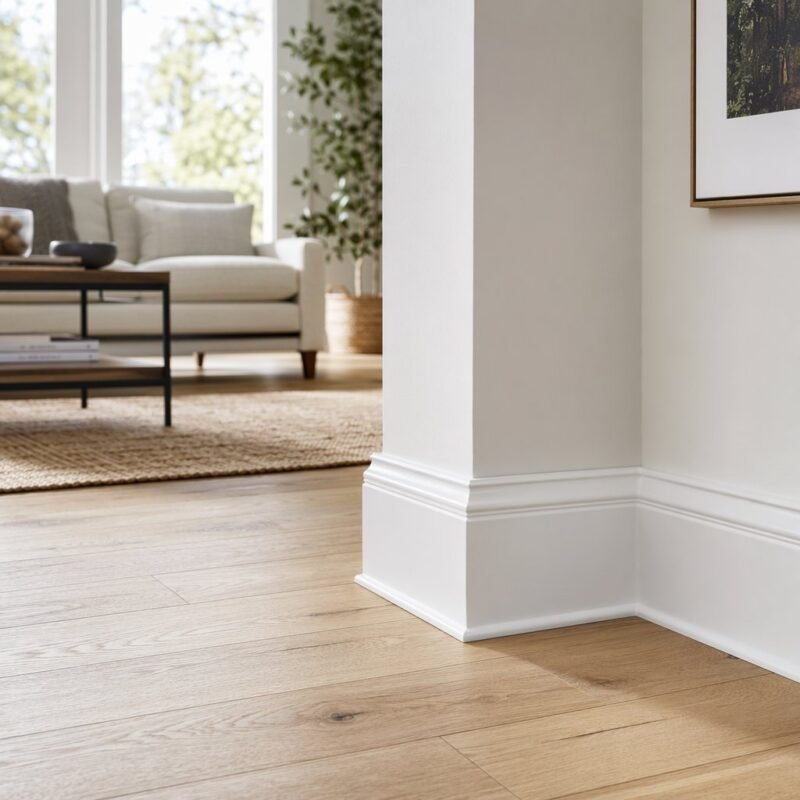

Baseboards and flooring rarely get chosen at the same time, which is how most mismatches happen. The flooring goes in, someone picks a baseboard that was on sale, and six months later the room feels slightly off in a way that’s hard to explain. Choosing baseboards to match flooring doesn’t have to be this complicated — the pairing rules are straightforward once you understand what you’re actually trying to achieve, adds TRI Property Pros team.
The goal is never an exact match. It’s coherence — making sure your trim and floor speak the same visual language, whether that means matching tones, creating intentional contrast, or letting one element anchor the other.
Matching Baseboard Material to Your Flooring Type
The flooring material in a room should be the first thing that guides your baseboard selection. Different floor types pair naturally with different baseboard materials, and understanding that relationship is the fastest way to avoid a mismatch.
Hardwood and engineered wood floors are the most forgiving. They work with painted MDF baseboards (the most common residential choice), solid wood stained to complement the floor, or wood painted white. According to the standard residential baseboard profile guide, MDF is now the dominant material in new construction because it holds paint crisply and resists splitting at corners — advantages solid wood doesn’t always offer at the same price point.
Luxury vinyl plank (LVP) and laminate floors present a specific challenge: they tend to have cooler, more synthetic undertones. Painted white or off-white baseboards are almost always the right call here, because a stained wood baseboard can clash with the artificial grain patterns common in these products. If you want the look of a stained wood baseboard with LVP, choose a floor with convincingly warm tones first, then match the baseboard stain closely.
Tile floors in kitchens and bathrooms typically call for painted baseboards rather than wood, partly for moisture resistance and partly because the clean lines of painted trim read better next to the geometric repetition of tile. Rubber or vinyl cove base is also a practical option in wet areas where water could wick behind a wood baseboard.
| Flooring Type | Best Baseboard Material | Best Finish | Notes |
|---|---|---|---|
| Hardwood / Engineered Wood | MDF or solid wood | Painted or stained | Both options work; stained adds warmth, painted adds contrast |
| Luxury Vinyl Plank (LVP) | MDF | Painted (white/off-white) | Avoid stained wood, can conflict with synthetic grain patterns |
| Laminate | MDF or PVC | Painted | PVC is more moisture-resistant near transitions |
| Ceramic / Porcelain Tile | MDF or rubber cove base | Painted or resilient | Rubber cove base in wet areas; painted wood elsewhere |
| Carpet | MDF | Painted | Baseboard installs before carpet; gap covered by carpet edge |
The Color Matching Decision: Contrast vs. Continuity
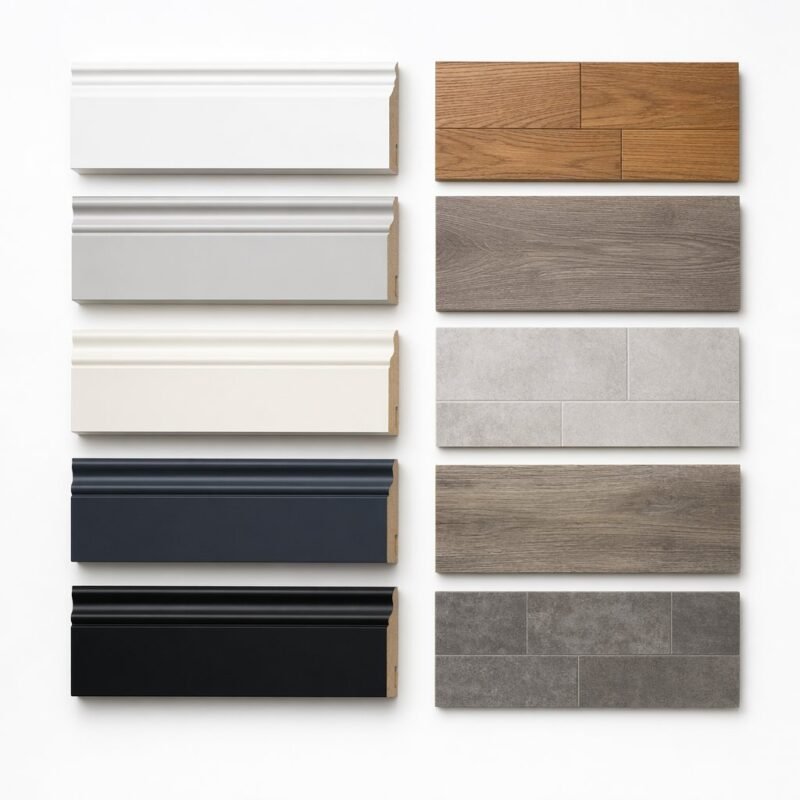
White baseboards with any floor color is the most common pairing, and it’s popular for good reason. White trim creates a clean boundary between wall and floor, reads as architectural detail rather than furniture, and adds apparent height to a room. Benjamin Moore’s White Dove (OC-17) and Sherwin-Williams’ Extra White (SW 7006) are two of the most widely used trim whites precisely because they’re warm enough to avoid a clinical feel while still reading clearly as white against most flooring tones.
The alternative, matching the baseboard tone to the floor, creates a seamless, low-contrast look that makes the room feel larger and more cohesive. This works best with medium-tone hardwoods (like white oak or hickory) and a stained baseboard in a complementary shade. It’s a harder look to pull off well because small color differences between floor and trim become more visible under certain light conditions, not less. If you’re going this route, test the baseboard stain against an actual flooring sample before committing to the full installation.
Dark floors, espresso, jacobean, or ebony stains, typically look best with white or light-painted baseboards. A dark baseboard against a dark floor can make the room feel like a cave, regardless of how much natural light it gets. The visual break of lighter trim prevents that effect and frames the flooring as a feature rather than letting it absorb the entire room.
Height and Profile: Matching Scale to the Space
Baseboard height is often an afterthought, but it has a measurable effect on how proportional a room feels. A standard 3-inch baseboard in a room with 10-foot ceilings can look like it barely exists. Taller rooms generally need taller baseboards, the rule of thumb many designers use is that baseboard height should be roughly 1 inch for every foot of ceiling height, though this is a starting point rather than a hard standard.
Contemporary and minimalist rooms tend to use tall, flat baseboards (5 to 7 inches, no decorative profile) because the clean lines read as intentional rather than default. Traditional or craftsman-style rooms call for baseboards with more pronounced profiles, a base cap molding on top of a taller flat piece is a common way to add visual weight without going to a custom profile. Colonial and Victorian styles push this further with ornate multi-piece assemblies that can run 8 inches or taller.
The flooring finish line also affects height choices in a practical way. LVP and hardwood both have expansion gaps at the wall, which the baseboard covers. If your flooring installers left larger-than-standard gaps (a common occurrence with floating floors in older homes with uneven subfloors), you may need a taller baseboard or a separate quarter-round shoe molding to cover the gap properly. Check this before you order baseboards, it’s far cheaper to buy the right size the first time.
When You’re Renovating vs. Installing From Scratch
The decision-making process looks different depending on whether you already have baseboards or already have flooring installed. When you’re choosing baseboards to match flooring that’s already down, your options narrow considerably, and that’s actually useful: it removes a decision layer and makes the selection faster.
If the baseboards are staying and you’re replacing the floor, your baseboard color and style effectively become constraints. Match the new flooring to what’s already on the wall rather than the other way around, changing baseboards after new flooring is installed is additional labor and cost that most budgets don’t anticipate. Pull an existing baseboard piece to a flooring showroom and test samples directly against it in person.
If you’re installing everything new, the floor is the longer-term decision. Flooring is harder to change and more expensive, so choose it first and let the baseboard selection follow from it. Most paint and trim decisions are relatively easy and inexpensive to revisit in five years; flooring is not.
If you’re inheriting baseboards in a rental or a home you can’t modify, white or off-white wall paint is almost always the best way to reduce visual conflict between mismatched trim and flooring. Paint is the easiest fix when changing the physical materials isn’t an option, and a clean neutral on the walls typically draws attention away from trim-floor mismatches rather than toward them.
Mistakes That Create the Most Visible Problems
The most frequent baseboard mistake isn’t a color problem, it’s skipping the shoe molding. Quarter-round or flat base shoe fills the small gap between the baseboard and the floor surface, and without it, floating floors in particular show obvious daylight at the base of the wall. It’s a small cost and a fast installation, but it’s the difference between a finished look and one that always seems like something is slightly wrong.
The second most common issue is mixing profiles across rooms that open directly onto each other. A chunky colonial baseboard in a living room that transitions into a thin modern profile in an adjacent dining room creates a visual discontinuity that catches the eye every time someone walks between the spaces. If you’re updating part of a house, carry the same baseboard profile through any room that shares a visible transition.
Finally, buying baseboards before installing the flooring and confirming the actual expansion gap is a reliable way to end up short on height. Measure the gap after the floor is down, then size the baseboard accordingly.
Frequently Asked Questions
Do baseboards have to match the flooring color?
Baseboards do not need to match the flooring color, and in most cases they shouldn’t. White or off-white painted trim against any flooring tone is the most versatile and widely used approach. Matching creates a seamless look that can work well but requires careful color sampling to avoid undertone clashes.
What color baseboards go best with dark floors?
White or very light-painted baseboards work best with dark floors. Dark trim against dark flooring tends to make a room feel smaller and heavier. Light trim creates a visual boundary that frames the floor as a design feature and keeps walls from feeling closed in.
Should baseboards match door and window trim?
Yes, baseboards, door casings, and window trim should all use the same color and ideally the same finish. Matching all trim in a room is one of the simplest ways to make a space look professionally finished rather than assembled from separate decisions made at different times.
How tall should baseboards be?
A rough guide is 1 inch of baseboard height per foot of ceiling height, but most residential rooms use 3 to 5 inches. Eight-foot ceilings typically look proportional with 3.5 to 4.5 inch baseboards; rooms with 9- to 10-foot ceilings benefit from 5 to 7 inches. Contemporary rooms lean toward taller flat profiles; traditional rooms use shorter profiles with more decorative molding detail.
Does LVP flooring require special baseboard considerations?
LVP requires a consistent expansion gap of 1/4 inch around all walls, which the baseboard must fully cover. Measure the gap after the flooring is installed, not before, to confirm the baseboard height you need. Adding a flat base shoe molding underneath the baseboard is the easiest way to cover larger-than-expected gaps without replacing the baseboards you’ve already bought.
Painted or stained baseboards: which is better?
Painted baseboards are more versatile, easier to touch up, and work with virtually any flooring type, making them the right choice for most rooms. Stained wood baseboards work best when they’re pairing with solid hardwood floors of a similar species and tone, where the result looks intentionally warm rather than accidental.
The Bottom Line
The simplest decision that’s almost always right: paint your baseboards white (or off-white) and let the flooring carry the color story. That one choice sidesteps the undertone-matching problem, works across every flooring type, and is easy to update later when tastes change.
Where it gets more interesting, and where a room can feel genuinely designed rather than assembled, is when the floor and trim are chosen together from the start, with the ceiling height and room style informing profile and height as well. That kind of coordination shows up not as any single dramatic detail, but in how a space reads as finished and considered rather than just functional.
For rooms with engineered wood flooring, white painted MDF trim is typically the most practical starting point. For rooms where the vinyl plank flooring installation is already done, check the expansion gap first, then size the baseboard accordingly.

Most Viewed