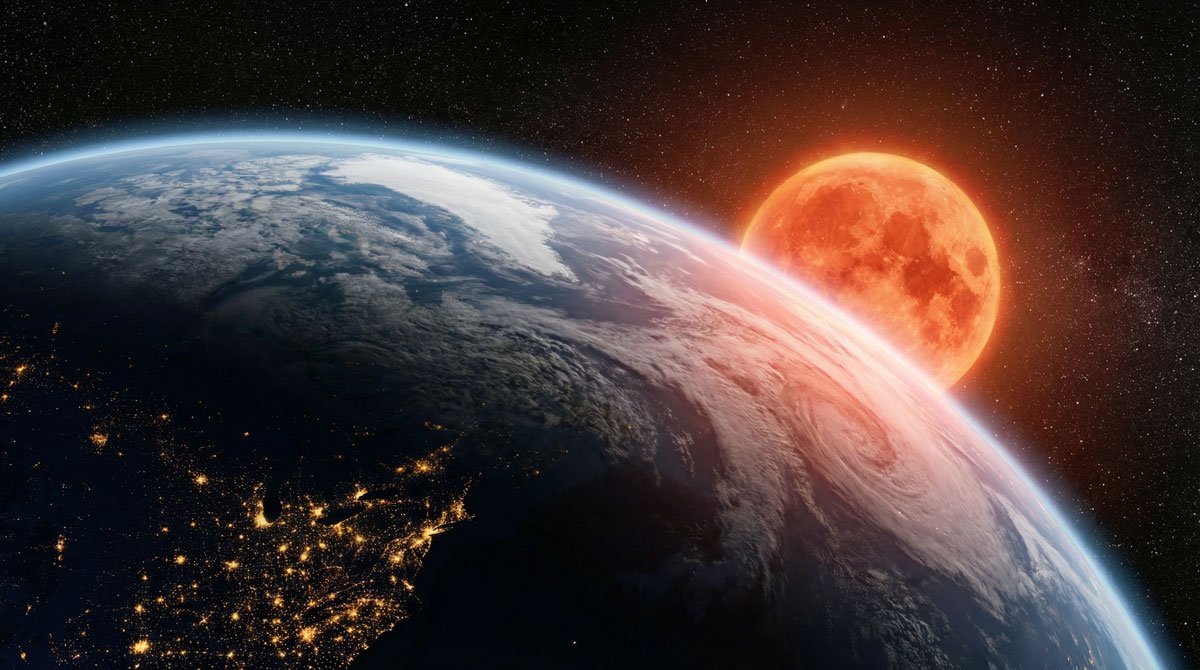

Like every living thing, our planet has an expiration date. It’s a staggering, almost unbelievable thought. While we navigate our daily lives, a cosmic clock is ticking, counting down to a scientifically predicted finale billions of years from now. This is the ultimate, inevitable farewell to life on Earth, a grand story written in the stars and governed by the unyielding laws of physics.
This article is your comprehensive guide to that grand, complex story. We will journey through the scientific timeline of Earth’s inevitable end, explore the sudden cosmic catastrophes that could rewrite our fate, and confront the role we play in our own survival. Prepare to explore the what, when, and why of our planet’s final days, and what it truly means to contemplate the end of life on Earth.
The Grand Timeline: Earth’s Inevitable Expiration Date
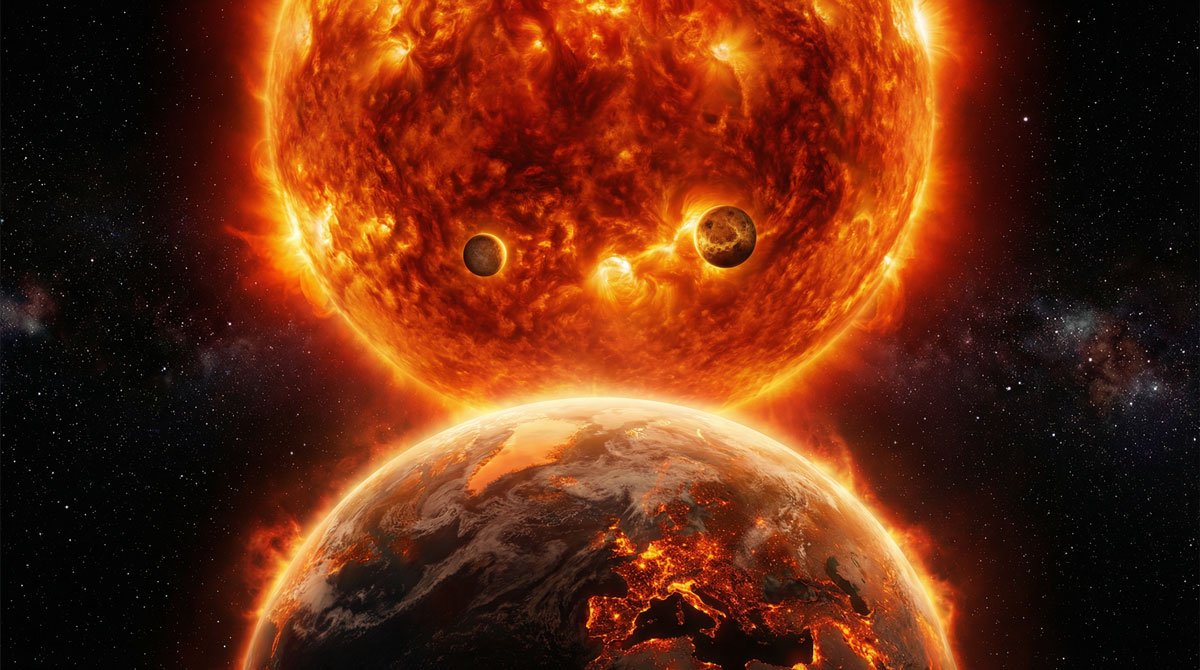
Our planet’s ultimate fate is inextricably linked to its star. The Sun, a brilliant sphere of hot gas that has nurtured life for eons, is the engine of our world. But it is also a ticking clock, subject to the same cycle of birth, life, and death as everything else in the cosmos. As it ages, its luminosity steadily increases, setting in motion a slow, irreversible process that will eventually render Earth uninhabitable. This is the most certain of all extinction scenarios.
This isn’t a sudden catastrophe you might see in a disaster movie. It’s a slow burn, a planetary transformation unfolding over hundreds of millions of years. The process begins with the Sun’s increasing brightness, which will trigger a series of devastating environmental shifts. This long, drawn-out farewell is a fundamental consequence of stellar evolution, a destiny that cannot be avoided. Understanding this timeline is key to grasping the ultimate context of our existence.
To help visualize this immense cosmic journey, we’ve compiled the key milestones of Earth’s final chapter. This table outlines the planet’s slow descent from a vibrant, living world to a barren, scorched rock, based on the most current and robust scientific models.
| Time from Now (Approx.) | Key Event | Primary Cause & Consequence |
|---|---|---|
| ~600 Million Years | C3 Photosynthesis Fails | The Sun’s increasing luminosity accelerates the weathering of silicate minerals, which traps atmospheric CO2. Levels eventually drop too low for the majority of Earth’s plant life (which use C3 photosynthesis) to survive, causing a collapse at the base of the food chain. |
| ~1 Billion Years | Oceans Begin to Evaporate | Now roughly 10% brighter, the Sun’s intense radiation will heat the planet to a point where the atmosphere becomes a “moist greenhouse.” The oceans will begin to boil away into space, marking the point of no return for liquid water on the surface. |
| ~1.3 Billion Years | Surface Becomes Uninhabitable | With the oceans gone and temperatures soaring, the average global surface temperature will reach a blistering 80°C (176°F). Life as we know it, especially complex multicellular organisms, cannot survive these conditions. |
| ~2-3 Billion Years | Magnetic Field May Collapse | Earth’s liquid outer core, which generates our protective magnetic field, is predicted to solidify. Without this shield, the planet will be defenseless against the solar wind, which will strip away any remaining atmosphere and volatiles. |
| ~4 Billion Years | Runaway Greenhouse Effect | The planet’s temperature will spiral out of control, creating conditions more extreme than modern-day Venus. The surface will become hot enough to melt rock, ensuring the final sterilization of the planet. All remaining life, even the hardiest microbes, will perish. |
| ~7.5 Billion Years | Earth is Engulfed by the Sun | The Sun, having exhausted the hydrogen fuel in its core, will swell into a massive red giant. Its outer layers will expand beyond Earth’s current orbit, engulfing and vaporizing our planet completely. This is the final, definitive farewell to life on Earth. |
Cosmic Roulette: Other Ways the World Could End
While the Sun’s evolution guarantees a slow, methodical demise, it is not the only threat on the cosmic horizon. The universe is a dynamic and often violent place. Earth navigates a cosmic shooting gallery, where random, cataclysmic events could trigger a much more sudden and unpredictable farewell to life on Earth. These scenarios are a matter of probability rather than certainty, but their consequences would be just as final.
Asteroid and Comet Impacts
We have seen this movie before, and it does not end well for the incumbents. Sixty-six million years ago, a city-sized asteroid struck the Yucatán Peninsula, plunging the world into darkness and ending the 150-million-year reign of the dinosaurs. This cataclysmic event, while devastating, paved the way for mammals—and eventually us—to rise. The geological record shows that major impacts occur roughly every 100 million years. It’s a terrifying game of chance we are destined to play again. A large enough impactor, such as a major asteroid like Vesta or a long-period comet, could possess enough kinetic energy to boil the upper layers of the oceans and sterilize the planet in a flash.
Gamma-Ray Bursts (GRBs)
Imagine the most powerful explosion in the universe since the Big Bang. A gamma-ray burst, the death cry of a massive star or the collision of two neutron stars, could be pointed directly at us. Though these events are rare, a GRB originating within a few thousand light-years of Earth would be catastrophic. A blast lasting just ten seconds could shred our ozone layer, Earth’s vital shield against harmful solar radiation. The consequences would be a brutal, one-two punch. First, unfiltered UV rays would decimate marine life, including the phytoplankton that form the base of the oceanic food chain and produce much of our oxygen. Second, the energy would create nitrogen oxides in the atmosphere, forming a reddish-brown smog that would block sunlight and trigger a rapid, planet-wide ice age.
Planetary Deoxygenation
Our oxygen-rich atmosphere, the very air we breathe, is not a permanent feature of our world. It is a biological product, maintained by life itself. Earth’s deep history holds a chilling precedent: the Late Ordovician mass extinction, around 450 million years ago. During this period, a sudden, dramatic drop in atmospheric and oceanic oxygen levels, possibly triggered by global cooling and glaciation, wiped out over 80 percent of marine species. This demonstrates that Earth’s life-support system can fail. Frighteningly, some climate models warn that as the Sun’s output continues its slow, inexorable increase, a similar deoxygenation event is inevitable in about a billion years. This process could suffocate the planet in as little as 10,000 years, a geological blink of an eye.
The Human Factor: A Self-Inflicted Farewell?
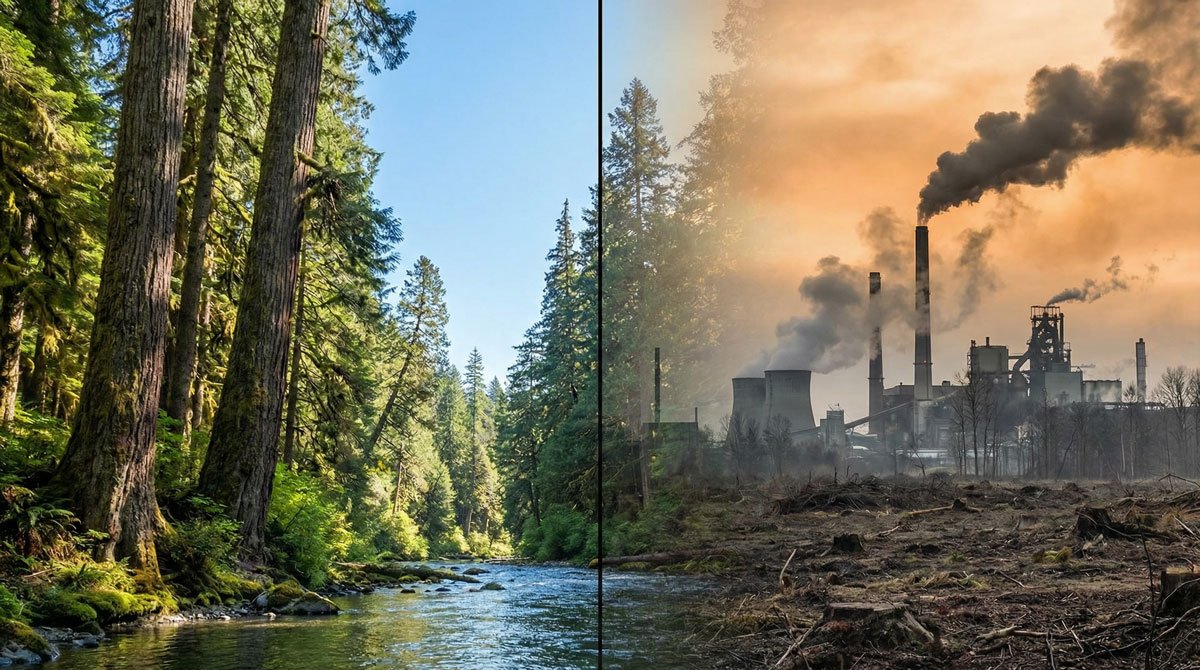
The cosmic timeline unfolds over billions of years, a scale almost beyond human comprehension. But a more immediate, unsettling question has emerged from our own actions. Are we, humanity, forcing a premature farewell? We have entered the Anthropocene, a proposed geological epoch defined by our own staggering impact on Earth’s systems. Our industrial civilization, powered by burning millions of years of stored sunlight in the form of fossil fuels, has fundamentally altered the climate, erased habitats, and triggered what many scientists call the sixth mass extinction event.
This self-inflicted crisis is what led the brilliant physicist Stephen Hawking to issue one of his most stark warnings. He believed that our long-term survival depended on leaving our home planet, viewing our planetary challenges not just as environmental problems, but as symptoms of a deeper existential threat. His perspective reframes the farewell to life on Earth as a choice, not just a distant fate.
“Spreading out may be the only thing that saves us from ourselves. I am convinced that humans need to leave Earth.”
— Stephen Hawking
This raises a profound, and for many, a disturbing cosmic question: Are intelligent civilizations destined to self-destruct? This is the core of the “Great Filter” theory. First proposed by economist Robin Hanson, the theory suggests that somewhere between the origin of life and the ability to colonize other star systems, a barrier exists that is incredibly difficult for life to overcome. The filter could be the jump to multicellular life, the development of intelligence, or, perhaps most chillingly, the period after a civilization develops technology powerful enough to destroy itself. By creating technologies that can reshape a planet, a civilization may inevitably sow the seeds of its own demise. Our current global struggle with climate change, nuclear proliferation, and resource depletion could be humanity’s great filter in action.
Beyond Earth: Humanity’s Audacious Escape Plan
Faced with the certainty of an eventual planetary farewell, humanity has conceived its most ambitious project yet: becoming an interplanetary species. The idea of space colonization, once the domain of science fiction, is now a serious and tangible goal for national space agencies and visionary private companies alike. It represents our ultimate insurance policy against extinction, a way to ensure the continuity of human consciousness regardless of Earth’s fate.
The barren, red plains of Mars are the primary target for this grand endeavor. Organizations like NASA and SpaceX are actively developing the next generation of technologies needed to send humans to our neighboring planet, not just for a fleeting visit, but to stay. From fully reusable super-heavy-lift rockets like Starship to advanced life support systems and plans for creating self-sustaining habitats using local Martian resources, the dream of a permanent Martian colony is slowly but surely moving toward reality. This is humanity’s audacious attempt to cheat fate and continue its story among the stars.
However, the challenges are monumental, almost beyond comprehension. We are creatures of Earth, exquisitely evolved over millions of years to thrive in its specific gravity, its dense, oxygen-rich atmosphere, and under the protection of its powerful magnetic field. Surviving, let alone building a thriving civilization, on a hostile world like Mars—with its thin atmosphere, deadly radiation, and extreme temperatures—requires overcoming immense technological, biological, and psychological hurdles. For the foreseeable future, we remain utterly and completely dependent on the intricate, life-sustaining web of our home planet’s biosphere.
This grand vision of escaping to the stars serves as a powerful, and perhaps necessary, mirror. As we look outward for a new home, it forces us to recognize the profound, irreplaceable value of the one we already have. Perhaps the greatest legacy of our quest for the stars will be a renewed, desperate commitment to protecting the pale blue dot we call home. The farewell to life on Earth may be inevitable in the cosmic long run, but a premature departure of our own making is not.
Frequently Asked Questions
- 1. When will all life on Earth truly end?
- The final, absolute end for all life on Earth is predicted to occur in about 4 billion years. At this point, the Sun’s increasing heat will trigger a runaway greenhouse effect, boiling the oceans and making the surface hotter than Venus. The planet itself will likely be consumed by the Sun around 7.5 billion years from now.
- 2. What is the most likely way life on Earth will end?
- The most certain and scientifically accepted scenario is the slow, natural evolution of our Sun. Over the next billion years, its increasing luminosity will cause Earth’s oceans to evaporate and its atmosphere to be stripped away, gradually wiping out all life long before the Sun becomes a red giant.
- 3. Can humans survive without Earth?
- Currently, no. Humans are completely dependent on Earth’s complex biosphere for breathable air, water, food, and protection from cosmic radiation. While space colonization is a long-term goal, the technology to create a self-sustaining, independent human civilization off-world does not yet exist and is likely centuries away.
- 4. Will humanity ever colonize other planets?
- It is a serious ambition for organizations like NASA and SpaceX, with Mars being the primary target. However, the challenges—including radiation, lack of a breathable atmosphere, and immense logistical difficulties—are enormous. While it may be possible in the distant future, it is not a viable solution to our immediate planetary problems like climate change.
- 5. What did Stephen Hawking mean about leaving Earth?
- Stephen Hawking warned that humanity’s long-term survival depends on becoming a multi-planetary species. He argued that threats like climate change, nuclear war, or engineered pandemics make staying on a single planet far too risky. He urged us to begin exploring other star systems as an ultimate insurance policy for the human race.
A Farewell That Defines Us
The story of Earth’s end is written on a cosmic scale, a definitive farewell billions of years in the making. It is a humbling reminder of our place in the universe, a small, temporary outpost of life in the vastness of space and time. Yet, it is also a story that is being shaped right now, in our time, by our choices. The distant, astronomical certainty of our planet’s demise forces us to confront the more immediate, self-inflicted challenges we face in the Anthropocene.
Ultimately, contemplating this grand farewell gives our present moment profound and urgent meaning. Our innate drive to explore the cosmos and our moral responsibility to protect our only home are two sides of the same coin. How we navigate this dual challenge—looking to the stars while caring for the ground beneath our feet—will define the legacy of our civilization. What we do today, in the face of both near-term crises and an ultimate cosmic end, is what truly matters. The final farewell to life on Earth is inevitable, but the dignity and wisdom with which we approach it is entirely up to us.

Most Viewed