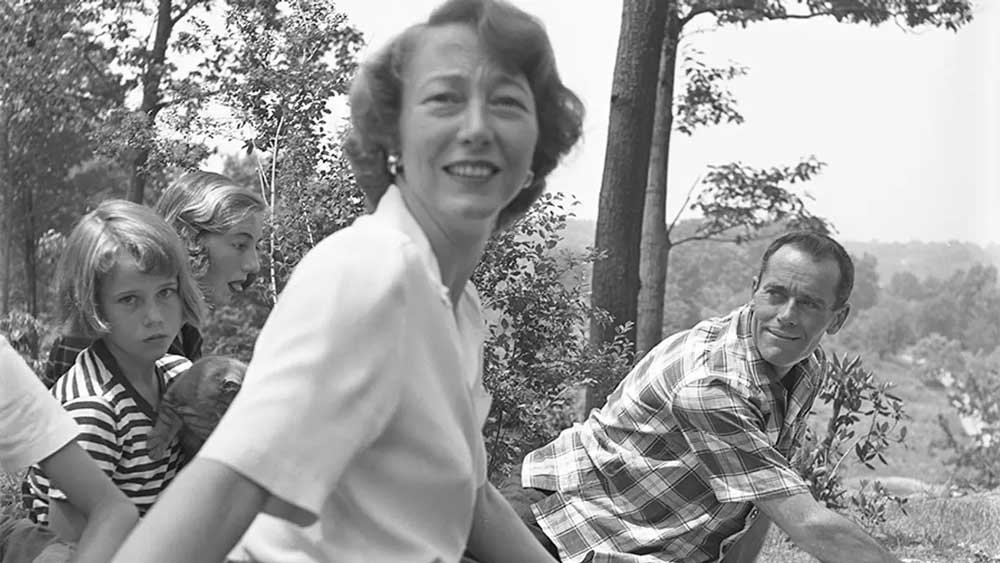

The year was 1952, and Henry Fonda was accepting the “Stage Father of the Year” award. He spoke warmly of his children, Jane and Peter, the future stars of Hollywood. But in the family photos often shown from that era, a third child is always present, a quiet, blonde girl who seems to hover at the edge of the frame. She was never mentioned. It is a striking omission that speaks volumes about the life she would choose to lead.
This forgotten figure was Frances de Villers Brokaw, the daughter of Fonda’s second wife, Frances Ford Seymour, from her first marriage. Born into a world of immense wealth and social standing, her life was a complex tapestry woven with Manhattan aristocracy and Hollywood tragedy [1]. She was an heiress who became a painter, a woman who actively chose a life of quiet anonymity over the relentless glare of the spotlight.
This is not just the story of Jane Fonda’s half-sister. It is the story of a woman who carved out her own identity far from the family drama. We will explore her early life, her artistic career in Rome, and the profound, yet private, legacy she left behind.
The Gilded Cage: Early Life and the Brokaw Legacy
Frances was born on October 10, 1931, into a world of unimaginable privilege [2]. Her father, George Tuttle Brokaw, was a wealthy New York lawyer and sportsman, a man whose family owned a mansion on the Upper East Side. Her mother, Frances Ford Seymour, was a Canadian-American socialite. They were, by all accounts, American royalty.
The family nicknamed her “Pan,” a playful moniker that belied the seriousness of her inheritance. Her father died tragically in 1935 when he stumbled into a swimming pool at a sanitarium [3]. This sudden loss left the young Frances as an independently wealthy child, a multi-million dollar heiress before she was even a teenager [4].
By the age of 14, she had inherited a significant monthly income and a share of the multi-million dollar Brokaw corporations. This financial independence would later give her the freedom to choose her own path, a profound luxury her famous half-siblings, Jane and Peter, did not share. Her wealth was a shield, allowing her to step away from the public life that would consume the Fondas.
Surviving the “Fonda Curse”: A Life Defined by Resilience
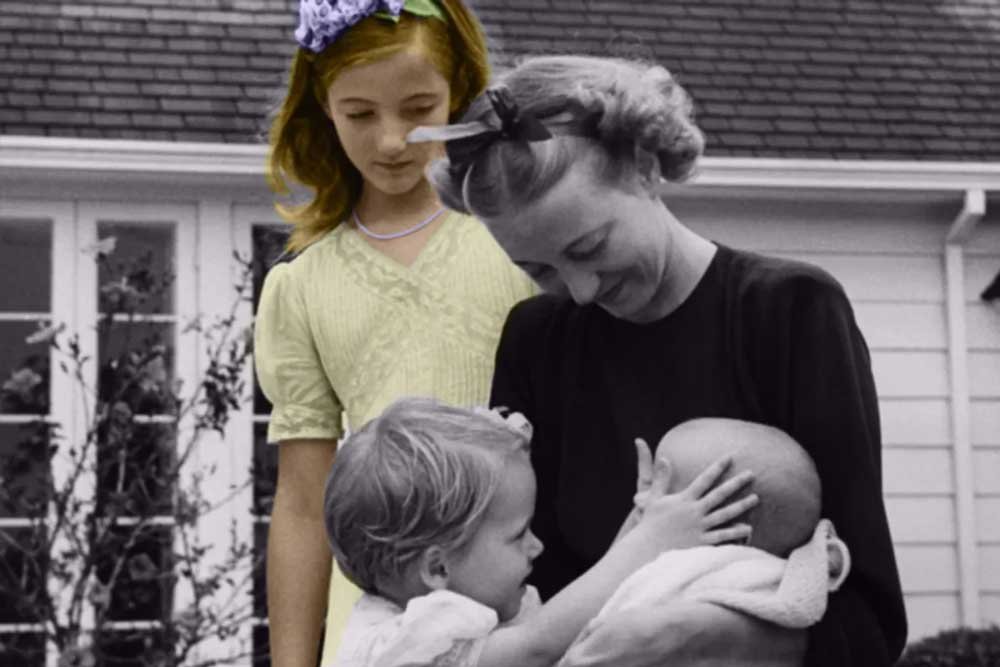
Frances’s childhood was marked by a series of devastating personal tragedies. Her mother, Frances Ford Seymour, married Henry Fonda in 1936, bringing Frances into the tumultuous Fonda household [5]. The marriage was deeply unhappy and ended when Henry Fonda requested a divorce.
In 1950, her mother committed suicide by slitting her throat in a mental institution, a horrific event that shocked the world [6]. Just a few years earlier, Frances had also lost her half-sister, Ann Clare Brokaw, in a fatal car accident [7]. These events cast a long, dark shadow over her formative years.
While Jane and Peter Fonda would later process their trauma in the public eye, Frances chose a different path. She sought refuge in privacy, a quiet resilience that defined her adult life. She married Charles Leo Abry briefly in 1949 [8], but her true escape lay across the Atlantic, a decisive break from the painful memories of her American past.
The Rome Chapter: Finding Identity in Art
Frances found her true home and purpose in Italy. She married her second husband, Francesco Corrias, an Italian diplomat, and settled in Rome [9]. This move was a deliberate, physical break from the “Fonda Curse” and the relentless celebrity machine. She traded the drama of Hollywood for the quiet, ancient beauty of the Eternal City.
In Rome, she became an accomplished painter, dedicating herself to her art. Her life was one of quiet creation, far removed from the gossip columns and Hollywood premieres [10]. She was no longer just an heiress or a sister; she was an artist in her own right, finding her voice on the canvas.
The Artist’s Palette: A Life in the Roman Art Scene
Frances de Villers Brokaw Corrias, as she was known, worked until her death in 2008. She primarily worked in watercolors and held exhibitions when she was younger. She chose to let her canvases speak for her, rather than her celebrity connections. This was her final, powerful act of self-determination, a life built on personal passion rather than inherited fame.
The Legacy Continues: From Frances to Pilar Corrias
Frances’s most visible legacy today is her daughter, Pilar Corrias, a highly respected gallerist in London [11]. Pilar has credited her mother’s artistic life in Rome as a profound influence. The quiet painter’s passion for art was passed down, shaping a new generation in the global art world. It is a beautiful, quiet continuation of Frances’s artistic spirit.
Frances died peacefully in Rome on March 10, 2008, at the age of 77 [12]. Her half-sister, Jane Fonda, attended the funeral, a final, quiet acknowledgment of their shared, complicated history. Frances had successfully navigated a life of immense privilege and profound tragedy, ultimately choosing the simple, fulfilling life of an artist.
Comparison: Two Sisters, Two Paths
The lives of the two half-sisters offer a fascinating study in contrast. Both were shaped by the same family trauma, yet their responses to it were diametrically opposed. One chose the stage, the other the studio. One chose the spotlight, the other the shadow.
| Feature | Frances de Villers Brokaw (The Private Artist) | Jane Fonda (The Public Activist) |
|---|---|---|
| Primary Identity | Painter, Heiress, Diplomat’s Wife | Actress, Activist, Fitness Guru |
| Life Location | Rome, Italy (primarily) | Hollywood, New York (global) |
| Approach to Trauma | Retreat, Privacy, Artistic Expression | Public Advocacy, Therapy, Memoir |
| Financial Status | Inherited Wealth (Heiress) | Earned Wealth (Career) |
| Legacy | Artistic Influence (via daughter, Pilar Corrias) | Cultural Icon, Political Activism |
Frequently Asked Questions (FAQ)
- 1. Was Frances de Villers Brokaw related to Henry Fonda?
- Frances was Henry Fonda’s stepdaughter, not his biological child. Her mother, Frances Ford Seymour, married Henry Fonda in 1936 after the death of Frances’s biological father, George Tuttle Brokaw.
- 2. Why was she called “Pan”?
- “Pan” was a childhood nickname given to Frances de Villers Brokaw. While the exact origin is not widely documented, it was a common way for the family to refer to her in private, a name that stuck from her early years.
- 3. What happened to her inheritance?
- Frances inherited a substantial fortune from her father, George Tuttle Brokaw, and his family’s estate. This wealth provided her with lifelong financial independence, allowing her to pursue her artistic career in Rome without financial pressure.
- 4. Did she have children?
- Yes, Frances de Villers Brokaw had at least one daughter, Pilar Corrias, who is a well-known and successful contemporary art gallerist based in London. Her daughter continues her artistic legacy.
- 5. How did she die?
- Frances de Villers Brokaw Corrias died peacefully in Rome on March 10, 2008, at the age of 77. She had lived a quiet life as a painter in Italy for many years, successfully avoiding the public scrutiny that plagued her family.
Conclusion & Call to Action
Frances de Villers Brokaw was never a mystery to herself. She was a woman who, despite being born into a whirlwind of celebrity and tragedy, made a conscious decision to live life on her own terms. Her quiet strength and dedication to art in Rome stand as a powerful testament to personal resilience. She proved that the most meaningful legacies are often the ones built in silence, far from the noise of fame.
Do you know of other famous figures who chose privacy over the spotlight? Share your thoughts in the comments below.
References
- Frances Ford Seymour – Wikipedia
- Frances Ford Seymour – Wikipedia
- George Tuttle Brokaw – Wikipedia
- Jane Fonda’s Mystery Sister: 4 Facts About Frances de Villers Brokaw – Decider
- Frances Ford Seymour – Wikipedia
- Frances Ford Seymour – Wikipedia
- Jane Fonda’s Mystery Sister: 4 Facts About Frances de Villers Brokaw – Decider
- George Tuttle Brokaw – Wikipedia
- George Tuttle Brokaw – Wikipedia
- London Gallerist Pilar Corrias on Why She Chose to… – Artnet
- London Gallerist Pilar Corrias on Why She Chose to… – Artnet
- Frances Sophia De Villers Brokaw Corrias (1931-2008) – Find a Grave Memorial

Most Viewed