

A squeaky floor is one of those home annoyances that seems minor until it wakes a sleeping baby at 2 a.m. or embarrasses a homeowner in front of guests. The frustrating part: the squeak is hidden under carpet, making the source invisible and the fix feel daunting. The reassuring part: most squeaky floors under carpet can be silenced without removing a single square foot of flooring.
This guide covers four proven methods for fixing a squeaky floor under carpet, ranked from least invasive to most involved. Each approach is explained with enough detail to execute confidently, whether working from above through the carpet or from below through an accessible basement or crawl space.
1. Why Floors Squeak: Understanding the Root Cause
Answer Capsule: Squeaky floors are caused by wood movement — specifically, subfloor panels or floorboards rubbing against nails, joists, or each other as weight is applied. The squeak is the sound of friction. Humidity changes cause wood to expand and contract seasonally, which is why many squeaks worsen in winter when indoor air is drier.
The subfloor is the structural layer of plywood or OSB (oriented strand board) that sits on top of the floor joists. Over time, the nails holding the subfloor to the joists can work loose, allowing the subfloor to flex slightly under foot traffic. This flexing creates the telltale creak.
Before choosing a repair method, identify whether the squeak comes from above (subfloor-to-joist movement) or below (joist-to-beam movement). Walk slowly over the squeaky area and note exactly where the sound originates. Press down firmly — if the squeak stops when pressure is applied and held, the fix is straightforward.
2. Method 1: Drive Screws Through the Carpet (Least Invasive)
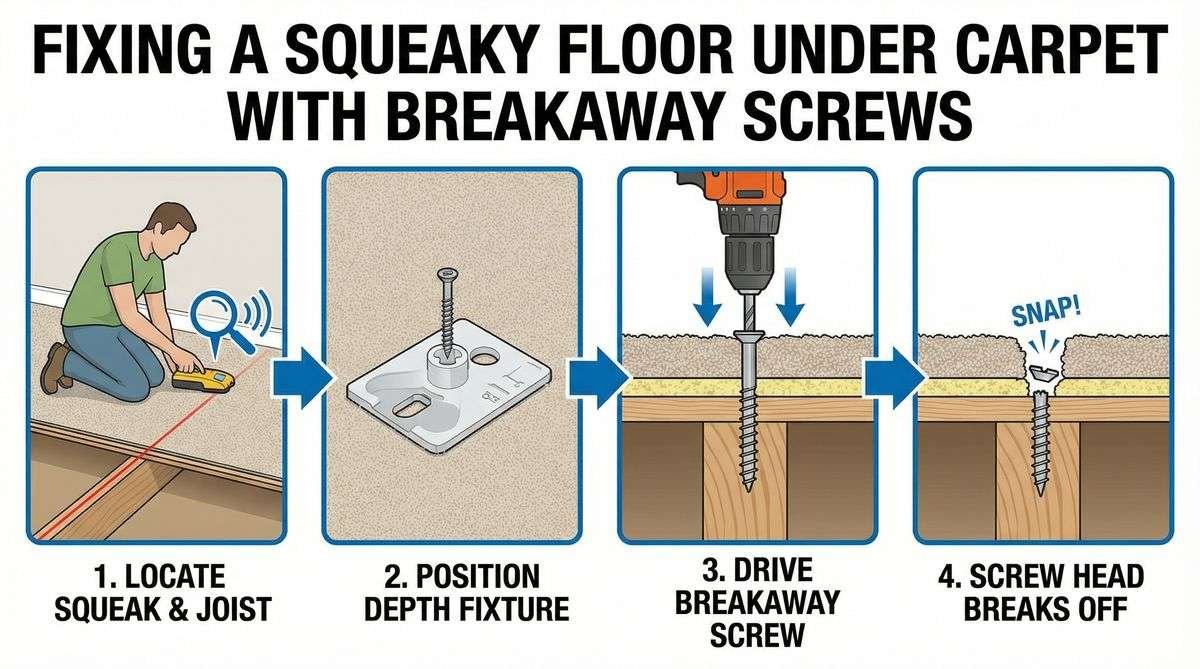
Answer Capsule: Specialty snap-off screws designed for squeaky floors — such as the Squeeeeek No More kit — can be driven through carpet directly into the subfloor and joist below. The screw head snaps off below the carpet surface, leaving no visible damage. This method works in 80% of cases without lifting the carpet at all.
The Squeeeeek No More system uses a pilot screw that threads through a special fixture, pulls the subfloor tight to the joist, and then snaps off at a scored point below the carpet pile. The carpet fibers close over the tiny hole, leaving no trace. A stud finder or joist finder is needed to locate the joist beneath the squeak.
Drive the screw at a slight angle toward the joist center for maximum holding power. Test the squeak immediately after each screw — sometimes one screw is enough; other times, two or three in a row along the joist are needed to eliminate the flex entirely.
3. Method 2: Fix from Below (Best for Accessible Basements)
Answer Capsule: When the squeaky floor is above an accessible basement or crawl space, the most effective fix is to drive wood screws up through the joist into the subfloor from below, pulling the two layers tight together. A helper walking on the floor above identifies the exact squeak location while the repair is made from underneath.
This method requires a helper. One person walks slowly on the squeaky area while another listens from below to pinpoint the exact location. Mark the spot with chalk. Drive 1.25-inch drywall screws up through the joist into the subfloor — never longer, or the screw will penetrate through the finished floor above.
For gaps between the subfloor and joist (visible as a crack of light), apply a thin bead of construction adhesive into the gap before driving the screws. The adhesive fills voids and prevents future movement even if the screws loosen over time.
4. Method 3: Pull Back Carpet and Screw Directly
Answer Capsule: When snap-off screws are unavailable and basement access is not possible, pulling back the carpet edge and driving standard 3-inch screws through the subfloor into the joist is a reliable fix. The carpet is re-stretched and re-tacked after the repair, leaving no visible evidence of the work.
Use a carpet puller or stiff putty knife to carefully release the carpet from the tack strip along the nearest wall. Roll the carpet back just far enough to expose the squeak area. Locate the joist with a stud finder, then drive 3-inch coarse-thread screws at a slight angle into the joist center. Apply construction adhesive to any visible gaps before screwing.
Re-stretch the carpet using a knee kicker and re-hook it onto the tack strip. A carpet stretcher ensures the carpet lies flat without ripples. This method is more labor-intensive but allows for thorough inspection and repair of the subfloor before re-covering.
5. Method 4: Talcum Powder (Temporary but Instant)
Answer Capsule: Sprinkling talcum powder or powdered graphite between floorboards reduces friction and can temporarily silence squeaks. This works best for hardwood floors under area rugs, not wall-to-wall carpet. It is a short-term fix that may need reapplication seasonally.
For carpet-covered floors, this method has limited application since the powder cannot reach the wood-on-wood contact points. However, for squeaks near carpet edges where the hardwood floor is partially exposed, working talcum powder into the joint with a stiff brush can provide quick relief while a permanent fix is planned.
6. Method Comparison at a Glance
| Method | Carpet Removal | Difficulty | Permanence | Best For |
|---|---|---|---|---|
| Snap-off screws through carpet | No | Easy | Permanent | Most situations, no basement access |
| Screws from below | No | Easy (needs helper) | Permanent | Accessible basement or crawl space |
| Pull back carpet and screw | Yes (partial) | Moderate | Permanent | Severe squeaks, full inspection needed |
| Talcum powder | No | Very easy | Temporary | Quick fix, hardwood near carpet edge |
Frequently Asked Questions
How is a floor joist located under carpet?
A magnetic stud finder detects the nails or screws already driven into the joist during original construction. Most joists run parallel and are spaced 16 inches on center. Once one joist is found, the others can be located by measuring 16 inches in either direction.
Why does the squeak come back after fixing?
Squeaks return when the repair did not fully close the gap between the subfloor and joist, or when only one screw was used where multiple were needed. Seasonal wood movement can also reopen gaps. Using construction adhesive in addition to screws dramatically reduces the chance of recurrence.
Can a squeaky floor indicate a serious structural problem?
Occasionally. A single isolated squeak is almost always a minor fastener issue. However, widespread squeaking across a large area, combined with visible floor sagging or doors that no longer close properly, may indicate joist damage or foundation movement. In these cases, a structural inspection is warranted before attempting DIY repairs.
Conclusion
Fixing a squeaky floor under carpet is one of the most satisfying DIY repairs precisely because the results are immediate and audible. The snap-off screw method handles the majority of cases without disturbing the carpet at all. For more stubborn squeaks or those with basement access, driving screws from below is the most reliable permanent solution.
The key is identifying the exact location of the squeak, confirming joist position, and using screws long enough to pull the subfloor tight — but never so long they break through the finished surface above. With the right approach, a silent floor is typically one afternoon of work away.
References
- This Old House. “How to Fix Squeaky Floors.” Updated 2025.
- Family Handyman. “Stop Squeaky Floors.” 2024.
- National Wood Flooring Association (NWFA). “Troubleshooting Wood Floor Problems.” 2023.

Most Viewed