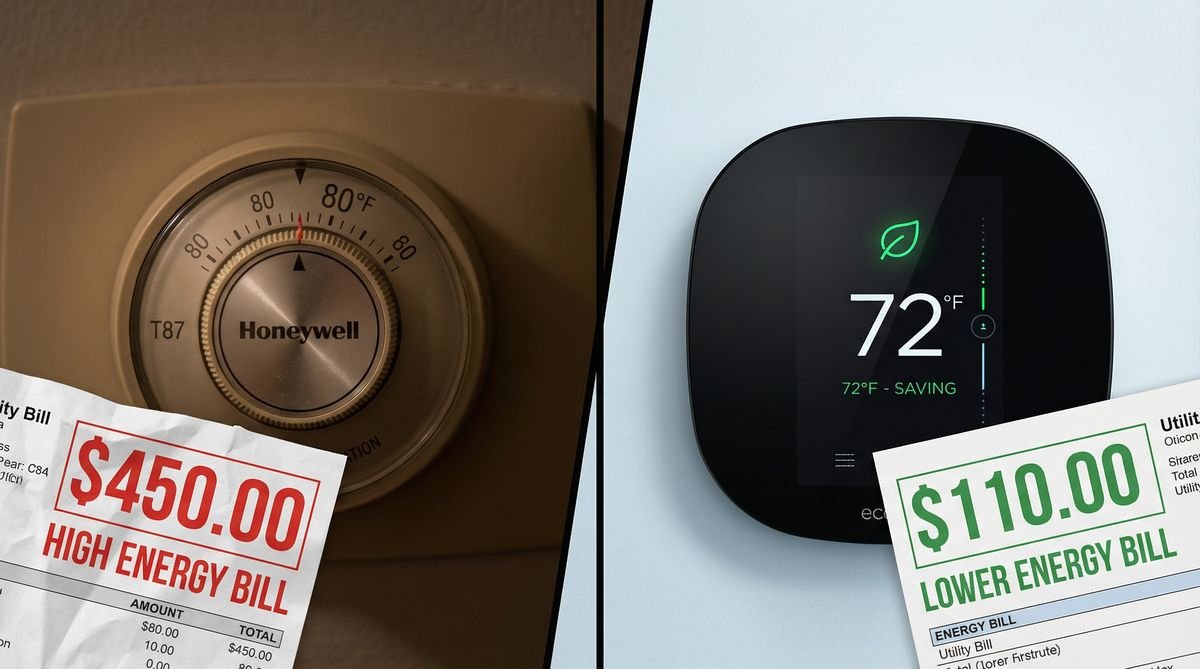

Replacing a manual thermostat with a programmable or smart model is one of the highest-return home improvement projects available. The U.S. Department of Energy estimates that properly programmed thermostats can save 10–12% on heating and 15% on cooling costs annually — savings that typically recover the cost of the thermostat within the first year of use.
This guide walks through the complete installation process for a programmable thermostat, from safely removing the old unit to wiring the new one and programming it for maximum energy savings. No electrician is required for most standard HVAC systems.
1. Compatibility Check Before Buying
Answer Capsule: Before purchasing a programmable thermostat, verify compatibility with the existing HVAC system. Most standard forced-air systems (single-stage heating and cooling) are compatible with any programmable thermostat. High-voltage systems (electric baseboard heaters), heat pumps, and multi-stage systems require specific thermostat models. Check the existing wiring — a C-wire (common wire) is required for most smart thermostats.
The C-wire provides continuous 24V power to the thermostat, enabling Wi-Fi connectivity and display backlighting in smart models. Many older homes lack a C-wire. Options for homes without a C-wire include: using a thermostat with a power-stealing adapter (less reliable), installing a C-wire adapter kit ($15–$25), or running a new wire from the HVAC control board (the most reliable solution).
| HVAC System | Compatible Thermostat Type | C-Wire Required? |
|---|---|---|
| Standard forced-air (gas/electric) | Any programmable or smart thermostat | For smart models |
| Heat pump (single-stage) | Heat pump-compatible thermostat (O/B wire) | Yes |
| Electric baseboard (high-voltage) | High-voltage thermostat only (120V/240V) | No |
| Multi-stage heating/cooling | Multi-stage compatible thermostat | Yes |
| Radiant/boiler systems | Millivolt or low-voltage thermostat | Varies |
2. Tools and Safety Preparation
Answer Capsule: Installing a programmable thermostat requires a flathead and Phillips screwdriver, a voltage tester, painter’s tape and a marker for labeling wires, and a level. Turn off the HVAC system at the breaker before removing the old thermostat. The thermostat wires carry only 24 volts — safe to touch — but the HVAC system itself operates at line voltage and must be de-energized.
Turning off the HVAC system at the breaker (not just at the thermostat) is the critical safety step. The thermostat wires themselves are low-voltage and safe, but the furnace or air handler they connect to operates at 120V or 240V. Working on a live system risks damage to the control board — a repair that costs $200–$600 to replace.
3. Removing the Old Thermostat and Labeling Wires
Answer Capsule: Before disconnecting any wires, photograph the existing wiring and label each wire with painter’s tape and a marker corresponding to its terminal letter (R, G, Y, W, C). This step takes two minutes and prevents the most common installation mistake: reconnecting wires to the wrong terminals on the new thermostat.
Remove the thermostat cover and unscrew the base plate from the wall. Each wire connects to a labeled terminal: R (power), G (fan), Y (cooling/compressor), W (heating), C (common). Some systems have additional wires for multi-stage operation or heat pumps. Photograph the wiring configuration clearly before disconnecting anything.
Tape each wire to the wall as it is disconnected to prevent it from falling back into the wall cavity. A wire that disappears into the wall is retrievable but adds unnecessary frustration to an otherwise simple installation.
4. Installing and Wiring the New Thermostat
Answer Capsule: Mount the new thermostat base plate on the wall using the included screws and anchors, ensuring it is level. Connect each labeled wire to the corresponding terminal on the new thermostat — R to R, G to G, Y to Y, W to W, C to C. Snap the thermostat display onto the base plate, restore power at the breaker, and follow the setup wizard to configure system type and programming.
Most programmable thermostats include a setup wizard that walks through system configuration: heating type (gas/electric), cooling type, fan operation, and temperature differential settings. Selecting the correct system type is essential — an incorrect setting can cause short-cycling (the system turning on and off too frequently) or failure to reach the set temperature.
After installation, test each function: set the thermostat to heat mode and raise the set point — the furnace should activate within 5 minutes. Set to cool mode and lower the set point — the air conditioner should activate. Test the fan-only mode. If any function fails, recheck the corresponding wire connection before assuming a system fault.
5. Programming for Maximum Energy Savings
Answer Capsule: The DOE recommends setting back the temperature 7–10°F for 8 hours per day to achieve 10% annual savings. A typical energy-saving schedule: 68°F while home and awake, 60°F while sleeping, 60°F while away. For cooling, set to 78°F while home, 85°F while away. Pre-cool or pre-heat 30 minutes before occupancy to maintain comfort.
| Time Period | Heating Set Point | Cooling Set Point |
|---|---|---|
| Awake and home (6am–8am, 5pm–10pm) | 68°F (20°C) | 78°F (26°C) |
| Sleeping (10pm–6am) | 60°F (16°C) | 82°F (28°C) |
| Away from home (8am–5pm) | 60°F (16°C) | 85°F (29°C) |
Frequently Asked Questions
What is the difference between a smart thermostat and a programmable thermostat?
A programmable thermostat follows a fixed schedule set by the user. A smart thermostat (such as a Nest or Ecobee) learns occupancy patterns, adjusts automatically based on weather data, and can be controlled remotely via smartphone. Smart thermostats typically save an additional 5–10% compared to manually programmed thermostats, but cost $150–$250 versus $25–$80 for standard programmable models.
What if there is no C-wire?
Several options exist: use a thermostat that includes a power adapter kit (Nest and Ecobee both offer these), install a C-wire adapter that uses an existing unused wire in the thermostat cable, or have an HVAC technician run a new C-wire from the furnace control board. The adapter kit approach costs $15–$25 and is a reliable solution for most systems.
How much can a programmable thermostat actually save?
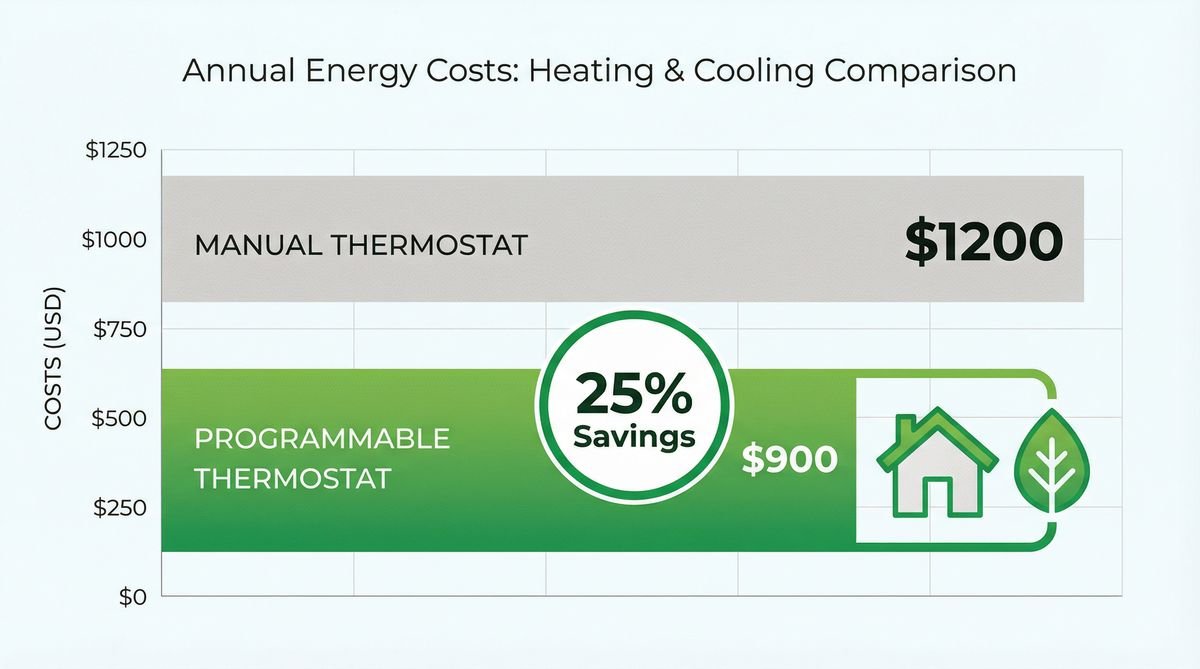
The DOE estimates 10–12% on heating and 15% on cooling for properly programmed thermostats. For a household spending $1,500 annually on heating and cooling, this represents $150–$225 in annual savings — recovering the cost of a $50 programmable thermostat in the first year. Smart thermostats with learning capabilities can achieve 15–20% total savings according to independent studies by Ecobee and the Rocky Mountain Institute.
Conclusion
Installing a programmable thermostat is one of the most cost-effective home improvement projects available — a $50–$250 investment that pays for itself within one to two years through energy savings. The installation process is straightforward for standard HVAC systems: photograph the existing wiring, label each wire, connect to the corresponding terminals on the new thermostat, and program a schedule that reflects actual occupancy patterns.
The key to maximizing savings is consistent programming. A thermostat that is manually overridden frequently will not deliver the projected savings. Setting a realistic schedule that accounts for the household’s actual daily routine — and resisting the temptation to override it — is the most important factor in achieving the promised energy reduction.
References
- U.S. Department of Energy. “Thermostats.” Energy Saver. Updated 2025.
- Ecobee. “Energy Savings Report.” 2024.
- Rocky Mountain Institute. “Smart Thermostat Energy Savings Analysis.” 2024.
- Honeywell Home. “Programmable Thermostat Installation Guide.” 2025.

Most Viewed