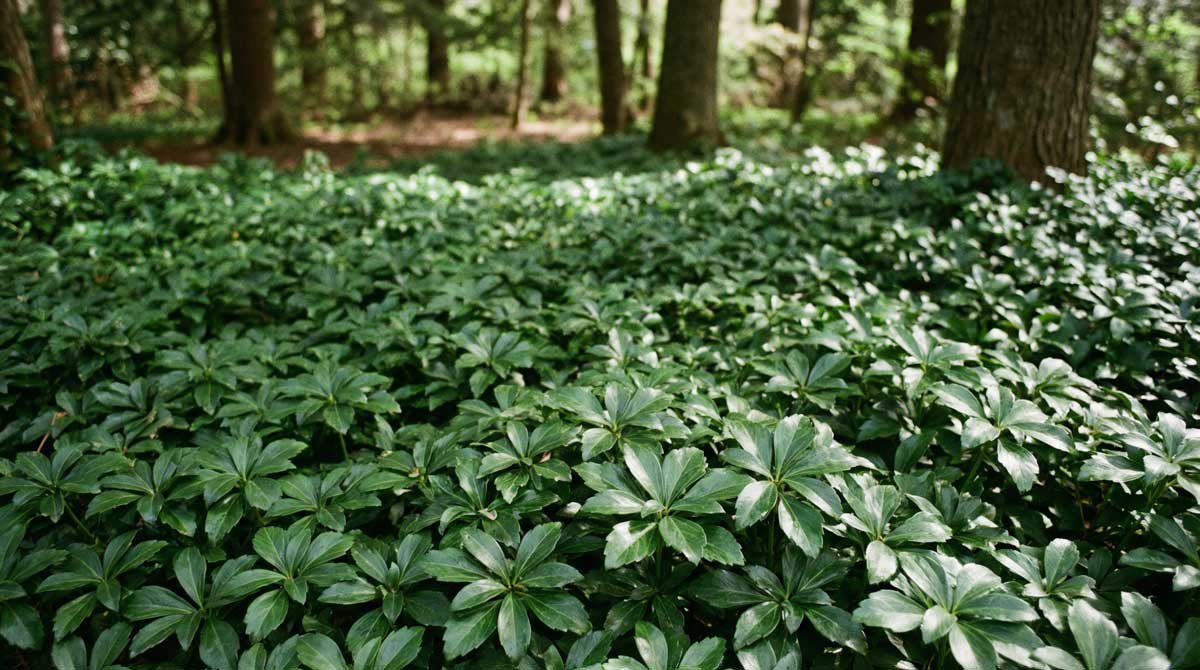

Are you struggling to find a plant that thrives in the shady corners of your garden where nothing else seems to grow? Imagine a lush, evergreen carpet that effortlessly covers those bare spots, suppresses weeds, and stays vibrant year-round with minimal effort. For many gardeners, Japanese pachysandra (Pachysandra terminalis) has been the go-to solution for decades, offering a dense, uniform ground cover that solves numerous landscaping challenges.
However, its vigorous growth and potential for invasiveness raise important questions. Is it the right choice for your garden? What are the alternatives? This comprehensive guide will not only walk you through every aspect of growing and caring for Japanese pachysandra but also empower you with the knowledge to make an informed, ecologically responsible decision. We will delve into its landscape applications, compare it to native species, analyze its cost-effectiveness, and provide a detailed seasonal care calendar. By the end of this article, you will be a true expert on this popular but complex plant.
What is Japanese Pachysandra?
Japanese pachysandra, also commonly known as Japanese spurge or carpet box, is a low-growing, evergreen perennial that belongs to the boxwood family (Buxaceae). Native to Japan, Korea, and northern China, it has become a landscaping staple in temperate climates worldwide, particularly in North America. It typically reaches a height of 6 to 12 inches and spreads indefinitely via underground stems called rhizomes, forming a dense, weed-suppressing mat of foliage.
The plant is prized for its glossy, dark green, diamond-shaped leaves that are arranged in attractive whorls at the top of the stems. This foliage remains evergreen, providing year-round interest, though it may yellow slightly in harsh winter conditions. In early spring, it produces small, fragrant white flowers on short spikes, which add a delicate, though often overlooked, ornamental touch.
Its popularity stems from its remarkable resilience and adaptability. Japanese pachysandra is exceptionally shade-tolerant, capable of thriving in deep shade where turfgrass and other plants fail. It is also deer-resistant, drought-tolerant once established, and adaptable to a range of soil types, including heavy clay. These characteristics make it a powerful problem-solver for challenging areas in the landscape.
Japanese Pachysandra vs. Native Alternatives
While Japanese pachysandra offers many benefits, its aggressive spreading habit has led to it being classified as invasive in several regions, particularly in the eastern United States. It can escape cultivation and form dense monocultures in natural woodlands, outcompeting and displacing native flora that local wildlife depends on. This ecological concern has prompted many gardeners to seek out native alternatives.
The most notable native alternative is Allegheny spurge (Pachysandra procumbens). Native to the southeastern United States, it offers a similar aesthetic but with a much more well-behaved growth habit. It spreads slowly via rhizomes and is not considered invasive. Its leaves are more matte than glossy and often feature attractive silvery mottling, providing a different textural quality. Understanding the differences is crucial for responsible gardening.
| Feature | Japanese Pachysandra (P. terminalis) | Allegheny Spurge (P. procumbens) |
|---|---|---|
| Origin | Native to Japan, Korea, China | Native to the Southeastern U.S. |
| Growth Habit | Highly aggressive spreader, can be invasive | Slow, clumping spreader, well-behaved |
| Foliage | Glossy, dark green, evergreen | Matte, blue-green, often mottled, semi-evergreen |
| Flowers | Fragrant white flowers on upright terminal spikes | Fragrant white/pinkish flowers on spikes from the base |
| Hardiness | USDA Zones 4-8 | USDA Zones 5-9 |
| Ecological Impact | Can displace native plants, low wildlife value | Supports local ecosystems, higher wildlife value |
| Maintenance | Requires containment to prevent unwanted spread | Low maintenance, does not require containment |
When to choose which: If you need to cover a large, contained area quickly and are not in a region where it is considered invasive, Japanese pachysandra can be an effective choice. However, for most residential gardens, and especially for those near natural woodlands, Allegheny spurge is the superior, ecologically responsible option that provides similar benefits without the risk.
Planting Guide: Step-by-Step
Proper planting is the foundation for establishing a healthy, thriving bed of pachysandra. Following these steps will ensure your plants get the best possible start.
Choosing the Right Location
Location is everything for pachysandra. It thrives in partial to full shade, such as under the canopy of large trees or on the north side of a building. While it can tolerate some morning sun, direct afternoon sun will cause the leaves to scorch and turn yellow. The ideal site is one that receives less than four hours of direct sunlight per day.
Soil Preparation
Pachysandra prefers moist, well-drained, acidic soil (pH 5.5 to 6.5) rich in organic matter. Before planting, it is highly beneficial to amend the soil. Clear the area of all weeds and turfgrass. Then, spread a 2- to 4-inch layer of organic compost, peat moss, or well-rotted leaf mold over the entire bed and work it into the top 6-8 inches of soil. This improves drainage, aeration, and nutrient content, creating an ideal growing environment.
Planting Instructions
Pachysandra is typically sold in flats as small, rooted plants (plugs) or in small pots. The best time to plant is in the spring or early fall, which allows the roots to establish before the stress of summer heat or winter cold.
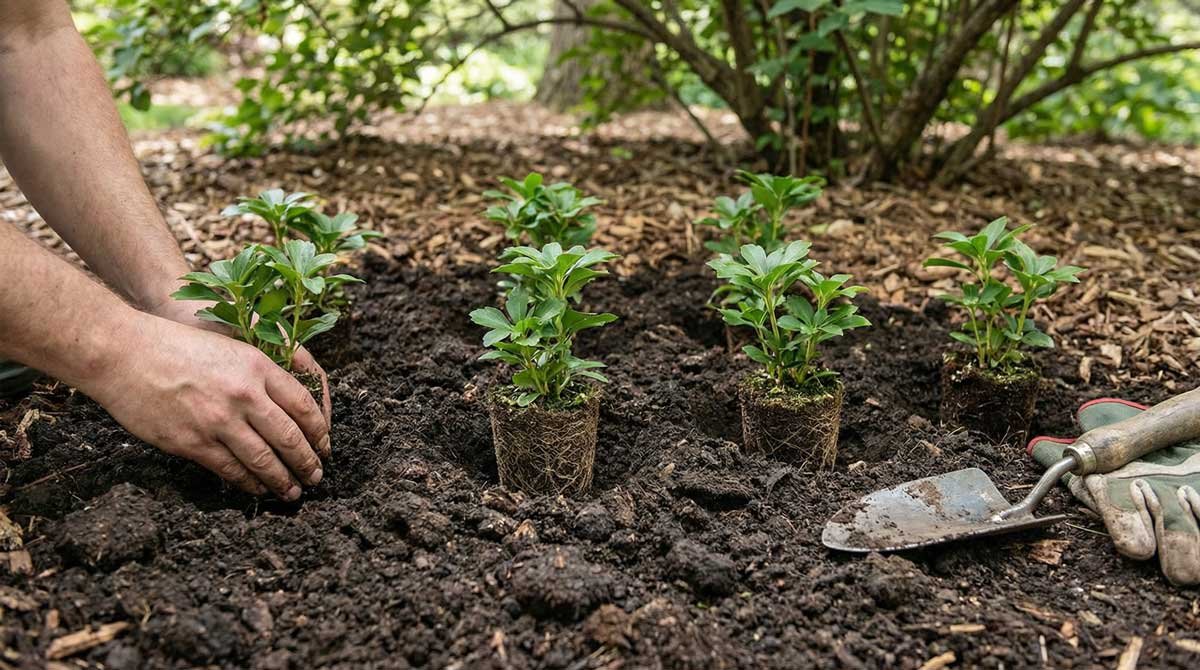
Spacing: For dense coverage, space individual plants 6 to 12 inches apart. A closer spacing of 6-8 inches will result in a filled-in look within 2-3 years, while a 12-inch spacing may take 3-4 years.
Digging: Dig a hole for each plant that is twice as wide as the root ball and just as deep.
Planting: Gently remove the plant from its container and place it in the hole, ensuring the top of the root ball is level with the surrounding soil. Planting too deep can lead to stem rot.
Backfilling: Fill the hole with the amended soil, gently firming it around the root ball to eliminate air pockets.
Initial Watering and Mulching
Immediately after planting, water the entire bed thoroughly to settle the soil and hydrate the roots. Apply a 1- to 2-inch layer of organic mulch, such as shredded bark or leaf mold, around the plants. Mulch helps conserve soil moisture, suppress weeds while the pachysandra fills in, and regulate soil temperature.
Complete Care and Maintenance
Once established, Japanese pachysandra is famously low-maintenance, but a few key practices will keep it looking its best and ensure it remains healthy and contained.
Watering Requirements
During the first growing season, provide about 1 inch of water per week if rainfall is insufficient. This is crucial for developing a strong root system. Once established, pachysandra is quite drought-tolerant, especially in shady locations. You will likely only need to water during extended periods of drought.
Light and Shade Management
This plant is a true shade lover. If overhanging tree limbs are removed, exposing the pachysandra bed to more direct sun, you may notice yellowing or scorching. If possible, try to maintain the shady conditions it prefers.
Fertilizing Schedule
Pachysandra is not a heavy feeder. In most cases, the annual decomposition of fallen leaves from overhead trees provides sufficient nutrients. If your soil is poor or growth seems lackluster, you can apply a balanced, slow-release granular fertilizer formulated for acid-loving plants (like one for rhododendrons or azaleas) in the early spring.
Pruning and Thinning
Pruning is not strictly necessary, but it can rejuvenate an older patch or encourage denser growth. In early spring, you can mow the entire bed with a lawnmower set to its highest setting (4-6 inches). This will remove any winter-damaged foliage and stimulate a flush of new, lush growth. You can also use hedge shears for this task. To control its spread, install a root barrier or annually edge the bed with a spade to sever and remove any escaping rhizomes.
Seasonal Care Calendar
| Season | Task | Description |
|---|---|---|
| Early Spring | Pruning & Fertilizing | Mow or shear old foliage before new growth begins. Apply a balanced, slow-release fertilizer if needed. |
| Late Spring | Weed & Edge | Remove any weeds that have emerged. Edge the bed to maintain clean lines and control spread. |
| Summer | Watering | Water deeply during prolonged droughts, especially for newly planted beds. |
| Fall | Leaf Management | Rake heavy accumulations of fallen leaves off the bed to prevent matting and fungal disease. A light layer can be left as natural mulch. |
| Winter | Monitor | In areas with little snow cover, some foliage may experience winter burn. This is usually cosmetic and can be pruned in spring. |
Pest and Disease Management
While generally robust, Japanese pachysandra can be susceptible to a few specific problems, particularly when stressed or grown in poor conditions.
Common Pests
The most significant pest is the Euonymus scale. These tiny, armored insects attach to the stems and leaves, sucking the plant’s juices and causing yellow spots, leaf drop, and dieback. To manage scale, prune out heavily infested areas to improve air circulation and apply horticultural oil during the crawler stage (typically in late spring) to smother the insects.
Fungal Diseases
Volutella leaf blight is the most serious disease affecting pachysandra. It starts as tan or brown blotches on the leaves, which expand and develop concentric rings. Cankers can form on the stems, causing entire sections of the plant to wilt and die. This disease thrives in damp, humid conditions.
Prevention and Treatment
Prevention is the best defense against disease. Ensure good air circulation by thinning dense patches if necessary. Avoid overhead watering; use a soaker hose or drip irrigation to water at the soil level. Rake up and destroy fallen leaves and debris. If blight occurs, prune out and destroy all infected plants and apply a fungicide labeled for Volutella blight according to package directions.
Propagation Methods
One of the easiest ways to expand your pachysandra patch or start a new one is through propagation. This can be done through division or stem cuttings.
Division Method
Division is best done in the spring. Simply dig up a clump of established plants, ensuring you get a good section of the root system. Use a sharp spade or knife to divide the clump into several smaller sections, each with plenty of roots and top growth. Replant these divisions immediately at the desired location and water them in well.
Stem Cuttings
In late spring or early summer, take 3- to 4-inch cuttings from the tips of healthy stems. Remove the leaves from the lower half of the cutting and dip the cut end in rooting hormone. Insert the cuttings into a pot filled with a moist, sterile potting mix. Cover the pot with a plastic bag to maintain high humidity and place it in a bright, indirect light. Roots should form in 4-6 weeks.
Success Rates and Timeline
Both methods have very high success rates. Division is the fastest way to get established plants, while cuttings are a good way to produce a large number of new plants from a small amount of source material. You can expect propagated plants to begin spreading and filling in during their second growing season.
Landscape Design Applications
Beyond being a simple ground cover, Japanese pachysandra can be a versatile tool in landscape design when used thoughtfully.
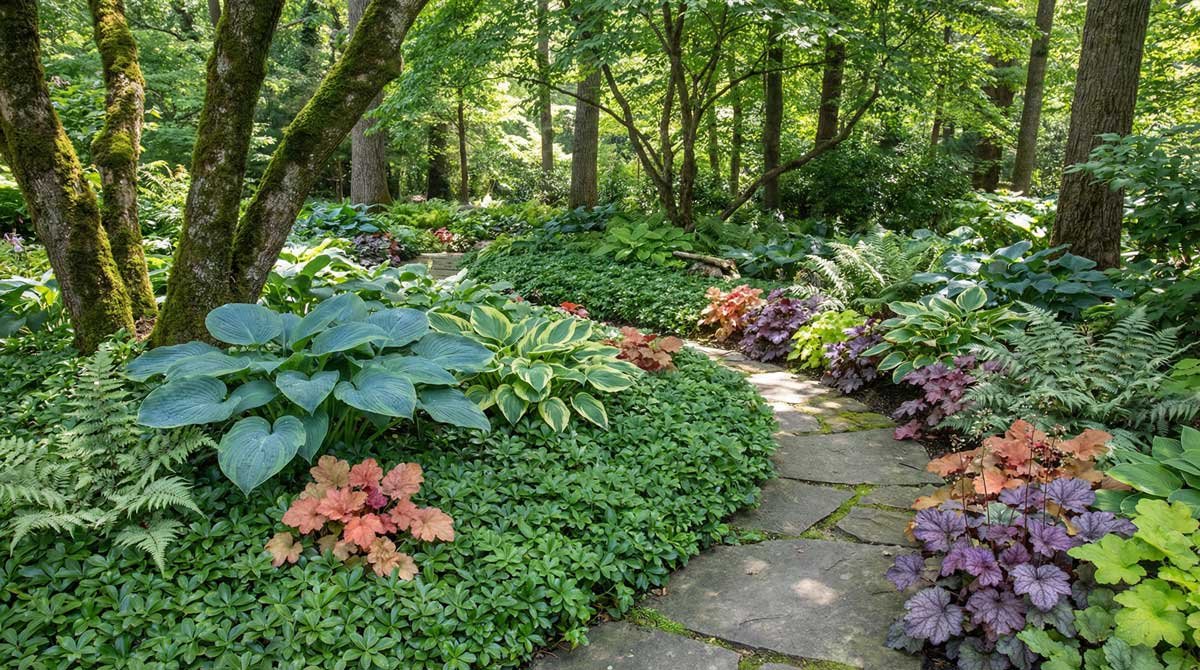
Shade Garden Design
Pachysandra creates a perfect uniform, fine-textured green canvas that makes an excellent backdrop for other shade-loving plants. Its glossy leaves contrast beautifully with the broad foliage of Hostas, the delicate fronds of Ferns, and the colorful blooms of Heucheras (Coral Bells) and Astilbes. Use it to create a living mulch that unifies disparate planting elements into a cohesive design.
Erosion Control Solutions
On shaded slopes and banks where it is difficult to establish turfgrass, pachysandra’s dense network of rhizomes and roots is highly effective at stabilizing soil and preventing erosion. Once established, it creates a tough, interlocking mat that holds soil in place even during heavy rainfall.
Border and Edging Ideas
Use Japanese pachysandra to create a formal, evergreen border along shaded walkways, driveways, or patio edges. Its uniform height and dense growth create a clean, tidy line that requires far less maintenance than a traditional lawn edge. It can also be used to define the transition between a woodland area and a more formal garden space.
Real-World Case Studies
Consider the classic use case: a large, mature oak tree that casts deep shade, making lawn growth impossible. Planting Japanese pachysandra under the tree’s canopy not only solves the bare ground problem but also creates a visually appealing, park-like setting that reduces the need for mowing and maintenance around the tree’s sensitive surface roots.
Cost-Benefit Analysis
Investing in a ground cover is a long-term decision. Understanding the costs and benefits associated with Japanese pachysandra is essential for planning and budgeting.
| Cost/Benefit Factor | Japanese Pachysandra | Traditional Turfgrass (in Shade) | Other Ground Covers (e.g., Vinca) |
|---|---|---|---|
| Initial Cost | Moderate (Flats of plugs can be pricey) | High (Seed/sod for shade is expensive) | Moderate to High |
| Establishment Time | 2-3 years for full coverage | 1-2 years, but often fails | 2-4 years |
| Long-Term Maintenance | Low (Edging, occasional thinning) | High (Mowing, fertilizing, aerating) | Moderate (Weeding, containment) |
| Water Needs | Low once established | High | Low to Moderate |
| Weed Suppression | Excellent | Poor in shady conditions | Good to Excellent |
| Durability/Longevity | Very High (Decades) | Low (Often requires reseeding) | High |
Initial Investment: The primary cost is the plants themselves. A flat of 50-100 plugs can range from $50 to $150. For a large area, this can be a significant upfront expense. However, its propagation ease means you can start with a smaller patch and expand it over time for free.
Long-Term Savings: The long-term value is where pachysandra shines. It eliminates the recurring costs and labor associated with mowing, fertilizing, and watering a shady lawn. Its excellent weed suppression also saves countless hours of manual weeding. While it requires annual edging to control its spread, this is a far less intensive task than regular lawn care.
Common Mistakes and Solutions
Even with a tough plant like Japanese pachysandra, gardeners can encounter problems. Here are some common mistakes and how to avoid them.
1. Planting in Too Much Sun: This is the most frequent error. The result is yellow, scorched leaves and stunted growth. Solution: Choose a location with partial to full shade. If the area becomes sunnier over time, consider transplanting the pachysandra or planting a new tree or shrub to create more shade.
2. Poor Drainage/Overwatering: While it likes moist soil, pachysandra hates “wet feet.” Saturated soil leads to root rot and makes the plant vulnerable to Volutella blight. Solution: Amend heavy clay soils with compost to improve drainage before planting. Water deeply but infrequently once established, and always water at the soil level, not overhead.
3. Ignoring Scale Infestations: Scale insects can be inconspicuous at first, but a large infestation can severely weaken or kill a patch. Solution: Regularly inspect the stems and undersides of leaves. At the first sign of scale, prune out the worst-affected areas and treat with horticultural oil.
4. Failing to Control Spread: Underestimating its vigor can lead to pachysandra invading lawns, garden beds, and even natural areas. Solution: Be proactive. Install a root barrier (at least 8 inches deep) around the bed or commit to edging the patch with a spade every spring to keep it in bounds.
Japanese Pachysandra Varieties
Several cultivars of Pachysandra terminalis are available, offering subtle variations in appearance and growth.
| Variety | Key Features | Best For |
|---|---|---|
| ‘Green Carpet’ | More compact, uniform, and slightly shorter than the species. Very dense growth. | Creating a very neat, formal, carpet-like effect. |
| ‘Green Sheen’ | Exceptionally glossy leaves that look perpetually wet and polished. | Adding a textural highlight and reflecting light in dark corners. |
| ‘Variegata’ | Slower growing with creamy white edges on the leaves. | Brightening up very dark, shady spots and providing color contrast. |
Frequently Asked Questions (FAQ)
- 1. Is Japanese pachysandra really invasive?
- It depends on your location. In several U.S. states, particularly in the Mid-Atlantic and Northeast, it is listed as invasive because it can escape gardens and harm local ecosystems. Always check your local invasive species list before planting. In many other areas, it is considered aggressive but manageable within a garden setting.
- 2. How do you get rid of Japanese pachysandra?
- Removal can be difficult due to its extensive rhizome system. Small patches can be dug out manually, but you must be diligent in removing all root fragments. For larger areas, you can cover the patch with heavy cardboard and a thick layer of mulch for a full growing season (sheet mulching). As a last resort, a systemic herbicide can be effective, but should be used with caution.
- 3. Can you walk on Japanese pachysandra?
- It is not tolerant of foot traffic. Occasional stepping on it won’t kill it, but it is not a lawn substitute and will become damaged and patchy under regular traffic. Use stepping stones for paths through a pachysandra bed.
- 4. Why are my pachysandra leaves turning yellow?
- The most common cause is too much direct sunlight. Other causes can include nutrient deficiency (less common) or the initial stages of a scale infestation. Assess the light conditions first.
- 5. How fast does Japanese pachysandra spread?
- Once established (after the first year), a single plant can spread 6-12 inches in a year. A well-planted bed will typically achieve full, dense coverage in 2-4 years, depending on the initial spacing.
- 6. Is pachysandra toxic to dogs or cats?
- According to the ASPCA, Japanese pachysandra is non-toxic to dogs, cats, and horses. However, consuming any plant in large quantities can cause mild gastrointestinal upset.
- 7. Does pachysandra attract ticks?
- No more than any other ground cover. Ticks prefer moist, shaded environments, which can include pachysandra beds. However, the plant itself does not specifically attract them. Maintaining clean edges and keeping the area free of excessive leaf litter can help reduce tick habitat.
- 8. What is the difference between pachysandra and vinca (periwinkle)?
- Both are aggressive, shade-tolerant ground covers. Pachysandra has upright, fleshy stems and whorled leaves, while Vinca minor is a vining plant with pairs of leaves along its stems. Vinca also has prominent blue or purple flowers and can be even more aggressive and difficult to control than pachysandra.
- 9. Can I plant pachysandra under a black walnut tree?
- Yes. Japanese pachysandra is tolerant of the chemical juglone, which is exuded by black walnut trees and is toxic to many other plants. This makes it an excellent ground cover choice for this notoriously difficult situation.
- 10. Do I need to rake leaves off my pachysandra?
- A light layer of leaves will decompose and provide natural nutrients. However, a thick, heavy mat of leaves (like from an oak or maple tree) should be gently raked off in the fall to prevent it from smothering the plants and promoting fungal diseases over the winter.
Conclusion and Call to Action
Japanese pachysandra remains a powerful and effective tool in the gardener’s arsenal, unmatched in its ability to create a lush, evergreen carpet in deep shade. Its low maintenance needs, deer resistance, and weed-suppressing power make it an attractive solution for many landscape challenges. However, its potential for invasiveness cannot be ignored. By understanding its growth habits, considering native alternatives like Allegheny spurge, and committing to responsible containment if you do choose to plant it, you can harness its benefits while minimizing its risks.
Whether you are designing a new shade garden, looking for an erosion solution, or simply trying to solve a bare spot under a mature tree, you now have the expert knowledge to proceed with confidence. Choose wisely, plant correctly, and enjoy the enduring green beauty that a well-managed ground cover can provide.

Most Viewed