
Table of Contents
ToggleEarly Life and Musical Foundation (1882-1909)
Leopold Stokowski’s life began shrouded in a mystery of his own making. While his official birth certificate confirms he was born Leopold Anthony Stokowski in London on April 18, 1882, he often cultivated an image of a more exotic, Eastern European origin. This narrative, suggesting a Polish or even Pomeranian background, was part of a carefully constructed persona designed to add a touch of mystique to his artistic identity, a practice encouraged by his first wife, pianist Olga Samaroff.
His father was a cabinet-maker of Polish descent, and his mother was of Irish origin. This mixed heritage gave him a plausible claim to a more continental European identity, which he used to his advantage in a world where such a background was often seen as a mark of artistic authenticity. The name itself, Stokowski, is a Polonised version of a Lithuanian name, adding another layer to his complex identity.
Despite the cultivated accent and ambiguous stories, Stokowski’s prodigious musical talent was undeniable from a very young age. At just 13, he enrolled in London’s Royal College of Music, becoming one of its youngest-ever students. There, he focused on the organ, studying alongside future luminaries like composer Ralph Vaughan Williams. His training as an organist would profoundly influence his later approach to the orchestra, which he treated as a single, massive instrument with a vast palette of tonal colors.
Before dedicating himself to conducting, Stokowski held several prestigious positions as an organist and choirmaster in London, including at St. James’s Church, Piccadilly. In 1905, he moved to New York City to become the organist at St. Bartholomew’s Church, where his captivating performances earned him a significant following. However, his ambition extended beyond the organ loft. He soon left for Paris to immerse himself in the study of conducting, preparing for the next, and most defining, chapter of his career.
The Cincinnati Years: First Innovations (1909-1912)
In 1909, with minimal practical conducting experience but immense self-confidence, Leopold Stokowski secured the position of Music Director for the Cincinnati Symphony Orchestra. He won over the orchestra’s president, Mrs. Christian R. Holmes, through a determined campaign of letters and a personal interview, demonstrating the charisma that would become his trademark.
From the outset, Stokowski’s tenure in Cincinnati was marked by a drive to innovate and broaden the orchestra’s appeal. He introduced the concept of “pops concerts,” offering lighter fare to attract new audiences, a revolutionary idea at the time. More significantly, he began his lifelong crusade as a champion of contemporary music, programming works by living composers like Richard Strauss, Jean Sibelius, and Claude Debussy.
His commitment to new music was unwavering. On November 24, 1911, he conducted the American premiere of Sir Edward Elgar’s Symphony No. 2, a bold move that signaled his intention to make the orchestra a relevant, forward-looking institution. However, his progressive vision soon clashed with the more conservative orchestra board. Frustrated by their resistance and administrative limitations, Stokowski abruptly resigned in April 1912, leaving Cincinnati after just three seasons but having already established himself as a dynamic and audacious force in the American music scene.
The Philadelphia Orchestra Era: Creating the “Philadelphia Sound” (1912-1941)
Just two months after leaving Cincinnati, Leopold Stokowski was appointed the music director of the Philadelphia Orchestra, a position he would hold for nearly three decades and where he would achieve his most enduring fame. When he arrived in 1912, the orchestra was a capable but not yet world-class ensemble. Stokowski transformed it into an instrument of unparalleled virtuosity and sonic beauty.
At the heart of this transformation was the creation of the legendary “Philadelphia Sound.” This signature sonority was characterized by a deep, lush, and seamless string tone, achieved through Stokowski’s insistence on “free bowing.” Instead of having all string players bow in unison, he encouraged them to change bow direction at different times, creating a continuous, organ-like wave of sound. This, combined with his meticulous attention to balance and color, produced a sound that was both opulent and intensely expressive.
Stokowski’s innovations were not limited to sound. He was a radical experimenter, constantly tinkering with the orchestra’s setup to achieve his desired effects. He rearranged the seating of the orchestra, placing the woodwinds and brass in different configurations to alter the blend of sound. He was also notorious for altering the orchestration of the works he conducted, adding or changing instruments to enhance what he felt was the composer’s intent—a practice that horrified purists but thrilled audiences.
Under Stokowski, the Philadelphia Orchestra became the foremost champion of new music in America. He conducted the American premieres of staggering and often difficult works, including Alban Berg’s opera Wozzeck, Arnold Schoenberg’s massive Gurrelieder, and Igor Stravinsky’s revolutionary The Rite of Spring. His commitment to new sounds extended to his role in the founding of the Curtis Institute of Music in 1924, where he helped recruit faculty and ensured a steady stream of top-tier musicians for his orchestra.
The Conducting Technique: Hands Without a Baton
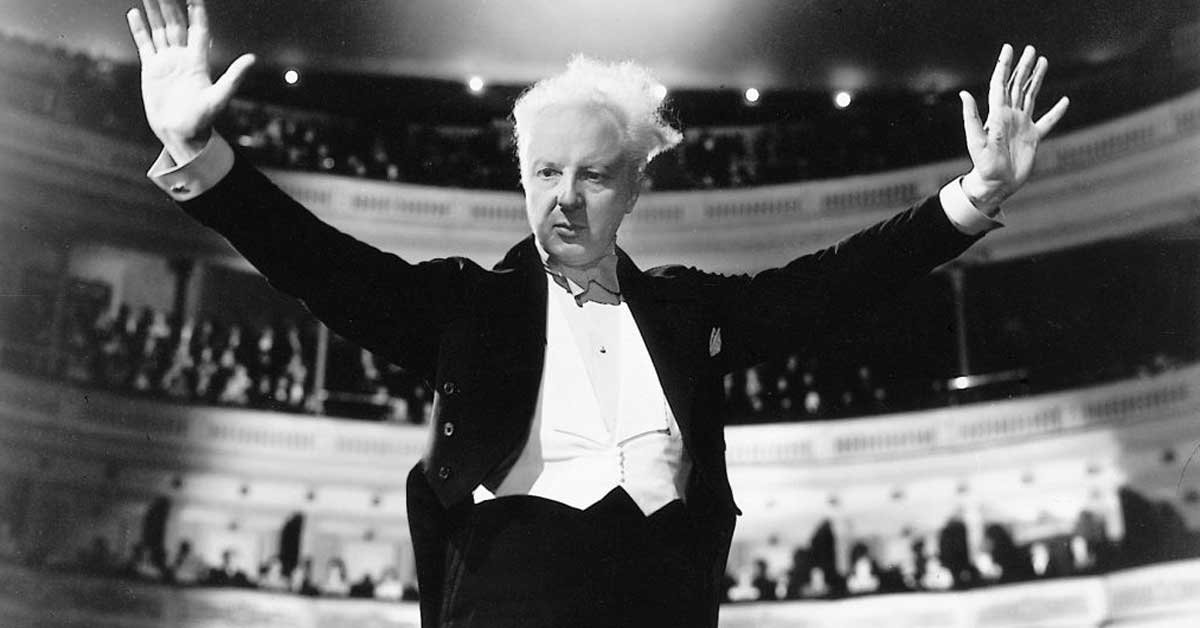
Perhaps the most visually striking aspect of Leopold Stokowski’s artistry was his decision to conduct without a baton. At a time when the baton was the conductor’s universal symbol of authority, Stokowski abandoned it, choosing instead to shape the music with his bare hands. He found the baton to be a rigid and unnecessary barrier between himself and the musicians, preferring the fluidity and expressive potential of his fingers and hands.
His technique was a study in controlled intensity. He used his left hand to sculpt phrases and cue entrances with poetic grace, while his right hand maintained the rhythmic pulse with clarity and precision. His gestures were not flamboyant for showmanship’s sake; they were directly linked to the sound he wanted to produce. A shimmering tremolo in his fingers might elicit a delicate sound from the strings, while a clenched fist could summon a powerful tutti from the full orchestra. This direct, physical connection to the music allowed for an extraordinary level of nuance and emotional depth.
Stokowski also brought a unique theatricality to the concert hall. He experimented with stage lighting, sometimes conducting in near-darkness with only a spotlight on his face and hands, focusing the audience’s attention entirely on the music and its interpretation. This approach was a world away from the metronomic precision of some of his contemporaries.
| Conductor | Approach to Score | Conducting Style | Key Trait |
|---|---|---|---|
| Leopold Stokowski | Interpretive, willing to alter orchestration | Expressive, free-hand, theatrical | The Innovator |
| Arturo Toscanini | Strict fidelity to the printed score | Intense, precise, rhythmically driven | The Purist |
| Wilhelm Furtwängler | Philosophical, focused on underlying structure | Mystical, less rhythmically precise, organic | The Philosopher |
This table illustrates the fundamental differences between Stokowski and his two great rivals. While Toscanini sought to be a faithful servant of the composer’s text and Furtwängler explored the music’s metaphysical depths, Stokowski saw himself as a co-creator, using the score as a blueprint for a vivid, modern sonic experience.
A Champion of Contemporary Music and Innovation
Leopold Stokowski’s belief in musical progress was the driving force of his career. He saw it as his duty to introduce audiences to the music of their own time, no matter how challenging or controversial. Over his 60-year career, he gave the premieres of hundreds of new works, championing composers who were ignored or dismissed by other mainstream institutions.
His list of major premieres is staggering and includes some of the most important works of the 20th century. Beyond Berg, Schoenberg, and Stravinsky, he was an early advocate for Gustav Mahler, conducting the American premiere of his Eighth Symphony, the “Symphony of a Thousand.” He later gave the long-delayed world premiere of Charles Ives’s monumental and notoriously difficult Fourth Symphony in 1965 with the American Symphony Orchestra, a feat other conductors had deemed impossible.
Equally controversial were his own orchestral transcriptions, particularly of the works of Johann Sebastian Bach. His lush, romantic arrangement of the Toccata and Fugue in D minor became his signature piece, beloved by audiences but derided by critics who accused him of sacrilege. For Stokowski, these transcriptions were not a distortion but a translation. He argued that since Bach’s organ works were designed for the grand acoustics of a cathedral, the modern symphony orchestra was the only instrument capable of recreating that sonic grandeur for a concert hall.
Stokowski was also a pioneer in recording technology. He made his first commercial recording with the Philadelphia Orchestra in 1917 for the Victor Talking Machine Company. He embraced the recording process not as a mere documentation of a live performance, but as a distinct art form. He experimented with microphone placement and acoustical setups, working closely with engineers to capture the richness of his orchestral sound on disc, preserving his unique interpretations for future generations.
Hollywood and Popular Culture: Stokowski on Screen
Leopold Stokowski’s quest to bring classical music to the masses led him to the most powerful medium of the 20th century: Hollywood. His most famous collaboration was with Walt Disney on the groundbreaking 1940 animated film Fantasia. Stokowski not only conducted the Philadelphia Orchestra for the soundtrack but also appeared on screen, shaking hands with Mickey Mouse in a silhouette that has become an iconic image of cultural history.
Fantasia was a bold experiment to visualize classical music, pairing works by Bach, Tchaikovsky, and Stravinsky with imaginative animation. Stokowski worked closely with Disney’s team on the film’s innovative multichannel sound system, “Fantasound,” a precursor to stereophonic sound. The film brought classical music to a vast new audience, cementing Stokowski’s status as a household name.
He also appeared in other films, including One Hundred Men and a Girl (1937) and Carnegie Hall (1947), further blurring the lines between high art and popular entertainment. This celebrity status was amplified by his personal life, which was a frequent subject of media attention. His marriages, particularly to the heiress Gloria Vanderbilt, and his rumored romance with the screen legend Greta Garbo, kept him in the public eye, making him as much a celebrity as a musician. This high profile led some critics to dismiss him as a showman, but for Stokowski, it was all part of his mission to make classical music a vital part of modern life.
The American Symphony Orchestra: A Final Legacy (1962-1977)
At the age of 80, when most of his contemporaries were long retired, Leopold Stokowski embarked on one of his most ambitious projects. In 1962, he founded the American Symphony Orchestra (ASO) in New York City. He created the orchestra to fill the void left at Carnegie Hall after the New York Philharmonic moved to Lincoln Center, but his mission was far greater. He wanted to create a world-class orchestra that championed American musicians, offered concerts at affordable prices, and continued his lifelong advocacy for new and unusual repertoire.
With the ASO, Stokowski gave the aforementioned premiere of Ives’s Fourth Symphony, a landmark event in American music history. He continued to program daring and eclectic concerts, mixing familiar classics with neglected masterpieces and works by living composers. He remained committed to his vision of “Music for All of Us” (the title of his 1943 book), ensuring that ASO concerts were accessible to students, families, and anyone curious about classical music.
He remained the music director of the ASO until 1972, when he was 90 years old. He then returned to his native England, but his work was not done. He continued to make recordings, signing a new contract with CBS Records that would have taken him to his 100th birthday. He made his last recording in June 1977, just a few months before his death at the age of 95, a testament to his inexhaustible energy and unwavering devotion to music.
Frequently Asked Questions About Leopold Stokowski
1. Was Leopold Stokowski Polish or British?Leopold Stokowski was born in London, England, to a Polish father and an Irish mother, making him a British citizen by birth. He later became a U.S. citizen. He cultivated a vaguely Eastern European accent and persona for artistic effect, leading to the common misconception about his origins.
2. Why did Stokowski not use a baton?Stokowski believed the baton was a barrier to expression. He found he could communicate more directly and fluidly with the orchestra using only his hands, allowing for greater nuance in shaping musical phrases and dynamics.
3. What is the “Philadelphia Sound”?It is the signature sound of the Philadelphia Orchestra developed under Stokowski, characterized by a rich, warm, and seamless string tone. It was achieved primarily through his technique of “free bowing,” where string players change their bow direction at different times to create a continuous sound.
4. What was Stokowski’s relationship with Walt Disney?Stokowski and Disney collaborated on the 1940 film Fantasia. Stokowski conducted the Philadelphia Orchestra for the soundtrack and was instrumental in the development of the film’s pioneering stereophonic sound system, “Fantasound.”
5. Why is Stokowski sometimes considered less respected than Toscanini?While Stokowski was immensely popular with audiences, some critics and purists disapproved of his willingness to alter orchestrations and his theatrical showmanship. Toscanini, by contrast, was revered for his strict adherence to the composer’s score, representing a different, more literalist artistic philosophy.
6. How many works did Stokowski premiere?Stokowski gave the premieres of hundreds of new works throughout his career, including major compositions by Berg, Schoenberg, Stravinsky, Mahler, and Charles Ives. His commitment to contemporary music was unparalleled among major conductors of his era.
7. What are Stokowski’s most important recordings?His recordings are numerous, but key highlights include his Bach transcriptions, the first American recording of Stravinsky’s The Rite of Spring, the premiere recording of Ives’s Fourth Symphony, and the soundtrack to Fantasia. His recordings with the Philadelphia Orchestra from the 1920s and 30s are considered landmarks of orchestral recording.
8. How did Stokowski influence modern conducting?Stokowski’s influence on modern conducting is profound and multifaceted. His rejection of the baton, his emphasis on expressive hand gestures, and his commitment to contemporary music have inspired generations of conductors. Many modern conductors follow his example of championing new works and using innovative techniques to shape orchestral sound.
Conclusion: Why Stokowski Still Matters Today
Leopold Stokowski was more than a conductor; he was a visionary who reshaped the role of the orchestra in modern society. He challenged the notion that classical music was a museum piece, to be revered but not touched. Instead, he treated it as a living, breathing art form, one that should evolve, excite, and connect with the widest possible audience. His relentless innovation, from the “Philadelphia Sound” to his advocacy for new music and his embrace of new media, broke down barriers and redefined what an orchestra could be.
His legacy is not just in his hundreds of recordings, but in the very fabric of today’s musical life. The modern conductor who champions a living composer, the orchestra that experiments with concert formats, and the educator who uses technology to reach new listeners are all walking in Stokowski’s footsteps. He was a conductor far ahead of his time, a controversial genius whose ultimate goal was to share the power and beauty of music with all of humanity.
“Music is a universal language. It is the only language that can reach across all boundaries—national, cultural, and personal. Through music, we can touch the hearts of people everywhere and inspire them to greater heights of human achievement.” — Leopold Stokowski

Shaker Hammam
The TechePeak editorial team shares the latest tech news, reviews, comparisons, and online deals, along with business, entertainment, and finance news. We help readers stay updated with easy to understand content and timely information. Contact us: Techepeak@wesanti.com
More PostsMost Viewed