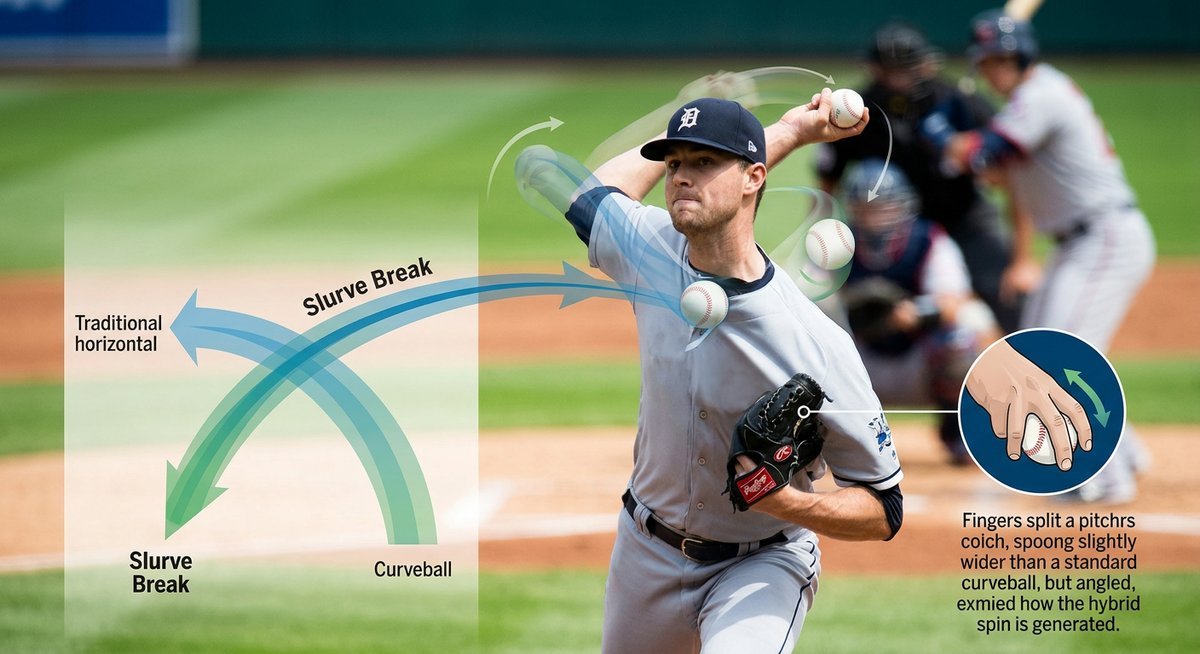

A slurve is a hybrid breaking ball that blends the sharp, lateral movement of a slider with the deeper, looping arc of a curveball — producing a pitch that breaks on a diagonal plane rather than purely sideways or straight down. The name itself is a portmanteau coined in mid-20th century dugouts, and the slurve meaning has been debated by pitching coaches and broadcast analysts for decades precisely because it occupies the gray zone between two well-defined pitch types.
Modern Statcast data has actually complicated matters further: automated pitch classification systems frequently tag slurves as either sliders or curveballs depending on the pitcher’s arm slot and spin axis, which means the pitch is more common in today’s game than the official numbers suggest. Barry Zito, Bert Blyleven, and Adam Wainwright all threw versions of it — each distinctive, none cleanly classifiable.
What Does Slurve Mean? (Core Definition)
A slurve (sometimes spelled “slurv”) is a breaking ball that sits mechanically between a slider and a curveball, producing diagonal movement that neither parent pitch generates alone. The slurv definition is identical — just an alternate spelling that shows up in casual baseball conversation and online searches.
The Definition
The pitch lives between its two parent pitches in nearly every measurable way: speed, spin axis, and movement shape. Where a slider cuts hard and late across the horizontal plane, and a curveball rolls downward with a pronounced vertical drop, the slurve sweeps diagonally — generating both lateral and downward movement simultaneously. Merriam-Webster formally defines slurve as “a baseball pitch having the characteristics of both a slider and a curve” — one of the few hybrid pitch terms to earn dictionary recognition.
The word itself is a portmanteau — a linguistic blend of slider and curve — coined to describe a pitch that resisted clean classification into either category.
Word History and First Use
The term emerged in baseball conversations during the mid-20th century, as pitching coaches and scouts struggled to categorize throws that showed characteristics of both breaking ball types. By the 1970s, slurve had entered mainstream baseball vocabulary firmly enough to appear in general sports dictionaries. Bert Blyleven, who threw one of the most devastating breaking balls in MLB history between 1970 and 1992, was among the first pitchers widely associated with the slurve — though he personally called it a curveball.
Slurve vs. Slider vs. Curveball — Key Differences
A slurve breaks on a diagonal plane — simultaneously lateral and downward — placing it mechanically between a slider’s tight horizontal cut and a curveball’s steep vertical drop. According to MLB’s Statcast pitch-tracking system, the distinguishing factor across all three pitch types is spin axis angle, not velocity or raw spin rate alone.
How Each Pitch Moves
A slider’s spin axis sits nearly vertical — typically around the 3 o’clock position for a right-handed pitcher — which produces tight, late horizontal cut with limited depth. Statcast data consistently shows sliders generating spin rates between roughly 2,300 and 2,600 RPM, with movement that arrives almost entirely in the final 10–15 feet of flight, making it a breaking ball built on deception through timing rather than arc.
A curveball’s spin axis tilts closer to 12-to-6, generating topspin that pulls the ball sharply downward. The looping flight path is visible earlier out of the hand, which is precisely why the pitch works — batters see a curveball as a strike and then watch it fall out of the zone. Spin rates typically range from 2,400 to 2,800 RPM, but the axis angle, not raw spin, is what produces the vertical drop.
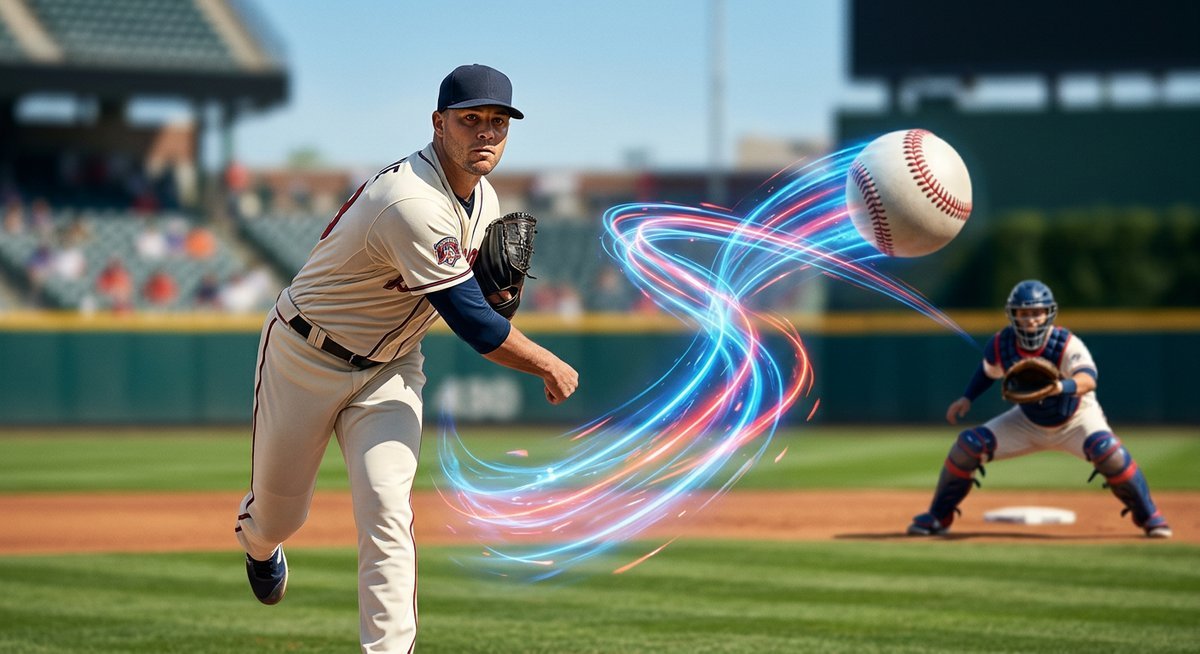
The slurve’s spin axis lands somewhere between those two poles, often around the 1-to-7 or 2-to-8 clock position. That diagonal axis is the mechanical signature of the pitch — it’s what forces the ball to break both down and across simultaneously. In practice, the movement profile looks like a curveball that got nudged sideways, or a slider that never stopped curving.
Comparison Table
| Pitch | Break Direction | Typical MLB Speed Range | Spin Axis (RHP) | Grip Style | Visual Cue for Batters |
|---|---|---|---|---|---|
| Slider | Lateral (horizontal cut) | 83–90 mph | ~3 o’clock (vertical axis) | Two-seam offset; fingers shifted toward outer third | Looks like a fastball, cuts sharply at the last moment |
| Curveball | Downward (vertical drop) | 74–82 mph | ~12-to-6 (topspin axis) | Spike or knuckle-curve grip; forward finger roll at release | Visible arc out of the hand; drops below the zone |
| Slurve | Diagonal (lateral + downward) | 78–86 mph | ~1-to-7 or 2-to-8 (tilted axis) | Off-center seam placement between slider and curveball grips | Appears to break like a curve, then sweeps away from the batter |
The speed overlap between the slurve and curveball is intentional — the slurve is not simply a faster curve. The distinguishing factor is axis tilt, which Statcast’s spin direction metrics can now measure precisely. A pitch classified as a curveball by one team’s scouting department may appear in another’s database as a slider, which is exactly why the slurve as a category remains genuinely difficult to pin down statistically.
How to Throw a Slurve — Grip, Arm Slot, and Release
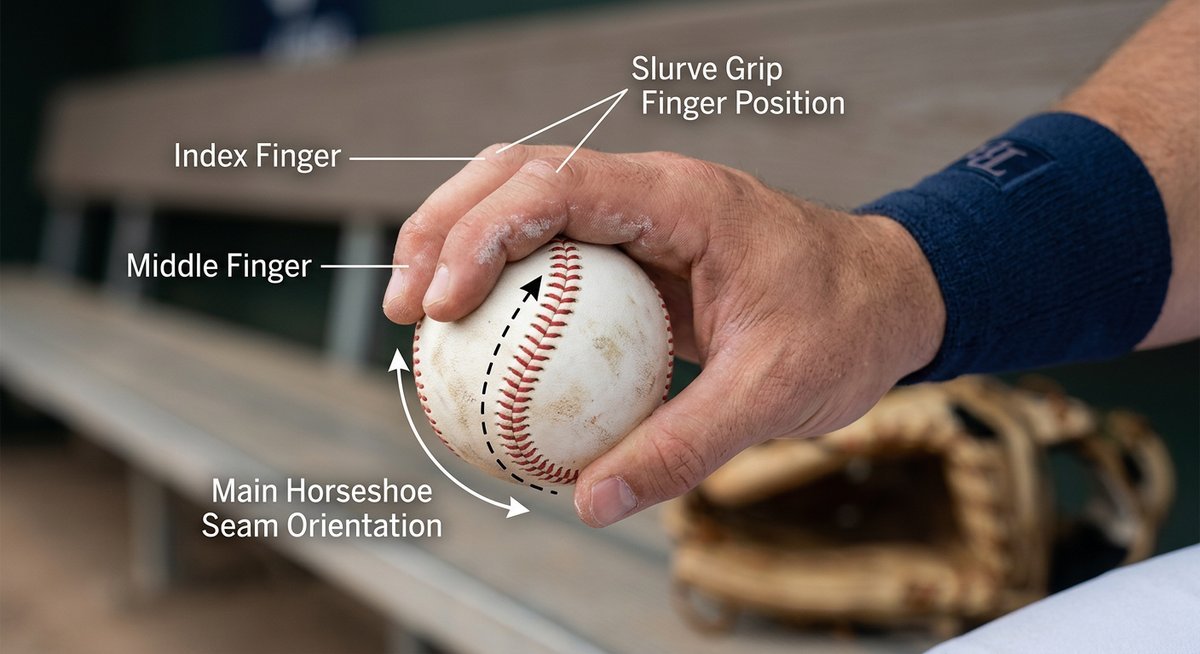
To throw a slurve, place the index and middle fingers slightly off-center across the seams between a slider and curveball grip position, deliver from a three-quarter arm slot, and apply a wrist snap at release that blends roughly 60 percent forward roll with 40 percent lateral snap. That combination of grip, slot, and release is what produces the pitch’s diagonal break.
The Grip
Place the index and middle fingers slightly off-center across the top of the baseball — not spiked into the seam like a traditional curveball, and not riding the outer edge of the seams like a slider. The fingers sit in the narrow zone between those two positions, applying pressure primarily through the middle finger to generate the off-axis spin that drives diagonal movement. The thumb tucks underneath the ball for support, roughly opposite the middle finger, while the ring finger and pinky rest loosely along the side.
Grip pressure is where most pitchers need to experiment. Heavier middle-finger pressure pulls the spin axis toward curveball territory, producing more depth. Shifting pressure toward the index finger sweeps the break more laterally, closer to slider shape. Small adjustments — a few millimeters of finger placement — create measurable changes in spin axis and, by extension, break shape.
Arm Slot and Delivery
A three-quarter arm slot is the most natural delivery point for a slurve. Overhand slots tend to sterilize the lateral component, turning the pitch into a curveball with poor depth. True sidearm slots push the break too flat, stripping out the downward plane entirely. The three-quarter angle lets the wrist snap travel on a diagonal path — part lateral, part forward — which is exactly what the pitch needs.
At release, the wrist action sits between the slider’s abrupt outward flick and the curveball’s smooth forward roll. Think of it as a 60/40 blend: roughly 60 percent forward roll, 40 percent lateral snap. Release point timing also matters — releasing slightly earlier in the arm’s arc adds depth to the break, while a later release amplifies the sweeping, horizontal component.
Developing Feel and Command
Building command of the slurve starts in slow-motion bullpen work, not game reps. Throwing the pitch at half-speed forces a pitcher to actually feel the wrist position at release rather than muscling through it. Once the release feels repeatable, spin rate becomes the most useful feedback tool available — on Statcast-equipped fields, a slurve typically registers a spin axis between roughly 30 and 60 degrees (on the standard clock-face model), sitting between a curveball’s near-vertical axis and a slider’s more horizontal one.
- Begin with slow bullpen reps at 50–60% effort, focusing entirely on wrist position at release.
- Use a radar gun or Statcast data to track spin rate — inconsistent spin rate signals grip or wrist inconsistency, not arm effort.
- Adjust finger pressure in small increments to dial break shape toward more depth or more sweep as needed.
- Graduate to full-effort reps only after the release feels mechanically identical across five consecutive slow throws.
Finger pressure adjustments are the fastest way to reshape the pitch. No grip change required — just a subtle shift in where force is applied at the moment of release.
Slurve Meaning in Slang and Beyond Baseball
Outside the diamond, slurve meaning in slang has drifted into casual English as a way to describe anything that combines two unexpected qualities into one — a blended move, a hybrid approach, a thing that refuses to be just one thing. The usage is niche but shows up in gaming communities, music production forums, and social media where portmanteaus thrive.
In Chinese (slurve中文), the pitch is typically translated as 滑弧球 (huá hú qiú) — literally “sliding arc ball” — which captures the diagonal movement nicely. Japanese baseball commentary uses スラーブ (surābu), a direct phonetic transliteration, reflecting how deeply American pitching terminology has embedded itself in East Asian baseball culture.
Slurve Synonyms and Related Terms
Strict slurve synonyms are rare because the pitch occupies such a specific mechanical niche. The closest alternatives in common baseball usage:
- Sweeping curve — a curveball with more lateral movement than vertical, functionally similar to a slurve but typically slower
- Sweeper — MLB’s modern Statcast classification for pitches with significant horizontal break; some sweepers overlap with what older scouts called slurves
- Breaking ball — the umbrella category covering sliders, curveballs, and slurves alike
- Bender — informal slang for any curveball variant, occasionally applied to slurves in casual conversation
The term “slurver” appears in some online searches as a supposed synonym, but it is not standard baseball terminology. It likely stems from autocorrect or phonetic guessing by users searching for slurve-related content.
Frequently Asked Questions
What is a slurve in baseball?
A slurve is a breaking ball that blends the lateral cut of a slider with the downward arc of a curveball, producing a diagonal break that moves on both horizontal and vertical planes simultaneously. The term is a portmanteau of “slider” and “curve.” Pitchers typically throw the slurve at 78–86 mph, slower than a slider but harder than most curveballs.
What is the difference between a slurve, a slider, and a curveball?
A slider breaks sharply and late in a predominantly horizontal direction, while a curveball drops on a steeper 12-to-6 or 11-to-5 arc with more topspin. The slurve splits the difference — its spin axis sits between the two, generating a sweeping diagonal break that borrows movement from both parent pitches without fully replicating either.
How do you throw a slurve?
Place the index and middle fingers slightly off-center across the seams — between a curveball’s spiked grip and a slider’s two-seam offset — with the thumb tucked underneath for support. Deliver from a three-quarter arm slot and apply a wrist snap at release that sits between the stiff lateral snap of a slider and the forward roll of a curveball.
Is a slurve bad for your arm?
The slurve places meaningful valgus stress on the medial elbow’s ulnar collateral ligament, comparable to a curveball, while the lateral snap component adds rotator cuff load similar to a slider. Youth pitchers with open growth plates face the highest injury risk. Limiting slurve volume in bullpen sessions and prioritizing proper arm slot mechanics significantly reduces that stress.
Which MLB pitchers are known for throwing a slurve?
Barry Zito’s slow, looping breaking ball — the pitch that earned him a 2002 Cy Young Award — was consistently classified as a slurve by analysts. Bert Blyleven threw a devastating 12-to-7 breaker across 22 MLB seasons that scouts labeled a slurve despite Blyleven calling it a curve. Adam Wainwright’s signature breaking ball similarly straddled the slurve-curveball boundary. Steve Carlton’s slider, which broke on a more diagonal plane than most, was retroactively described as slurve-adjacent by modern pitch-tracking standards.
What does “slurp” mean as an adjective?
Slurp is not a standard adjective in English — it functions primarily as a verb (to slurp a drink) and a noun (the slurp was loud). When people search for “slurp adjective” or “slurp adj,” they typically want the adjective form, which does not formally exist in major dictionaries. The closest usable forms are “slurpy” (informal, describing something that involves slurping sounds) and “slurped” (past participle used attributively, as in “a slurped noodle”). Slurp is unrelated to slurve.
What does SLVR mean in chat?
SLVR is internet shorthand for “silver,” commonly used in gaming communities to refer to a player’s rank tier (Silver rank in games like League of Legends, Valorant, or CS2). It also appears in fashion and design contexts as an abbreviation. SLVR has no connection to slurve — the two terms share superficial letter patterns but belong to entirely different vocabularies.
What does slurred mean?
Slurred means spoken indistinctly, with sounds running together rather than being clearly articulated — as in “slurred speech.” The word comes from the verb “slur,” meaning to blur or smear. Despite the visual similarity, slurred and slurve share no etymological connection. Slurred derives from Middle English, while slurve is a modern American baseball portmanteau coined in the mid-20th century.
Conclusion
The slurve is a hybrid breaking ball — part slider, part curveball — that generates diagonal movement by blending a lateral wrist snap with a forward forearm roll at release. Its spin axis sits between roughly 1 o’clock and 3 o’clock, producing a break that neither parent pitch achieves alone.
For the right pitcher, it’s a genuine weapon. A well-commanded slurve can neutralize same-side hitters in two-strike counts and fill an arsenal gap when neither a true slider nor a sharp curveball is available. The tradeoff is real, though — the combined wrist and forearm mechanics elevate UCL and rotator cuff stress, particularly for younger arms.
The grip mechanics and bullpen progression outlined earlier give any pitcher a starting framework, but the slurve ultimately rewards feel over formula. Every arm slot produces a slightly different version of the pitch — which is precisely why it has resisted standardization for seven decades and counting.

Most Viewed