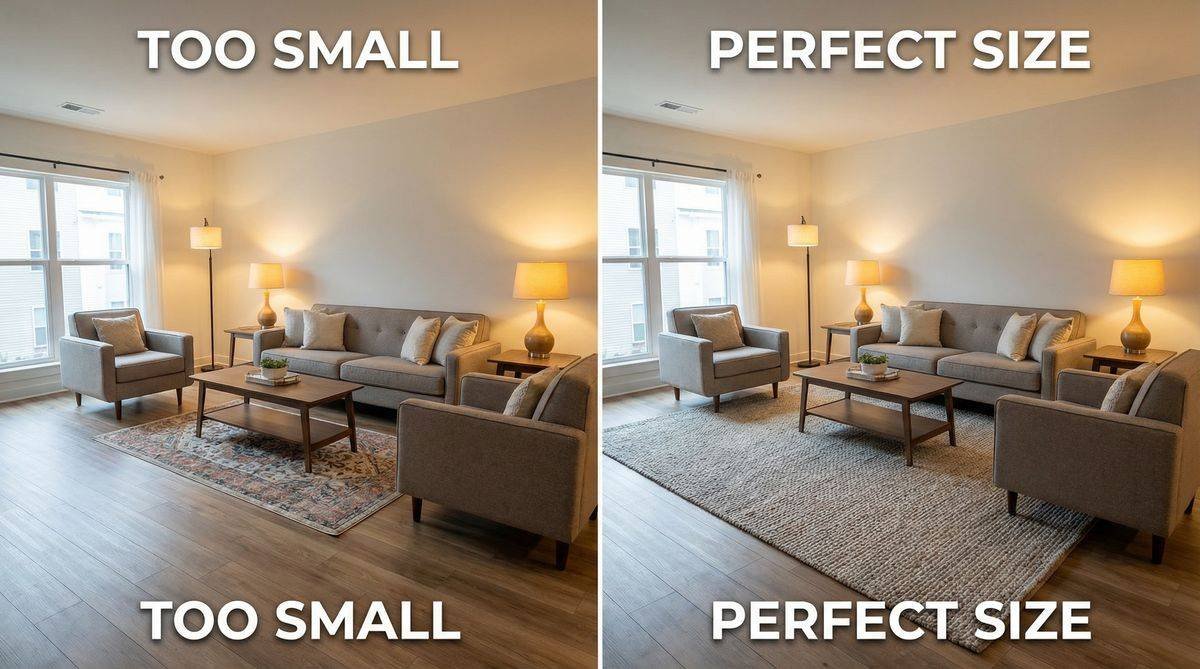

A rug that is too small makes a living room look like the furniture is floating on an island. A rug that is too large overwhelms the space and eliminates the visual breathing room that makes a room feel balanced, explains Keyrenter Triad Property Management. Getting the size right is the single most impactful rug decision — and it is the one most commonly made incorrectly.
This guide explains exactly how to choose the right size rug for a living room, covering the three standard placement configurations, the specific measurements that work for different room sizes, and the one mistake that interior designers say they see in nearly every home they visit.
1. The Three Placement Configurations and Their Sizing Rules
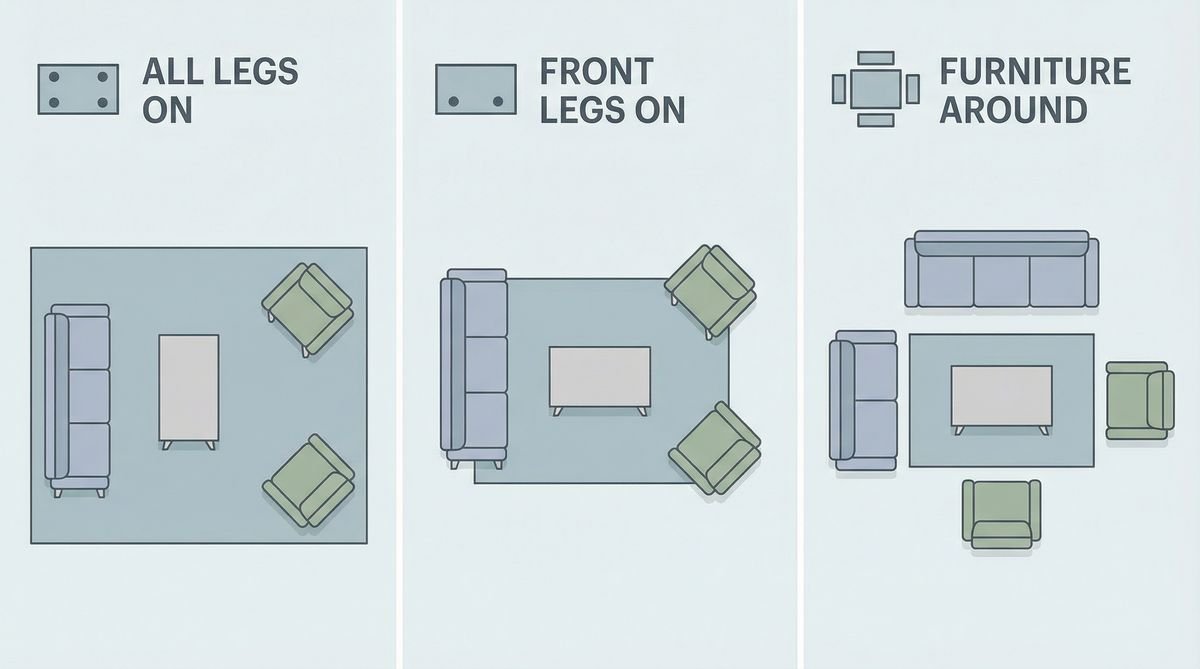
Answer Capsule: There are three accepted rug placement configurations for living rooms: all furniture legs on the rug (requires the largest rug), front legs only on the rug (the most popular and forgiving option), and all furniture floating off the rug (works only in very large rooms). Each configuration has specific minimum dimensions to look intentional rather than accidental.
The “all legs on” configuration requires a rug large enough that every piece of furniture in the seating arrangement sits fully on the rug. This creates a cohesive, unified look and is ideal for open-plan spaces. For a standard sofa-and-two-chairs arrangement, this typically requires a 9×12-foot rug or larger.
The “front legs on” configuration is the most versatile and widely recommended by interior designers. The front two legs of the sofa and chairs rest on the rug, visually anchoring the furniture to the rug while leaving the back legs on the bare floor. This works with an 8×10-foot rug in most standard living rooms and creates a connected, grounded feel without requiring a massive rug.
The “floating” configuration places the rug in the center of the seating area with all furniture legs off the rug. This works only in very large rooms where the rug itself acts as a decorative centerpiece rather than an anchor for the furniture grouping. A floating rug that is too small looks like a bath mat dropped in the middle of the room.
2. Standard Rug Sizes Matched to Room Dimensions
Answer Capsule: For a living room under 200 square feet, an 8×10-foot rug is the standard recommendation. Rooms between 200 and 300 square feet work best with a 9×12-foot rug. Rooms over 300 square feet may require a 10×14-foot rug or larger. Always leave 18–24 inches of bare floor between the rug edge and the wall.
| Room Size | Recommended Rug Size | Placement Style | Floor Border |
|---|---|---|---|
| Under 10×12 ft (small) | 5×8 ft | Front legs on / floating | 18–24 inches |
| 12×14 ft (medium) | 8×10 ft | Front legs on | 18–24 inches |
| 14×18 ft (large) | 9×12 ft | All legs on / front legs on | 18–24 inches |
| Over 18×20 ft (extra large) | 10×14 ft or larger | All legs on | 18–24 inches |
3. The Tape Test: How to Measure Before Buying
Answer Capsule: Before purchasing any rug, use painter’s tape to mark the exact dimensions on the living room floor. Live with the taped outline for 24–48 hours, walking around and sitting in the furniture arrangement. This simple test reveals whether the size feels right before committing to a purchase — and it costs nothing.
The tape test is the most underused tool in rug shopping. Lay painter’s tape in the exact dimensions of the rug being considered. Place the furniture in its intended arrangement. Then evaluate: does the rug feel too small? Does it crowd the walls? Does the furniture arrangement look anchored or floating?
This test is especially valuable for open-plan living rooms where the rug must define a seating zone without a room boundary to anchor it. The tape outline makes it immediately clear whether the rug will successfully delineate the space or disappear into the larger room.
4. Rug Shape: When to Break the Rectangle Rule
Answer Capsule: Rectangular rugs suit most living rooms because they mirror the room’s geometry and align naturally with rectangular furniture arrangements. Round rugs work well in square rooms or under a single round coffee table. Irregular or organic shapes are best reserved for accent use, not primary living room anchoring.
The shape of the rug should complement the shape of the furniture arrangement, not fight it. A long, narrow sofa arrangement benefits from a rectangular rug oriented in the same direction. A square seating arrangement — four chairs around a central table — can accommodate either a square or round rug effectively.
5. The Most Common Rug Sizing Mistakes
| Mistake | Why It Looks Wrong | The Fix |
|---|---|---|
| Rug too small for the room | Furniture appears to float; rug looks like an afterthought | Size up to 8×10 or 9×12 minimum |
| Rug pushed against the wall | Eliminates visual breathing room; makes room feel cramped | Leave 18–24 inches of bare floor at each wall |
| All furniture legs off rug in small room | Rug looks like a decorative mat, not an anchor | Use front-legs-on configuration instead |
| Rug oriented wrong direction | Conflicts with room’s natural flow and furniture lines | Orient rug parallel to the longest wall |
Frequently Asked Questions
Is an 8×10 rug big enough for most living rooms?
Yes, for most standard living rooms in the 12×14 to 14×16 foot range, an 8×10 rug is the correct size when using the front-legs-on configuration. It provides enough visual weight to anchor the furniture grouping while leaving the recommended 18–24 inches of bare floor at the walls.
How is a rug sized for an open-plan living and dining area?
In open-plan spaces, the rug defines separate zones. The living room rug should be large enough to encompass the full seating arrangement — typically 9×12 feet or larger — and positioned so it clearly separates the living zone from the dining zone. A gap of at least 24 inches between the living room rug and the dining room rug prevents the two zones from visually merging.
Can rugs be layered in a living room?
Yes. Layering a smaller decorative rug over a larger neutral base rug is a popular design technique. The base rug should follow standard sizing rules (8×10 or 9×12), while the layered rug sits centered on top, typically 2–3 feet smaller in each dimension. This adds texture and visual interest without requiring a single expensive statement rug.
Conclusion
Choosing the right size rug for a living room comes down to three decisions: which placement configuration to use, what dimensions match the room size, and whether the rug leaves the correct 18–24 inch border at the walls. The tape test eliminates guesswork entirely — it is the most reliable tool available before making a purchase.
The most important takeaway: when in doubt, size up. A rug that is slightly too large can always be repositioned or anchored differently. A rug that is too small will always look like a mistake, no matter how beautiful the pattern.
References
- American Society of Interior Designers (ASID). “Rug Placement Guidelines.” 2024.
- Architectural Digest. “How to Choose the Right Rug Size for Every Room.” Updated 2025.
- The Spruce. “Living Room Rug Size Guide.” Updated 2025.

Most Viewed