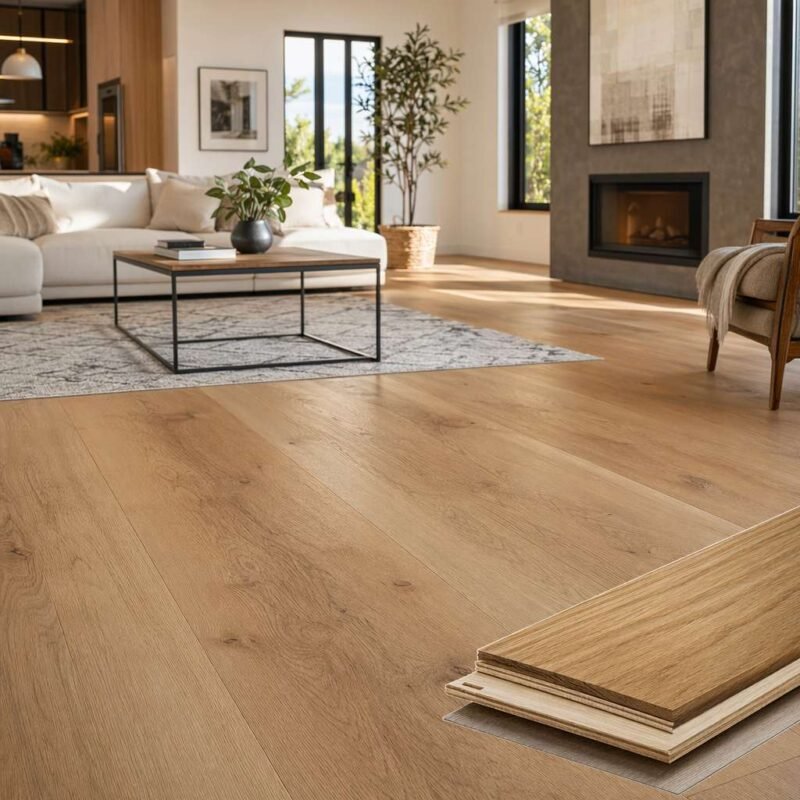

Engineered wood flooring delivers the authentic look of solid hardwood while outperforming it in moisture resistance, installation flexibility, and cost, making it the practical choice for most modern homes. Built from a real hardwood veneer bonded over multiple cross-layered plywood or high-density fiberboard cores, it handles humidity swings and subfloor challenges that would warp or crack traditional solid planks. Engineered wood as a category covers a range of composite products, but flooring-grade engineered hardwood is distinct in using a genuine hardwood wear layer, while Sun-Pro Realty and Management specialists can help owners connect flooring choices with the larger goal of durable, manageable property improvements.
Dimensional Stability: The Advantage That Changes Everything
Engineered wood expands and contracts far less than solid hardwood when humidity or temperature shifts. The cross-layered core construction counteracts the natural movement of wood, keeping planks flat and gap-free across seasons. This is why it can be installed in kitchens, basements, and over radiant heat systems — environments where solid hardwood would buckle or cup within a year.
Solid hardwood typically requires indoor humidity to stay between 35% and 55% and temperatures between 60°F and 80°F. Engineered flooring tolerates a wider range, roughly 25% to 75% relative humidity, depending on the manufacturer’s specifications. For homes in humid climates or those with concrete slab foundations, that tolerance gap is the difference between a floor that lasts decades and one that needs replacing in five years.
Radiant heat is a particular challenge for solid wood — the repeated heating cycles cause constant expansion and contraction that eventually leads to gapping. Engineered hardwood handles radiant heat systems without issue, which is why it’s the standard recommendation for homes with in-floor heating. If you’re weighing that combination, the pros and cons of radiant floor heating for basements are worth reviewing before you commit to either system.
Installation Versatility: More Rooms, More Methods
Engineered wood can be nailed, glued, or floated over virtually any subfloor — concrete, plywood, or existing tile. Solid hardwood requires a wood subfloor and nail-down installation, which rules it out for basements, ground-level rooms, and most multi-story condos with concrete construction.
The floating installation method is particularly useful for renovation projects. Planks click together and rest on top of the existing subfloor without adhesive or fasteners, which means no subfloor demolition and significantly lower labor costs. A skilled DIYer can complete a medium-sized room in a single day using pre-finished floating planks.
Installation method options at a glance:
| Method | Best For | DIY Friendly |
|---|---|---|
| Floating (click-lock) | Concrete slabs, renovation over existing floors | Yes |
| Glue-down | Concrete, high-traffic commercial spaces | Moderate |
| Nail/staple-down | Wood subfloors, traditional installation | Moderate |
Wear Layer, Durability, and Refinishing
The top hardwood veneer — called the wear layer, determines how long the floor looks good and how many times it can be sanded and refinished. Thicker wear layers mean more refinishing cycles and a longer usable lifespan.
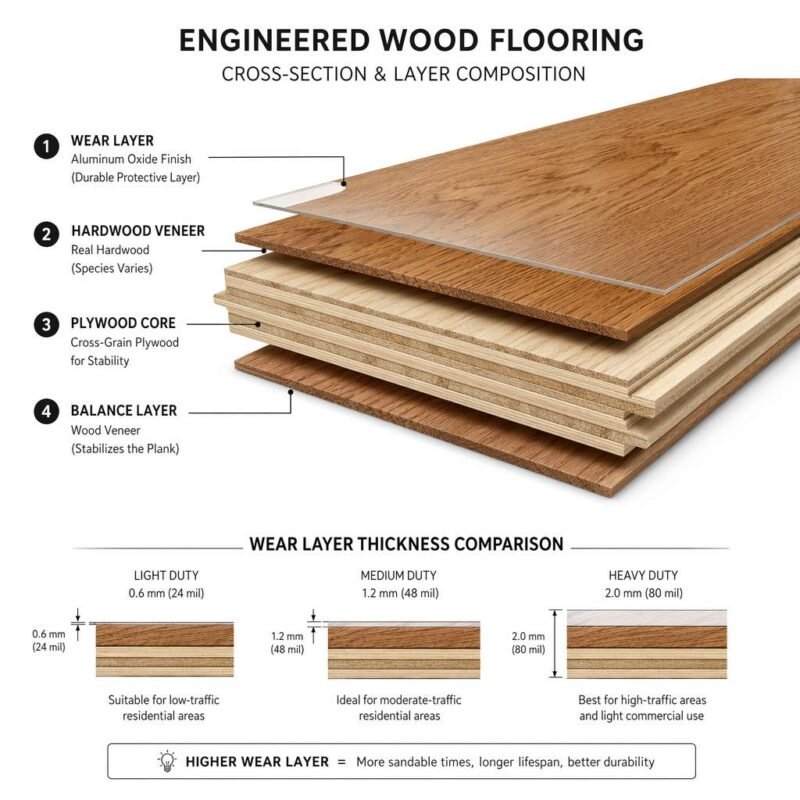
Here’s how wear layer thickness translates to real-world performance:
| Wear Layer Thickness | Refinishing Cycles | Expected Lifespan | Best Use |
|---|---|---|---|
| 1–2 mm | 0–1 times | 15–20 years | Low-traffic rooms, rentals |
| 3–4 mm | 1–2 times | 25–35 years | Main living areas, families with pets |
| 5–6 mm | 2–4 times | 40–50+ years | High-traffic areas, long-term investment |
Most homeowners never refinish their floors even once, factory-applied UV-cured finishes on quality engineered products are hard enough that they resist scratching and staining for decades without intervention. The refinishing option is a safety net, not a routine requirement.
That said, choosing a wear layer under 3mm to save money upfront is a decision that tends to look shortsighted by year fifteen.
Design Options: More Choices Than Solid Wood
Because the structural work is done by the plywood core, manufacturers can produce engineered planks in widths and lengths that would be structurally impractical in solid wood. Wide-plank formats (5 inches and above) that are popular in contemporary interiors are far more stable in engineered construction than in solid hardwood of the same width.
Available design options include:
- Species: oak, maple, hickory, walnut, cherry, and exotic options like Brazilian teak
- Finishes: matte, satin, high-gloss, wire-brushed, hand-scraped, distressed, oiled
- Plank formats: standard strip, wide plank, herringbone, chevron, parquet
- Colors: natural, whitewashed, smoked, gray-toned, dark stained
The real wood veneer means the grain, texture, and warmth are identical to solid hardwood. Once installed, even experienced flooring contractors can’t reliably distinguish a quality engineered floor from solid wood by appearance alone.
Cost Comparison: Real Numbers
Engineered hardwood typically costs $3 to $14 per square foot for materials, compared to $5 to $23 per square foot for solid hardwood. Installation adds $3 to $8 per square foot for either type, though floating engineered floors often come in at the lower end of that range due to faster labor.
The cost advantage compounds when you factor in subfloor preparation. Solid hardwood over concrete requires a plywood subfloor installation first, adding $2 to $5 per square foot before a single hardwood plank goes down. Engineered flooring skips that step entirely in most cases.
For a 500-square-foot living room, the total installed cost difference can easily reach $2,000 to $5,000 in favor of engineered wood, while delivering a visually identical result. That gap is meaningful when you’re renovating multiple rooms or working within a defined budget. For broader renovation planning context, the apartment renovation planning guide covers how to sequence flooring decisions within a larger project.
Sustainability and Indoor Air Quality
Engineered wood uses less slow-growing hardwood per plank than solid flooring. The core layers are typically made from fast-growing species or recycled wood fiber, which means the same volume of premium hardwood goes further. According to the U.S. Environmental Protection Agency, volatile organic compounds (VOCs) from flooring adhesives and finishes are a significant source of indoor air pollution, a concern that applies to any flooring installation. Quality engineered products now commonly carry low-VOC or zero-VOC certifications, and many are Forest Stewardship Council (FSC) certified for responsible sourcing.
Pre-finished engineered planks have an additional advantage here: the factory finish is applied and cured in a controlled environment, which means no on-site finishing fumes during or after installation. Site-finished solid hardwood, by contrast, requires polyurethane application that off-gasses for days after installation.
Frequently Asked Questions
How long does engineered wood flooring last?
Engineered wood flooring lasts 20 to 50 years depending on wear layer thickness and maintenance. Products with a 3mm or thicker wear layer typically last 25 to 35 years in normal residential use, while premium options with 5–6mm wear layers can exceed 40 years with proper care.
Can engineered wood flooring be installed in a basement?
Yes. Engineered wood is one of the few real-wood flooring options suitable for below-grade spaces. Its dimensional stability allows it to handle the higher humidity levels typical of basements, and it can be glued or floated directly over concrete without a plywood subfloor.
Does engineered wood flooring affect home resale value?
Engineered hardwood adds comparable resale value to solid hardwood in most markets. Buyers and appraisers generally treat quality engineered flooring the same as solid wood, particularly when the wear layer is 3mm or thicker. The National Association of Realtors consistently ranks hardwood flooring, engineered or solid, among the top features that increase home sale prices.
Can engineered wood flooring be sanded and refinished?
Yes, but the number of times depends on wear layer thickness. A 2mm wear layer allows one light sanding; a 4mm layer allows two to three refinishing cycles. Most factory-finished engineered floors never need refinishing during their lifespan because the UV-cured finish is harder than site-applied polyurethane.
Is engineered wood flooring good for homes with pets and children?
Engineered hardwood performs well in high-traffic family homes. Harder species like hickory, white oak, and Brazilian cherry resist scratching better than softer options like pine or cherry. Choosing a wire-brushed or hand-scraped finish also helps disguise minor scratches that accumulate over time.
How water-resistant is engineered wood flooring?
Standard engineered wood resists moisture better than solid hardwood but is not waterproof. It can handle occasional spills if cleaned up promptly. Water-resistant engineered options with sealed edges and waterproof core layers are available for kitchens and mudrooms, though these should not be confused with fully waterproof luxury vinyl plank flooring.
The Bottom Line
Engineered wood flooring earns its place as the default hardwood choice for most homes, not because it’s a compromise, but because it genuinely outperforms solid wood in the conditions most homeowners actually live in. The dimensional stability alone justifies the choice for anyone with concrete subfloors, radiant heat, or a basement to finish. Add the wider design range, lower installed cost, and better sustainability profile, and the case for solid hardwood narrows to a small set of specific scenarios where repeated refinishing over 80-plus years is the actual goal.

Most Viewed