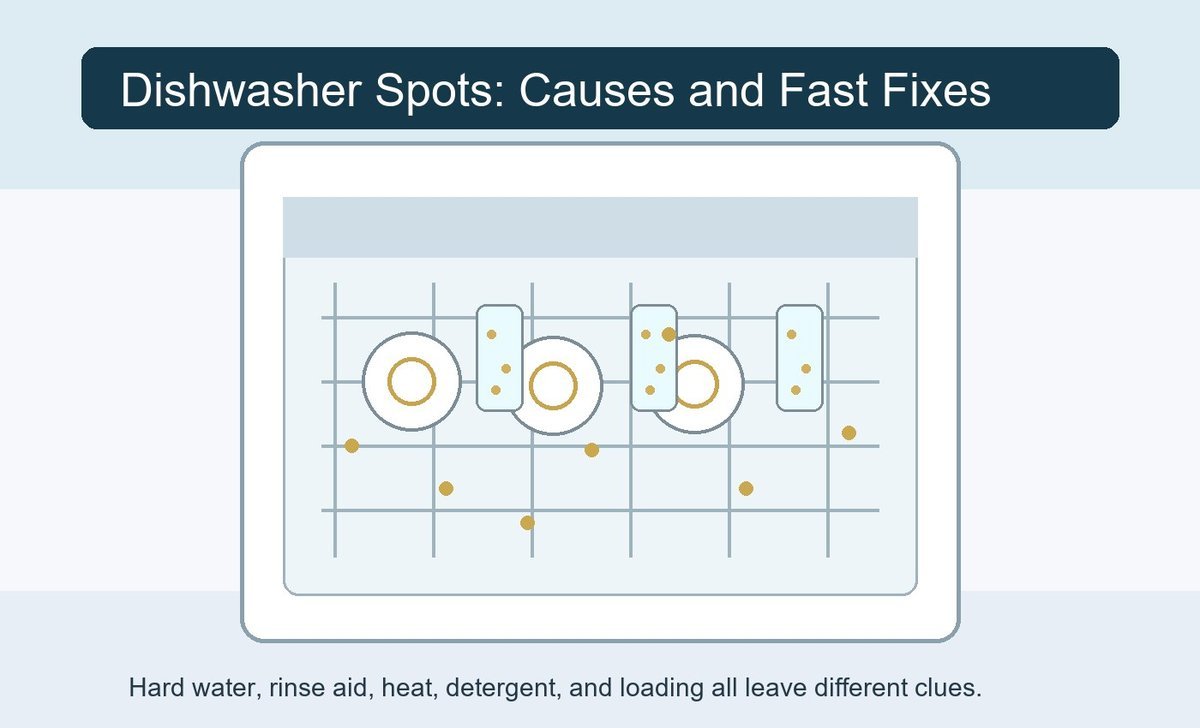

A dishwasher leaving spots on dishes is usually reacting to water chemistry or drying conditions, not simply failing to clean. White chalky marks often come from hard-water minerals, while scattered droplets on glass usually point to rinse aid, heat, or airflow problems.
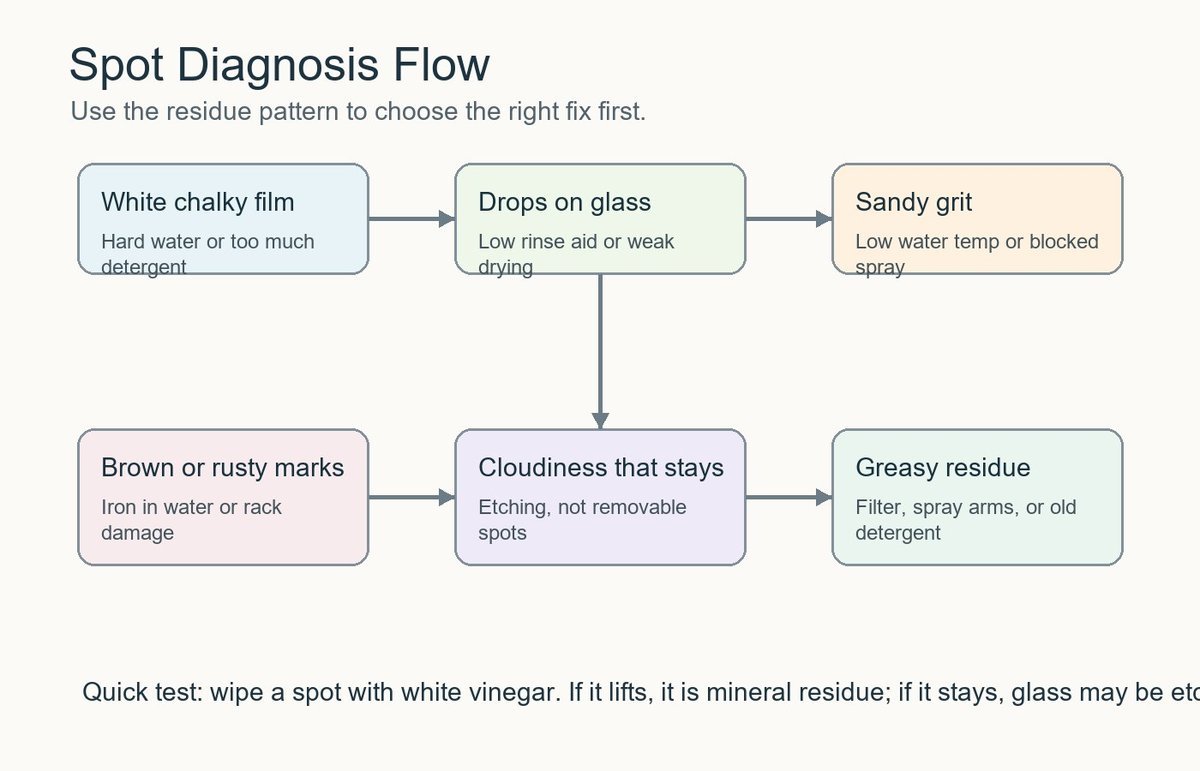
The fastest fix is to identify the residue first. If a spot wipes away with white vinegar, treat it as mineral film. If it will not wipe off and the glass feels permanently cloudy, the surface may be etched, which means the goal changes from removing spots to preventing more damage.
Why Your Dishwasher Leaves Spots After a Full Cycle
Most spotty dishes come from water drying on the surface before minerals, detergent, or food particles can rinse away cleanly. Hard water, an empty rinse-aid dispenser, low wash temperature, too much detergent, blocked spray arms, and tight loading are the most common causes.
GE Appliances lists hard water, rinse aid, temperature concerns, loading, detergent, and water pressure among the major reasons for spotting, grit, and film in dishwashers. That matches what homeowners often notice in practice: the machine may sound normal, finish the cycle, and still leave glasses looking dusty or speckled.
The trick is not to try every fix at once. A dishwasher gives clues. White powder on glass is different from gritty crumbs on bowls, and both are different from blue-gray scratches or rusty dots. One careful look at the pattern can save several wasted cycles.
| What You See | Most Likely Cause | First Fix to Try |
|---|---|---|
| White chalky film | Hard-water minerals or excess detergent | Use rinse aid, reduce detergent, and test water hardness |
| Round dried droplets on glasses | Poor drying or low rinse aid | Refill rinse aid and use heated dry or auto-open drying |
| Sandy grit on plates | Low water temperature, clogged filter, or blocked spray | Clean filter and run hot water at the sink before starting |
| Cloudy glass that vinegar will not remove | Etching | Lower detergent dose and avoid very hot aggressive cycles |
| Rust-colored or brown spots | Iron in water, rack damage, or metal contact | Inspect racks and separate stainless, aluminum, and silver items |
Hard Water Is the Usual Suspect Behind White Spots
Hard water leaves calcium and magnesium behind when droplets evaporate, so clean dishes can still dry with a pale film. The Water Quality Association explains that hard water contains dissolved minerals, especially calcium and magnesium, which can form scale on plumbing and fixtures.
In a dishwasher, those same minerals cling to glassware, stainless utensils, plastic containers, and dark plates. The deposits are most visible on clear glass because light catches the residue. A plate may be just as filmed, but it hides the problem better.
Run a simple vinegar check before changing parts. Put a spotted glass in a bowl or sink with white vinegar for a few minutes, then wipe it with a soft cloth. If the film lifts, the issue is mineral residue. If the surface stays cloudy, the glass is probably etched.
- Use a rinse aid every cycle, even if the detergent pod says it includes one.
- Check the rinse-aid setting and raise it one notch if glasses dry with droplets.
- Use less detergent in soft or moderately hard water, especially with compact loads.
- Consider a water softener if faucets, shower doors, and kettles also show scale.
There is a small domestic annoyance hidden inside those white rings. The dishes are not dirty, but they look neglected, which is why the problem feels more irritating than the chemistry behind it sounds.
Too Much Detergent Can Make Spots Worse
Excess detergent can leave a dusty film, especially in modern dishwashers that use less water than older machines. A full pod may be too much for a small load, soft water, or a lightly soiled rack, even when the packaging makes the dose look universal.
This is one of the most common surprises. People add more detergent because the dishes look bad, then the extra detergent makes the residue worse. Powder and gel make dose control easier than pods because you can scale the amount to the load and local water.
Start with the detergent label, then adjust downward if the load is small or if the residue feels slick, chalky, or perfumed. Store detergent in a dry place, too. Old or moisture-clumped detergent dissolves poorly, and poor dissolving often shows up as grit.
- Run one cycle with no dishes and a dishwasher cleaner or approved cleaning cycle.
- Clean the filter and check the sump area for labels, glass chips, or food debris.
- Run a normal load with half your usual detergent dose.
- Keep rinse aid full and compare the glasses after drying.
If the next load looks better, detergent was part of the problem. If it looks unchanged, move to water temperature and spray coverage before assuming the appliance needs service.
Rinse Aid and Drying Settings Matter More Than People Expect
Rinse aid helps water sheet off dishes instead of drying as droplets, which is why an empty dispenser often shows up as spots on glasses and flatware. It does not clean food by itself; it improves the final rinse and drying behavior.
Many dishwashers have a rinse-aid indicator, but it is easy to ignore until glasses start looking peppered with dots. Fill the dispenser, then give the machine several cycles to show the effect. Some models also let you adjust how much rinse aid is released.
Drying settings matter because a cooler, shorter, energy-saving cycle may leave more water on dishes. Plastic items make this more obvious because they do not hold heat like ceramic or glass. When a mixed load comes out with dry plates and wet plastic lids, that is often normal material behavior, not a broken heater.
| Setting or Habit | Why It Helps | When to Use It |
|---|---|---|
| Rinse aid | Reduces surface tension so water runs off | Every load, especially with glassware |
| Heated dry | Evaporates remaining water faster | When glasses dry with droplets |
| Sanitize or high-temp wash | Improves detergent dissolving and grease removal | Greasy loads or gritty residue, if items are safe for it |
| Door cracked after cycle | Lets steam escape instead of condensing back | Machines without auto-open drying |
Check Heat, Filter, and Spray Arms Before Calling for Repair
Grit and scattered residue often mean the dishwasher is not circulating or rinsing water cleanly enough. A dirty filter, blocked spray-arm holes, low incoming water temperature, or crowded rack can leave particles stuck to otherwise washed dishes.
Run the hot tap at the kitchen sink before starting the dishwasher. This pulls cold water out of the line so the machine begins with hotter water. Many detergents need enough heat to dissolve fully, and a cold start can leave powdery or sandy residue behind.
Next, remove and rinse the filter according to the owner manual. Look closely at the spray arms. Seeds, paper labels, eggshell fragments, and mineral scale can clog the holes, and one blocked spray arm can create a whole rack of bad results.
- Spin each spray arm by hand before starting the cycle.
- Keep tall pans, cutting boards, and trays away from the spray path.
- Place bowls at a downward angle instead of nesting them tightly.
- Do not block the detergent cup with a large plate or utensil handle.
- Scrape food, but avoid heavy pre-rinsing unless your manual recommends it.
For a broader home-systems check, Techepeak’s guide to choosing a home battery backup system is useful when appliance reliability is part of a larger household upgrade plan.
Glass Etching Is Different From Removable Spots
Etching is permanent glass surface damage, so it will not disappear with vinegar, rinse aid, or a cleaning cycle. It often looks like cloudy film, but the clue is stubbornness: mineral residue wipes away, while etched glass stays hazy.
Etching can happen when soft water, high heat, strong detergent, and delicate glassware meet too often. Once it happens, there is no reliable household fix for restoring the original clarity. Prevention becomes the practical answer.
Use less detergent if your home has soft water. Choose a gentler cycle for delicate glasses. Avoid high-heat or sanitize settings for glassware unless the manufacturer says the item can handle it. That small change can protect an expensive set of glasses from slowly turning cloudy.
When Spots Mean Water Quality or Appliance Service
Most spotting problems can be improved with rinse aid, detergent changes, better loading, or cleaning the filter. Service becomes more likely when spots appear with poor draining, weak spray, standing water, error codes, or repeated grit after basic maintenance.
If the whole house shows scale, rust stains, metallic taste, or cloudy fixtures, test the water before blaming the dishwasher. Britannica’s overview of hard water notes that hardness mainly comes from dissolved calcium and magnesium salts, which is why the same mineral pattern often appears on faucets, kettles, shower glass, and dishes.
Brown or orange dots deserve a separate look. They can come from iron in water, rusting dishwasher racks, or metal items touching during the wash. If the vinyl coating on a rack has split and exposed metal, repair caps or rack replacement may be cheaper than chasing detergent changes that will never solve rust.
Call a technician if the dishwasher does not heat, spray arms do not move, the tub does not fill correctly, or dishes stay gritty after the filter and spray arms are clean. At that point, the evidence points beyond normal cycle tuning.
FAQ
Why is my dishwasher leaving spots on dishes all of a sudden?
A sudden change usually comes from an empty rinse-aid dispenser, a different detergent, a clogged filter, a blocked spray arm, or a change in water hardness. Check those items before assuming the dishwasher has failed.
Does vinegar remove dishwasher spots?
Vinegar can remove many hard-water spots because it dissolves mineral residue. Use it as a spot test on glassware, but follow the dishwasher manufacturer’s guidance before using vinegar inside the machine because repeated acidic cleaning can affect seals or parts.
Why do my glasses look cloudy after the dishwasher?
Cloudy glasses are usually either mineral film or etching. If vinegar removes the cloudiness, it is mineral film. If vinegar does nothing, the glass is probably etched and cannot be restored to its original clarity.
Should I use more detergent if dishes are spotty?
No. More detergent can make spotting worse, especially with soft water or small loads. Try rinse aid, a cleaner filter, hotter incoming water, and a smaller detergent dose first.
Can rinse aid really stop spots?
Rinse aid can greatly reduce spots caused by droplets drying on glass and flatware. It works best when the dispenser is full, the setting is adjusted for local water conditions, and the drying cycle has enough heat or airflow.
When should I replace or repair the dishwasher?
Consider service when dishes stay gritty after filter cleaning, spray arms are clear, water is hot, and loading is correct. Heating failure, weak fill, poor draining, or non-spinning spray arms are stronger repair clues than white mineral spots alone.
Final Takeaway
Spotty dishes are frustrating because the machine looks like it completed the job while leaving proof that something went wrong. Fortunately, the fix is usually small: refill rinse aid, reduce detergent, clean the filter, improve loading, and confirm the water is hot enough.
If the vinegar test removes the marks, treat minerals and drying first. If the marks stay, protect the glass from further etching. That one distinction keeps the repair path practical instead of turning every load into guesswork.
Sources: GE Appliances dishwasher spotting guidance, Water Quality Association hard water resource, and Britannica’s hard water explainer.
Most Viewed