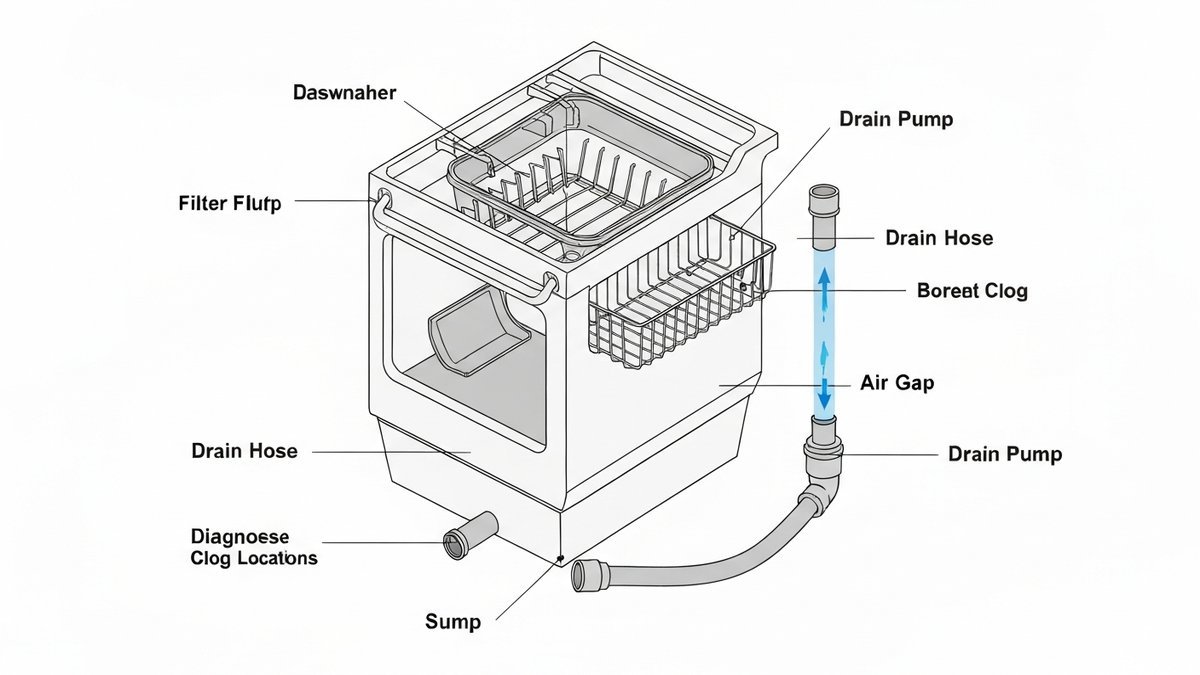
A dishwasher that fills with water at the start of the cycle and then sits there, humming quietly but refusing to drain, has a blockage somewhere in the drainage path. That path runs from the filter at the bottom of the tub, through the drain pump, up a corrugated hose, through an air gap or high loop under the sink, and into the garbage disposal or sink drain, notes Yellow Keys Realty professionals.
A clog at any single point along this path stops the entire system. Diagnosing a dishwasher not draining properly is a process of elimination that begins with the easiest, most common fix and works progressively toward the least common and most expensive.
Appliance service data indicates that approximately 55% of dishwasher drainage failures are caused by a clogged filter or sump, 25% by a kinked or obstructed drain hose, 10% by a blocked air gap, and 10% by a failed drain pump. The fix that solves the majority of cases costs nothing and takes five minutes. Start there.
Clean the Filter and Check the Sump
The filter is a cylindrical mesh assembly at the bottom of the dishwasher tub, beneath the lower spray arm. It traps food particles to prevent them from entering the drain pump.
Over weeks and months, it accumulates a paste of food debris, grease, paper fibers from jar labels, and occasionally solid objects like broken glass, toothpicks, or fruit pits. When the filter clogs, water cannot reach the drain pump. The dishwasher fills and washes but cannot drain.
Remove the lower rack. Twist the filter assembly counterclockwise — most are a single cylindrical unit that unscrews — and lift it out. Rinse it under hot water, using a soft brush to dislodge debris from the mesh screen. Inspect the sump, the recessed well where the filter sits. Remove any debris by hand. A single grape, a fragment of broken glass, or a twist tie dropped into the sump can block the drain impeller entirely. Replace the filter, ensuring it locks into position with a clockwise turn. Run a drain-only cycle to test. This step resolves well over half of all dishwasher drainage problems and is the first thing a repair technician will do after collecting the service call fee.
Inspect the Drain Hose
The drain hose runs from the dishwasher’s drain pump, typically accessible behind the lower front access panel, up through the cabinet and into the sink base cabinet, where it connects to the garbage disposal inlet or the sink drain tailpiece. A kinked hose restricts flow. A hose that has sagged below the connection point creates a low spot where water pools and debris accumulates, eventually forming a full blockage.
Pull the dishwasher out from under the counter enough to see the full length of the hose. Straighten any kinks. If the hose is old, stiff, or visibly crimped, replace it. A universal drain hose costs $10 to $20 at any hardware store. The hose connects with a spring clamp or screw clamp at both ends. Place a towel and a shallow pan under each connection before removing the clamps, as residual water in the hose will drain out. If the hose is not kinked but water will not flow through it, disconnect both ends and flush it with a garden hose outdoors or push a flexible drain brush through the entire length. Reinstall, tighten the clamps, and test.
Clear the Air Gap
If your sink has a small chrome or plastic cylinder mounted on the countertop next to the faucet, that is an air gap. It prevents dirty sink water from siphoning backward into the dishwasher.
Food particles, grease, and debris regularly lodge in the air gap and block the drainage path. The symptom is water backing up into the sink around the air gap during the dishwasher drain cycle, or water remaining in the dishwasher at the end of the cycle.
Remove the chrome cover by pulling it straight up. Underneath is a plastic cap, typically held in place by a collar that unscrews. Remove the cap and inspect the interior. Use a bottle brush or a straightened wire to clear any debris from the air gap body and the hoses connected to it. Flush the air gap with hot water from the sink. Reassemble. If your dishwasher connects through a high loop instead of an air gap — the drain hose is looped up as high as possible under the sink before connecting to the drain , confirm that the loop is securely fastened high in the cabinet. A sagging high loop allows sink water to flow backward into the dishwasher and creates a siphoning effect that prevents proper drainage.
| Cause | How to Check | Fix | Cost |
|---|---|---|---|
| Clogged Filter | Remove and inspect filter mesh | Rinse under hot water, brush clean | $0 |
| Blocked Sump | Look into filter well with flashlight | Remove debris by hand | $0 |
| Kinked Drain Hose | Pull out dishwasher, inspect hose | Straighten or replace hose | $0-$20 |
| Blocked Air Gap | Remove chrome cover, check for debris | Clear with brush, flush with water | $0 |
| Failed Drain Pump | Listen for hum during drain cycle | Replace pump assembly | $30-$60 |
Test the Drain Pump
If the filter, hose, and air gap are all clear and the dishwasher still does not drain, the drain pump is the remaining suspect. Listen during the drain cycle for a humming sound. If the pump hums but does not pump, the impeller is jammed. Disconnect power, remove the lower front panel, locate the drain pump , it is a small cylindrical motor with a hose connected to each end , and disconnect the hoses after placing a pan underneath. Remove the pump and inspect the impeller, the small plastic fan blade inside the pump housing. Remove any debris wrapped around the impeller shaft. If the impeller spins freely by hand and the pump still does not run, test for 120 volts at the pump terminals during the drain cycle. If voltage is present but the pump does not activate, replace the pump. Universal drain pumps cost $30 to $60.
Frequently Asked Questions
Why is there standing water in the bottom of my dishwasher?
Standing water at the end of a cycle means the dishwasher did not complete the drain phase. Start with the filter , it is the most common cause and the easiest to fix.
If the filter is clean, move to the drain hose for kinks or clogs, then the air gap, and finally the drain pump. Standing water left for more than 24 hours develops mold and requires a sanitizing cycle with vinegar or a dishwasher cleaner.
Can I use Drano or drain cleaner in my dishwasher?
Never. Chemical drain cleaners will damage the rubber seals, gaskets, and plastic components inside the dishwasher and the drain pump. The residue can contaminate dishes. Mechanical removal is the only safe method. If you need to deodorize the dishwasher after clearing a blockage, run an empty cycle with a cup of white vinegar placed on the top rack.
How much does dishwasher drain repair cost?
Cleaning the filter or clearing the air gap costs nothing. A replacement drain hose costs $10 to $20.
A replacement drain pump costs $30 to $60 for the part. Professional diagnosis and repair costs $150 to $300 including the service call. If the dishwasher is more than 10 years old, a repair exceeding $200 should be weighed against the cost of a new unit, which starts around $400 for a basic model.

Most Viewed