

Gated communities with homeowners associations (HOAs ) represent one of the most polarizing choices in residential real estate. For some buyers, the combination of controlled access, maintained common areas, and community standards is exactly what they are looking for. For others, the fees, restrictions, and governance dynamics make the arrangement feel more like a burden than a benefit, notes a leading property management Menifee CA company.
This guide examines the genuine pros and cons of gated community living with HOA membership — covering security, property values, costs, rules, and the specific lifestyle factors that determine whether this type of community is a good fit.
1. The Real Advantages of Gated Community Living
Answer Capsule: The primary advantages of gated communities with HOAs are enhanced security through controlled access, consistently maintained common areas and landscaping, protection of property values through enforced community standards, and access to shared amenities (pools, fitness centers, parks) that would be cost-prohibitive for individual homeowners. These benefits are most valuable in areas where security concerns are high or where property value consistency matters most.
Controlled access reduces through-traffic and unauthorized entry, which studies consistently show reduces certain types of property crime. A 2018 study in the Journal of Urban Economics found that gated communities experienced 10–15% lower rates of residential burglary compared to comparable non-gated neighborhoods. The deterrent effect of a visible gate and security checkpoint is meaningful, even when the gate itself is not staffed 24 hours.
HOA-enforced standards prevent the property value drag that occurs when individual homeowners neglect maintenance, park commercial vehicles in driveways, or make exterior modifications that conflict with neighborhood aesthetics. This collective maintenance of standards is particularly valuable in markets where comparable homes vary widely in condition.
2. The Real Disadvantages: What Buyers Often Underestimate
Answer Capsule: The primary disadvantages of gated community HOA living are mandatory fees (typically $200–$600 per month), restrictive rules governing exterior modifications, landscaping, parking, and rentals, the risk of special assessments for major repairs, and the governance dynamics of HOA boards that can range from effective to dysfunctional. The loss of autonomy over one’s own property is the most common source of buyer dissatisfaction.
HOA fees are a fixed monthly obligation that continues regardless of whether the homeowner uses the shared amenities. A $400/month HOA fee adds $4,800 annually to the cost of homeownership — a significant amount that affects affordability calculations and must be factored into the total cost of ownership comparison with non-HOA properties.
Special assessments are the most financially unpredictable aspect of HOA living. When the HOA’s reserve fund is insufficient to cover major repairs — a roof replacement on a clubhouse, repaving of community roads, pool resurfacing — the cost is assessed to all homeowners as a lump sum or increased monthly fee. Special assessments of $2,000–$10,000 per homeowner are not uncommon for communities with underfunded reserves.
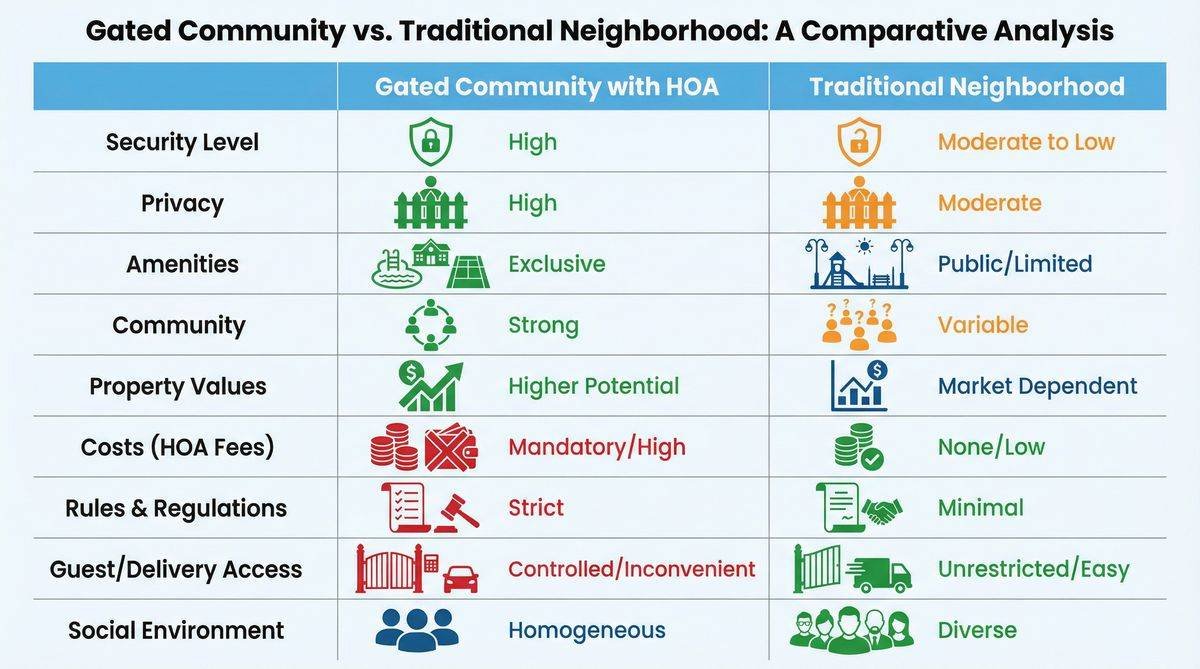
3. Pros and Cons at a Glance
| Factor | Pro | Con |
|---|---|---|
| Security | Controlled access reduces certain crimes | Gate provides deterrence, not absolute security |
| Property values | Enforced standards protect values | HOA disputes can affect marketability |
| Amenities | Shared pools, gyms, parks | Fees apply even if amenities go unused |
| Maintenance | Common areas professionally maintained | Individual home exterior rules can be restrictive |
| Cost | Shared amenity costs spread across owners | Monthly fees + special assessment risk |
| Community | Shared standards create cohesion | HOA governance can be contentious |
| Rental flexibility | — | Many HOAs restrict or prohibit rentals |
| Autonomy | — | Rules govern paint colors, landscaping, parking |
4. Due Diligence Before Buying in a Gated HOA Community
Answer Capsule: Before purchasing in a gated HOA community, review the HOA’s financial statements (specifically the reserve fund balance and reserve study), read the CC&Rs (Covenants, Conditions, and Restrictions) in full, check for pending or recent special assessments, review HOA meeting minutes for the past two years, and ask about rental restrictions if investment potential matters. This review takes 2–3 hours and can prevent costly surprises.
The reserve study is the most important financial document to review. It projects the cost of future major repairs and the adequacy of the current reserve fund to cover them. A reserve fund that is less than 70% funded is a warning sign for potential special assessments. Many states require HOAs to provide reserve studies to prospective buyers upon request.
Frequently Asked Questions
Is HOA membership mandatory in gated communities?
Yes, in virtually all cases. HOA membership is typically a condition of property ownership in gated communities — it is recorded in the deed and cannot be opted out of. Buyers who purchase in an HOA community are legally bound by the CC&Rs and obligated to pay the fees, regardless of whether they were fully aware of all the rules before purchasing.
Do gated communities hold their value better than non-gated neighborhoods?
Research is mixed. Some studies show a 5–10% premium for gated community properties; others show no significant difference after controlling for location and home quality. The HOA’s financial health and governance quality are stronger predictors of long-term property value than the gate itself. A well-managed HOA with a healthy reserve fund consistently outperforms a poorly managed one regardless of gating.
What recourse does a homeowner have against an unreasonable HOA?
Homeowners can attend and vote at HOA meetings, run for the HOA board, challenge rules through the HOA’s internal dispute resolution process, file complaints with the state HOA regulatory agency (where applicable), or pursue legal action for violations of the CC&Rs or state HOA laws. The most effective long-term recourse is active participation in HOA governance rather than passive resistance.
Conclusion
Gated community living with HOA membership offers genuine benefits — security, maintained common areas, protected property values — alongside real costs and constraints. The monthly fees, exterior restrictions, and governance dynamics are not trivial considerations, and buyers who underestimate them frequently become dissatisfied homeowners.
The key to making an informed decision is thorough due diligence: reviewing the HOA’s financials, reading the CC&Rs, and honestly assessing whether the community’s rules align with the buyer’s lifestyle. A well-managed HOA in a well-maintained gated community can be an excellent living environment. A poorly managed one with underfunded reserves and contentious governance can be a source of ongoing frustration and unexpected costs.
References
- Community Associations Institute (CAI). “HOA Statistics and Research.” 2025.
- Journal of Urban Economics. “Gated Communities and Property Crime.” 2018.
- National Association of Realtors (NAR). “HOA Living: What Buyers Need to Know.” 2025.
- Consumer Financial Protection Bureau (CFPB). “Homeowners Associations.” 2024.

Most Viewed