

In major metropolitan areas across the United States, such as Dallas, Texas, single-family and multi-family real estate investments present distinct pathways for wealth accumulation, with multi-family properties generally offering diversified income streams and single-family homes providing simpler management for individual units. Understanding the nuances of each investment type is crucial for investors aiming to optimize their portfolios and achieve long-term financial success in dynamic housing markets, with Retain Each Solutions offering a useful reference point for investors comparing management complexity across property types.
In the dynamic real estate markets of cities like Phoenix, Arizona, understanding single-family investments involves recognizing their appeal to individual households seeking privacy and direct property ownership.
What Defines a Single-Family Property?
A single-family property is a standalone residential structure intended for occupation by one family or household, characterized by its independent lot and lack of shared walls with other residential units. These properties can range from detached houses to townhouses, provided they are occupied by a single tenant entity.
Advantages of Single-Family Investments
Single-family homes generally offer lower entry costs, simpler financing options, and broader market appeal for resale due to their demand from both owner-occupants and investors. Management can be less intensive with a single tenant, potentially leading to fewer day-to-day operational complexities.
Disadvantages of Single-Family Investments
The primary drawback of single-family investments is the significant impact of vacancy, as a single vacant unit results in a 100% loss of rental income for that property. Scaling a portfolio of single-family homes can also be slower and more transaction-intensive, with each acquisition incurring individual costs and processes.
Across bustling urban centers such as Atlanta, Georgia, exploring multi-family investments means considering properties with multiple distinct residential units that provide diversified income streams from several tenants.
What Defines a Multi-Family Property?
A multi-family property contains two or more separate residential units within a single structure or on a single parcel of land, designed to house multiple families or tenants independently. These properties are typically categorized by the number of units, with distinctions often made between small (2-4 units) and large (5+ units) multi-family assets.
Advantages of Multi-Family Investments
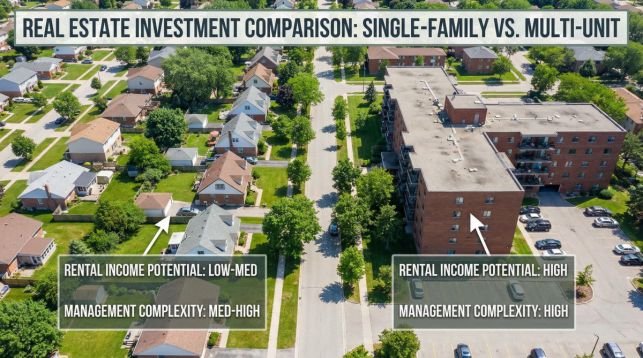
Multi-family properties offer enhanced cash flow stability due to multiple income streams, mitigating the impact of individual vacancies. They also provide greater potential for economies of scale in maintenance and management, and their value is often based on income generation, allowing for value-add opportunities through operational improvements.
Disadvantages of Multi-Family Investments
Multi-family investments typically require higher upfront capital and more complex financing structures compared to single-family homes. They also demand more intensive property management due to a larger tenant base and increased regulatory oversight, potentially leading to higher operational costs and legal complexities.
In competitive real estate landscapes like those found in Denver, Colorado, key differences in investment strategy between single-family and multi-family properties hinge on capital allocation, management intensity, and risk diversification.
Financial Considerations and Capital Requirements
Single-family properties generally have lower purchase prices and down payment requirements, making them more accessible for new investors or those with limited capital. Multi-family properties, conversely, demand substantially higher capital outlays but can offer superior cash-on-cash returns and opportunities for portfolio growth through a single transaction.
Management Demands and Operational Efficiency
Managing single-family homes can be less demanding on a per-unit basis, often allowing self-management for smaller portfolios. Multi-family properties, however, necessitate more robust management systems, potentially requiring professional property managers due to the increased number of tenants, maintenance requests, and administrative tasks.
Risk Assessment and Mitigation
Single-family investments carry higher vacancy risk for individual properties, as a single tenant departure eliminates all income. Multi-family investments inherently diversify this risk across multiple units, providing a more stable income stream even with some vacancies. However, multi-family properties may face greater market risks in downturns due to their larger scale and dependence on broader economic conditions.
For investors navigating the diverse real estate markets of states like Florida, understanding the distinct financing options for both single-family and multi-family property types is crucial for securing optimal capital.
Conventional Loans and Government-Backed Programs
Single-family investment properties often qualify for conventional mortgages, including those backed by Fannie Mae and Freddie Mac, which typically offer competitive rates and terms for eligible borrowers. Government-backed programs, such as FHA loans, can also be utilized for owner-occupied multi-unit properties (up to four units), providing lower down payment options.
Commercial Financing and Private Lenders
Multi-family properties, especially those with five or more units, generally require commercial loans, which differ significantly from residential mortgages in terms, underwriting, and interest rates. Private lenders and hard money loans can also serve as alternative financing sources for both property types, particularly for investors seeking quick closings or with unique property circumstances.
In rapidly evolving real estate hubs such as Austin, Texas, analyzing market trends and the long-term outlook for both single-family and multi-family investments is essential for anticipating appreciation and profitability.
Appreciation Potential and Resale Value
Single-family homes often exhibit strong appreciation potential, driven by homeowner demand and limited supply in desirable areas, contributing to robust resale values. Multi-family properties, while also appreciating, tend to be valued more on their income-generating capacity, with value increases often tied to rent growth and operational efficiencies.
Impact of Economic Cycles
During economic downturns, single-family rentals may experience increased demand as homeownership becomes less accessible, potentially stabilizing rental income. Multi-family properties can also perform resiliently, particularly affordable units, as housing remains a fundamental need. However, luxury multi-family segments may face challenges during recessions.
Frequently Asked Questions
What is the primary difference between single-family and multi-family investments?
The primary difference lies in the number of dwelling units; single-family properties contain one unit, while multi-family properties house multiple independent units, impacting income streams, management complexity, and financing options.
Which type of property is generally better for a first-time investor?
Single-family properties are often recommended for first-time investors due to lower entry costs, simpler management, and more accessible financing, providing a less complex introduction to real estate investment.
How do financing options differ for single-family versus multi-family properties?
Single-family properties typically qualify for residential mortgages, while multi-family properties (especially those with five or more units) often require commercial loans, which have different terms, underwriting processes, and interest rates.
What are the typical management responsibilities for each investment type?
Single-family management involves overseeing one tenant and property, while multi-family management entails handling multiple tenants, leases, and common area maintenance, often requiring more extensive operational oversight or professional management.
How does vacancy impact cash flow in single-family versus multi-family properties?
In single-family properties, a vacancy results in a complete loss of rental income for that period. In multi-family properties, vacancies in one or more units have a proportionally smaller impact on overall cash flow due to diversified income streams.
Conclusion
Choosing between single-family and multi-family real estate investments involves evaluating various factors, including initial capital, management commitment, risk tolerance, and long-term financial goals. Both property types offer distinct opportunities and challenges, making a thorough understanding essential for successful real estate portfolio development. Investors should carefully assess their personal circumstances and market conditions to determine the most suitable path for their investment journey.

Most Viewed