

Dual agency occurs when a single real estate agent — or two agents from the same brokerage — represents both the buyer and the seller in the same transaction. It is one of the most debated practices in residential real estate, and for good reason: the arrangement creates an inherent conflict of interest that can compromise the representation both parties receive, notes Peoria Property Management Company.
This guide explains exactly what dual agency is, how it works in practice, where it is legal, and what buyers and sellers should know before agreeing to it.
1. What Dual Agency Actually Means
Answer Capsule: Dual agency occurs when the same real estate agent or brokerage represents both the buyer and the seller in a single transaction. The agent collects the full commission (typically 5–6% of the sale price) rather than splitting it with a buyer’s agent. The fundamental problem is that the agent cannot fully advocate for either party — negotiating the highest price for the seller directly conflicts with negotiating the lowest price for the buyer.
There are two forms of dual agency. Single-agent dual agency occurs when one individual agent represents both parties — the most direct conflict of interest. Designated agency (also called designated dual agency) occurs when two different agents from the same brokerage represent the buyer and seller respectively. The agents are technically separate representatives, but the brokerage has a financial interest in both sides of the transaction.
The commission structure explains why dual agency occurs. In a standard transaction, the seller pays a total commission (typically 5–6%) that is split between the listing agent and the buyer’s agent. In dual agency, the listing agent retains the entire commission. This financial incentive can motivate agents to steer buyers toward their own listings rather than the best available options.
2. Is Dual Agency Legal?
Answer Capsule: Dual agency is legal in most jurisdictions but is prohibited in several. It is banned outright in Alaska, Colorado, Florida, Kansas, Maryland, Texas, Vermont, and Wyoming. Where it is legal, it requires written disclosure and informed consent from both parties before proceeding. Undisclosed dual agency — where the agent fails to disclose the arrangement — is illegal everywhere and constitutes a breach of fiduciary duty.
| Status | Description | Examples |
|---|---|---|
| Prohibited | Dual agency is illegal regardless of disclosure | Alaska, Colorado, Florida, Kansas, Maryland, Texas, Vermont, Wyoming |
| Permitted with disclosure | Legal with written consent from both parties | Most other states |
| Designated agency only | Single-agent dual agency prohibited; designated agency permitted | Some states with partial restrictions |
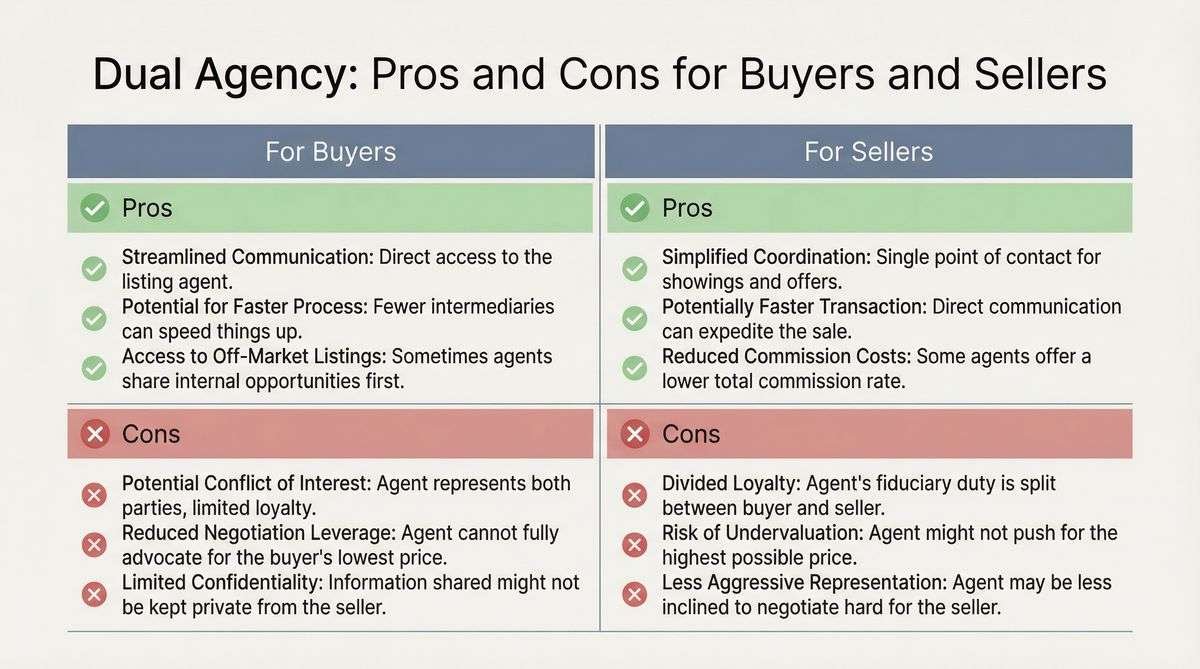
The legal requirement for disclosure exists because dual agency fundamentally changes the nature of the representation both parties receive. A buyer’s agent in a standard transaction has a fiduciary duty to the buyer — meaning they must act in the buyer’s best interest, including disclosing information that might affect the buyer’s decision. In dual agency, this duty is compromised because the same agent also has a duty to the seller.
3. The Real Risks of Dual Agency
Answer Capsule: The primary risk of dual agency for buyers is that the agent cannot share information that would help the buyer negotiate — such as how long the property has been on the market, the seller’s motivation to sell quickly, or the seller’s minimum acceptable price. For sellers, the risk is that the agent may prioritize closing the transaction (and collecting the full commission) over achieving the highest possible sale price.
In a dual agency arrangement, the agent is legally prohibited from sharing the seller’s bottom line with the buyer or the buyer’s maximum budget with the seller. This restriction is intended to protect both parties, but it also means the agent cannot provide the full negotiating guidance that each party would receive from their own independent representative.
Research by the Consumer Federation of America found that homes sold through dual agency transactions sold for an average of 1–3% less than comparable homes sold through standard agency arrangements — suggesting that sellers, in particular, may receive less favorable outcomes in dual agency transactions.
4. When to Accept or Decline Dual Agency
Answer Capsule: Declining dual agency and insisting on independent representation is the safest approach for both buyers and sellers. If dual agency is unavoidable — for example, when a buyer falls in love with a listing held by their own agent — the parties should negotiate the commission structure, ensure all communications are in writing, and consider consulting an independent real estate attorney to review the transaction.
Buyers who encounter dual agency should ask the agent directly: “Can you tell me how long this property has been on the market and whether the seller has received any other offers?” If the agent declines to share this information due to dual agency restrictions, the buyer is operating without information that would be freely available with independent representation.
Frequently Asked Questions
What must an agent disclose in a dual agency situation?
In jurisdictions where dual agency is legal, the agent must disclose the dual agency relationship in writing before proceeding and obtain written consent from both parties. The disclosure must explain that the agent’s ability to advocate for either party is limited and that the agent cannot share confidential information about either party’s negotiating position.
Does dual agency mean a lower commission for the seller?
Not automatically. The listing agent retains the full commission in dual agency, which is a financial benefit to the agent, not the seller. Sellers can and should negotiate a reduced commission when agreeing to dual agency — the agent is performing less work (no coordination with a buyer’s agent) and earning more (full commission). A reduction of 1–1.5% is a reasonable negotiation starting point.
What is the difference between dual agency and designated agency?
In designated agency, the brokerage assigns two separate agents — one for the buyer and one for the seller — even though both agents work for the same brokerage. Each agent maintains full fiduciary duty to their respective client. The conflict of interest is reduced compared to single-agent dual agency, but the brokerage still has a financial interest in both sides of the transaction closing.
Conclusion
Dual agency is a legal but inherently conflicted arrangement that limits the quality of representation both buyers and sellers receive. Where it is permitted, it requires informed written consent — and that consent should only be given after fully understanding what the arrangement means for negotiating power and information access.
The safest approach is independent representation: a buyer’s agent who works exclusively for the buyer and a listing agent who works exclusively for the seller. When dual agency is unavoidable, negotiating a commission reduction and maintaining all communications in writing are the most practical protections available.
References
- National Association of Realtors (NAR). “Understanding Agency Relationships.” 2025.
- Consumer Federation of America. “Real Estate Agent Commission and Agency Study.” 2023.
- Cornell Law School Legal Information Institute. “Dual Agency in Real Estate.” 2024.
- Consumer Financial Protection Bureau (CFPB). “Buying a Home: Working with Real Estate Agents.” 2025.

Most Viewed